Archive for the ‘Medieval’ Category

Barbary lions in the Tower of London

Monday, March 24th, 2008

Genetic analysis confirms that the two lion skulls found during a 1937 excavation of the Tower of London are north African Barbary lions, most likely gifts for the Royal Menagerie.

Dr Richard Sabin, Curator of Mammals at London’s Natural History Museum, said the results were the first genetic evidence to clearly confirm that lions found during excavations at the Tower of London originated in north Africa.

He said: “Although we have one of the best mammal collections in the world here at the Natural History Museum, few physical remains survive of the Royal Menagerie.

“Direct animal trade between Europe and sub-Saharan Africa was not developed until the 18th Century, so our results provide new insights into the patterns of historic animal trafficking.”

I’m not sure what new insights he means. I mean, it seems to me not much can be gleaned about the pattern of the traffic from knowing about the mere existence of the lions in the middle ages.

Anyhow, it’s still just cool. There aren’t any Barbary lions left in the wild now, and there are only about 40 in captivity.

Uh oh… New subway line in Rome

Friday, March 7th, 2008

Rome has only 2 subway lines, and they’re old and crappy and don’t hit many of the most famous locations in the center of town because it’s basically impossible to dig in the historic center without encountering structures of immense archaeological value.

The laws on the subject are strict: the city’s archaeological superintendency decides the fate of any archaeological find.

Most of them remain in place, with the new construction either changing route or going up around the ancient. Some are moved.

Some are even be destroyed, don’t ask me why. They let this Roman villa get split in two by a parking ramp. Go figure.

Anyway, since 2006 so far the subway digs have come across:

  • mosaics
  • aqueducts
  • an ancient arch
  • Roman Villas
  • the foundations of an imperial Roman public building
  • dating back to imperial times,
  • parts of a monumental complex built by Augustus’ partner Marcus Agrippa
  • Roman taverns near the ancient Forum
  • remains of 16th-century palaces
  • Roman tombs
  • A sixth-century copper factory
  • medieval kitchens still stocked with pots and pans

It remains to be seen what becomes of these treasures. The authorities are looking into the planned route to see if it can be made to snake around finds, but it seems to me no matter where they go, they’re going to find other stuff that needs snaking around.

I think they should include them in the build of the subway. Like box them in plexi or something. That would be coolest subway ever. People could get an education just taking the train.

Medieval belt buckle in Scottish sewer

Thursday, March 6th, 2008

It was found while crews were working to repair a collapsed sewer, to be fair. I don’t know that it was actually in the sewer when discovered.

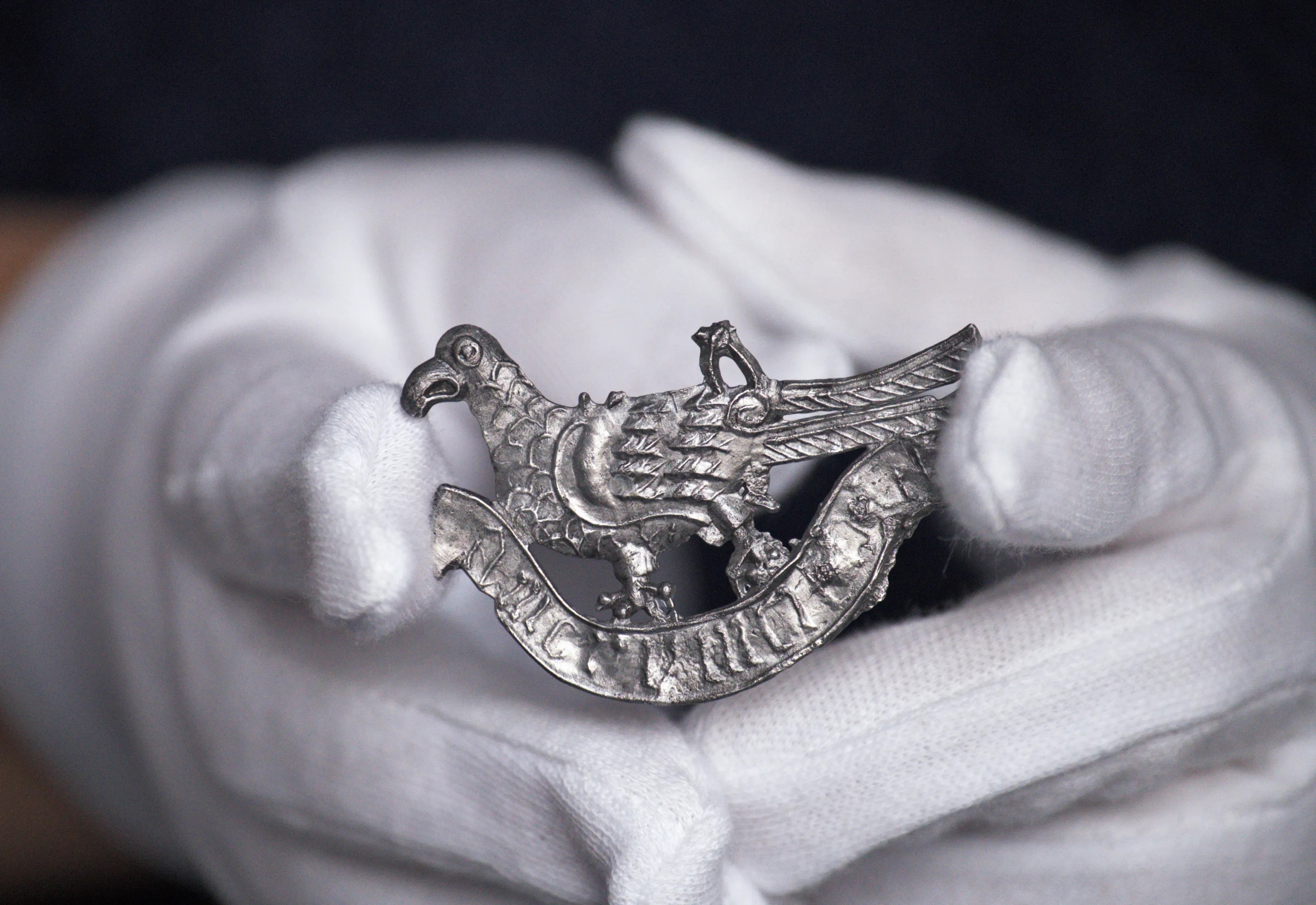
Anyway, it was made out of copper alloy in the 12th century it’s and is surprisingly well-preserved. Apparently waterlogged land is a good preservative of treasure.

“We found this encrusted buckle which had been folded over, but was obviously something nice,” she said.

“So we brought it back here and carefully unfolded the copper and discovered this most beautifully designed medieval buckle, which we think probably dates back to the 12th Century.

“It’s such a piece of work that it probably belonged to somebody with a bit of money.

“We suggested maybe a merchant in the medieval burgh because of course Perth was quite an important trading post.”

Earliest surviving heraldic roll blocked from leaving England

Tuesday, February 26th, 2008

Margaret Hodge, UK Culture Minister, has put an export block on the Dering Roll, a beautifully illuminated roll of arms from the 13th century. Sotheby’s is looking to sell it out of country, apparently, although I can’t find out the details of the sale other than it was part of a lot listed for sale on December 4.

The Minister’s ruling follows a recommendation by the Reviewing Committee on the Export of Works of Art and Objects of Cultural Interest, administered by the Museums, Libraries and Archives Council. The Committee recommended that the export decision be deferred on the grounds that the roll is of outstanding significance for the study of early English heraldry and is so closely connected with our history and national life that its departure would be a misfortune. The Committee awarded a starred rating to the roll meaning that every possible effort should be made to raise enough money to keep it in the country.

The Dering Roll was produced in England in the last quarter of the 13th century. It is eight and a half feet long and contains the coats of arms of approximately one-quarter of the English baronage of the reign of King Edward I. As the earliest surviving English roll of arms it is a key document of medieval English knighthood. As a statement of the knights who owed feudal service to the constable of Dover Castle, it carries outstanding local as well as national significance.

The cost is $400,000 or so and all offers need to be submitted by April 19 (although there might be an extension until July). For an illuminated roll of such historical importance and such lush design, that seems eminently doable. I’m surprised it hasn’t been snapped up already, possibly by one of the families whose coat of arms are represented.

~ Thanks to John Harrison of the Museums, Libraries and Archives Council, for the picture. ~

A brief history of chocolate

Sunday, February 24th, 2008

Smithsonian Magazine has a great little article on the history of chocolate. I knew that it was primarily a drink for most of its history, but I didn’t realize it only was made a solid only after the Dutch process made a powder from chocolate liquor.

In 1828, a Dutch chemist found a way to make powdered chocolate by removing about half the natural fat (cacao butter) from chocolate liquor, pulverizing what remained and treating the mixture with alkaline salts to cut the bitter taste. His product became known as “Dutch cocoa,” and it soon led to the creation of solid chocolate.

The creation of the first modern chocolate bar is credited to Joseph Fry, who in 1847 discovered that he could make a moldable chocolate paste by adding melted cacao butter back into Dutch cocoa.

By 1868, a little company called Cadbury was marketing boxes of chocolate candies in England. Milk chocolate hit the market a few years later, pioneered by another name that may ring a bell – Nestle.

So it seems the cream egg is the least of Cadbury’s accomplishments.

John Cadbury, incidentally, was a Quaker of notable social consciousness who went into the chocolate/coffee/tea beverage business out of Temperance Society idealism.

The Cadbury’s site has an excellent history section itself, both of the company and of the bean.

The Domesday Book online

Monday, February 11th, 2008

This most amazingly extensive snapshot of post-Norman conquest England is now finally fully digitized, searchable and freely available for long hours and lost weekends of perusal: the Domesday Book online.

The Domesday Book provides extensive records of landholders, their tenants, the amount of land they owned, how many people occupied the land (villagers, smallholders, free men, slaves, etc.), the amounts of woodland, meadow, animals, fish and ploughs on the land (if there were any) and other resources, any buildings present (churches, castles, mills, salthouses, etc.), and the whole purpose of the survey - the value of the land and its assets, before the Norman Conquest, after it, and at the time of Domesday. Some entries also chronicle disputes over who held land, some mention customary dues that had to be paid to the king, and entries for major towns include records of traders and number of houses.

You can see why this is an invaluable resource for historians or even just curious people. Besides the motherlode, the site has all kinds of hidden goodies like this handy list of the Latin, Celtic, Saxon and Viking origins of English town names, and this hot glossary of terms.

Maps stolen from Spanish National Library returned

Monday, February 4th, 2008

Police have found and returned several rare maps stolen from the Spanish National Library by a researcher/looting son of a bitch.

Among the stolen pieces is a map of the world torn from one of the first printed editions of Ptolemy’s 2nd c. AD “Cosmographia”. One of the first printed editions of anything, actually, given the 1482 publishing date, just 42 years after Gutenberg completed his printing press, and just 10 years before a certain Christopher Columbus used Ptolemy’s maps to get lost on his way to India.

Hand-drawn and beautifully preserved in living color, the world map was cut out of the book by said looting son of a bitch then sold through a variety of art dealer sons of bitches until it was found in an Australian gallery and returned to Spain. There are more still to be recovered.

Eight maps were recovered from Buenos Aires, Argentina. Two others were found in New York and handed over to Spain’s police chief in Washington, D.C., on Thursday. Another is awaiting authorization to be returned from Sydney, Australia. At least four that date to between the 15th and 17th centuries are still missing, Rubalcaba said.

TV dinners, a bus pass, 2 Fra Angelicos and a Rossetti watercolor

Friday, February 1st, 2008

Retired manuscripts curator Jean Preston lived in an unassuming brick row house, ate tv dinners and took the bus when she needed to go somewhere. After her death in 2006, they found that she’d been living with $8 million of rare art on the walls, in the closet, on the back of the doors.

Among the treasures were two paintings by Fra Angelico, the 15th century Italian Renaissance master, that were the missing pieces of an eight-part altar decoration. [...]

Hanging in the kitchen was a 19th century watercolour by pre-Raphaelite artist Dante Gabriel Rossetti, and in the sitting room, above an electric fire, a work by Sir Edward Burne-Jones.[...]

Another hidden treasure was a rare edition of the works of Chaucer that was too big to fit on Preston’s bookshelf and was found buried in a wardrobe. It sold for nearly $150,000.

The Fra Angelicos are going home to Florence for the first time since they were snatched out of the altar piece of the church of San Marco during the Napoleonic wars. A private collector bought them at auction, but he’s expected to give them to the Uffizi Gallery. The Rossetti “Hamlet and Ophelia” and Burne-Jones’ “Music” are headed for the Ashmolean Museum.

From crappy claret jug to Holy Grail in one auction

Monday, January 21st, 2008

The auctioneers thought it was a 19th c. French claret jug with an estimated value of a couple hundred pounds. Turns out, it’s an 11th c. Fatimid rock crystal ewer, one of only 6 known in the world.

Fatimid rock crystal ewers are considered among the rarest and most valuable objects in the entire sphere of Islamic art, with only five known to exist before this extraordinary appearance. Indeed this is the first time one has ever known to have appeared at auction. The last one to surface on the market was purchased by the Victoria and Albert Museum in 1862.

It ended up selling for £200,000, which is still a ridiculous bargain give its £5,000,000 market value. There’s no comment in the article about how this piece got to auction. I’m curious to know the history.

Oh, and just in case you didn’t read to the end of the article, allow me to force you:

Disaster befell the final known ewer which was from the Pitti Palace collection in Florence and had an inscription to Caliph al Hakim’s general, Husain ibn Jawhar. For many years it had been on display in the Museo degli Argenti and in 1998 it was accidentally dropped by a museum employee, shattering it irreparably.

:ohnoes:

Update: Restoring Medieval Kabul

Monday, January 14th, 2008

Way back in the June of 2006 I posted about a the Turquoise Mountain Foundation’s efforts to restore the medieval Kabul neighborhood of Murad Khane and revive the traditional local crafts of calligraphy, woodcarving and ceramics.

Now it seems that those efforts are paying off enormously, and that can only improve with the $3.5 million dollar donation they’ve just received from the Canadian government.

One-and-a-half years along, the scene just beyond the north bank of the Kabul River is impressive. A fleet of more than 50 wheelbarrows criss-crosses constantly, hacking through and carting away decades of chest-high waste from the last of four traditional courtyard houses targeted for renewal.

In their wake, aging craftsman lead teams of young men newly schooled in Afghan joinery in restoring the skeletal timber-frame buildings. A few of these homes remain diamonds in the rough, but one, known as The Peacock House for its distinctive feathered Nuristani marquetry panels, is already a shining jewel.

Not only are the restorations coming along at a brisk pace, but the craft school is a raging success as well, with ten times the expected number of applicants and big money commissions for their wares from British hotels and Arab collectors.