Archive for the ‘Roma, Caput Mundi’ Category

How in the hell did they steal this?

Friday, May 9th, 2008

More yuge loot news out of Spain, only this time it’s not massive quantities but just plain massive.

Italian police from the stolen artwork squad were in Barcelona on business when they happened past an antiques store. In the store, they noticed a solid marble oval bathtub that looked suspiciously familiar.

It was billed as a reproduction of a Roman bathtub and priced at €6000 ($9230). Only it isn’t a reproduction, and it’s actually worth €300,000 ($461,500). It was made in the second century A.D. under Hadrian’s reign and was stolen from the garden of an Italian villa in 2005.

The store owner had bought it a couple of years ago from some total idiots for €3000. Here’s the thing that really gets me, though: this tub weighs half a ton. How in God’s name did the thieves get it out of that garden? It can’t have been any kind of stealth operation. I mean, cranes and vehicles that make loud beeping sounds must have been involved.

Then to go through the trouble of shipping their half-ton of ill-gotten gains across the Mediterranean for a pittance …. It’s like a Mack Sennett short: The Keystone Bathtub Thieves.

Coolness from legit antiquities trade, for a change

Wednesday, May 7th, 2008

The London and Provincial Antique Dealer’s Association called their fair this year “Objects of Desire” and they weren’t lying.

A beautiful Roman double-headed bust of Bacchus and Ariadne sold for approximately $470,000, far above estimate but far below its artistic and historical value in my eyes.

Especially since it actually has a provenance, and a rather romantic one at that. It was purchase by a British army officer in Jerusalem during World War II.

The officer, Somerset de Chair, spotted it in an antique shop opposite the King David Hotel and placed a deposit on it, arranging payment terms in case he did not return from battle.

De Chair, who served as an intelligence officer during the siege of Baghdad, subsequently returned after sustaining an injury, arranged an export licence, and shipped it to the family home at Chilham Castle in Kent as “wounded officer’s kit”.

After he died in 1995, it was inherited by his elder son, Rodney de Chair, who was the seller last week.

Elder son = crazy. (Or seriously hard up.)

Lavinia

Friday, May 2nd, 2008

One of my favorite authors, Ursula K. LeGuin, has written a book about my favorite subject: Ancient Rome.

It’s called “Lavinia”, and the eponymous heroine is the legendary daughter of Latinus, King of the Latins, and the wife of Aeneas, hero of Troy, son of Venus and progenitor of the Julian clan. (For a quick and dirty rundown of the period, check out the remaining fragments of Appian’s History of Early Rome.)

It’s no garden variety historical novel, though. For one thing, Lavinia has some understanding that she might actually be fiction, a creation of the poet Virgil whose shade she encounters in a sacred grove.

For another thing:

Lavinia makes for an unlikely heroine, which is just what Le Guin likes about her. From Mulan to Buffy the Vampire Slayer, sassy, kick-ass girls are preferred nowadays to circumspect homebodies like Virgil’s Latin princess. There may even be a touch of self-reproach in Le Guin’s choice of Lavinia as her main character, since the heroine of her 1971 novel, “The Tombs of Atuan,” is a priestess named Tenar who rebels against a life entirely devoted to serving a pantheon of nameless, implacable gods. Lavinia, by contrast, embraces the ritual aspect of her designated role, all the humble and solemn daily sacrifices, the scattering of sacred salt, the tending of clan totems, and even her own fate, as a woman destined to have little choice in who her husband will be.

To be fair, the Tombs of Atuan aren’t anywhere near as appealing a childhood home as the bucolic hills of central Italy, and Lavinia wasn’t snatched from her parents as a wee sprog to be raised by servile eunuchs and cold priestesses.

Amazon tells me I’ll have “Lavinia” by Tuesday. A book report will ensue. :boogie:

Area man finds superrare Roman gold coins

Sunday, March 16th, 2008

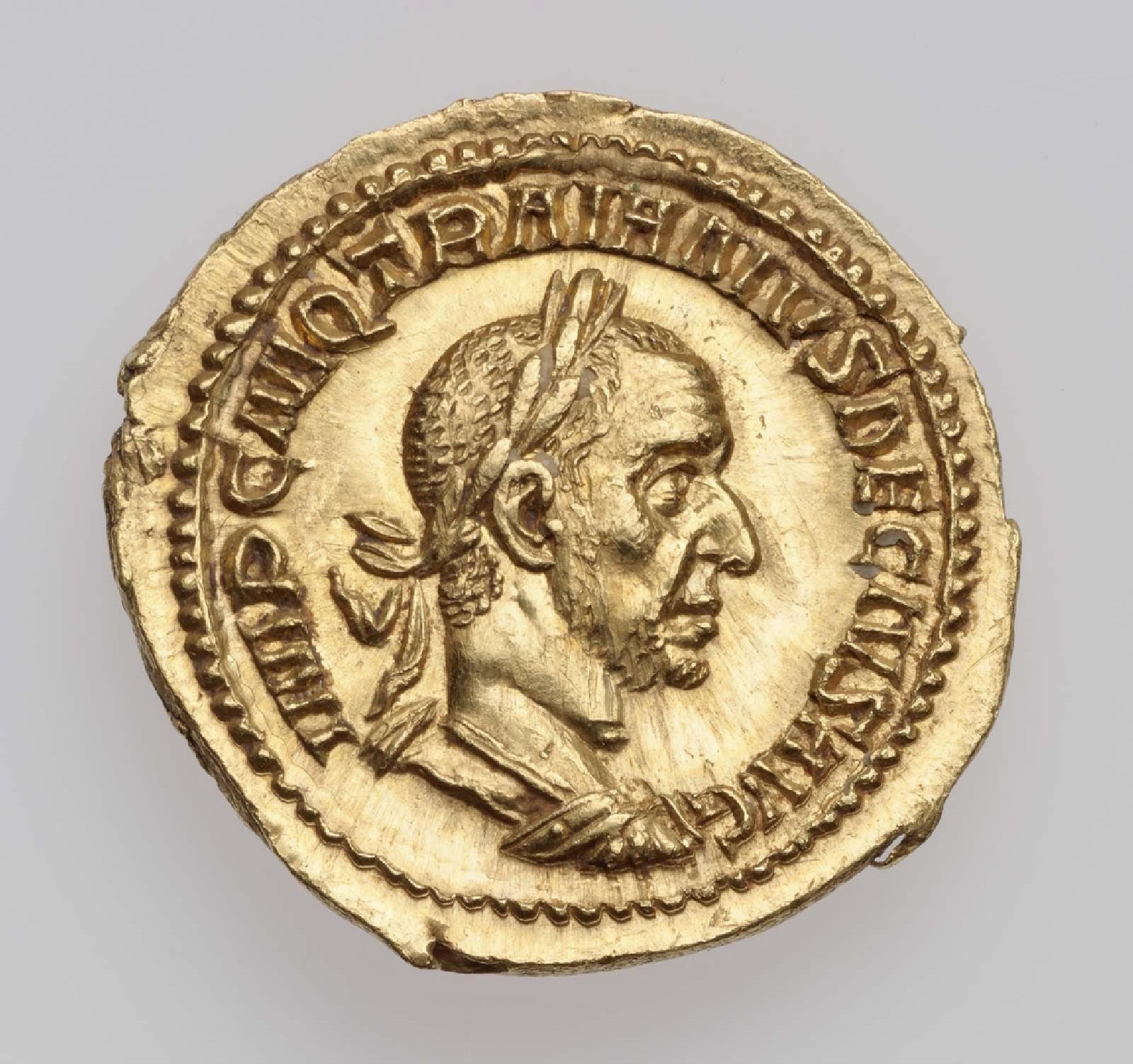
The area is Derbyshire, England, and the coins are so rare that one of them is entirely unclassified and the other kind hasn’t been seen since 1975. Rare Roman gold coins unearthed in Derbyshire.

The museum’s Sam Moorhead, an expert in Roman antiquities, said: “These are the two most stunning coins I have ever seen and I have looked at over 30,000.

“Ethically, I am not allowed to put a valuation on them but I reckon they are priceless.”

This is the best picture I could find, I’m sad to say:


I want to see them in all their golden glory, but the Derbyshire paper must have a dial-up readership or something, ’cause their pictures are loooow res.

Augustan temple digitally reconstructed

Friday, March 14th, 2008

This is what the Temple of Apollo, built by Augustus Caesar in 28 B.C., looks like now:

There’s so little of it left that reconstructing its former structure has been a challenge for archaeologists. University of Pennsylvania graduate student Stephan Zink spent two years on the Palatine examining the plinth foundations (those huge chunks of brown concrete in the middle) and the cross-sections of columns that remain.

Combining his own work with other measurements taken in the 50’s and 60’s, he’s been able to digitally reconstruct what the temple might have looked like back when it was brand new and 10 stories high.

Augustus’ home open to the public

Sunday, March 9th, 2008

Technically, it’s Octavian’s home because he lived in it with Livia in 30 BC, right after his victory over Marc Antony and Cleopatra at Actium in 31 BC, but before he donned the title of Augustus in 27 BC.

It was a modest home in terms of size, but the 4 rooms that have been restored and open to the public are decorated with the most gorgeous frescoes I’ve ever seen.

Some of his interior decoration was found intact when the Italian archaeologist Professor Gianfilippo Carettoni finally broke through to the rooms in the early 1970s.

Other frescoes had to be pieced together from fragments found by a team led by Irene Jacopi, the archaeologist in charge of the Palatine Hill.

The art is so delicate that no more than five visitors at a time will be able to enter the rooms. Nevertheless, they are expected to attract large crowds.

Also notable is the graffiti the builders left behind. They sketched a design for what might have been a floor mosaic and signed their names to it. It’s not often you to find out the names of contractors who worked on a house 2000 years ago.

Some pictures of the frescoes:

Uh oh… New subway line in Rome

Friday, March 7th, 2008

Rome has only 2 subway lines, and they’re old and crappy and don’t hit many of the most famous locations in the center of town because it’s basically impossible to dig in the historic center without encountering structures of immense archaeological value.

The laws on the subject are strict: the city’s archaeological superintendency decides the fate of any archaeological find.

Most of them remain in place, with the new construction either changing route or going up around the ancient. Some are moved.

Some are even be destroyed, don’t ask me why. They let this Roman villa get split in two by a parking ramp. Go figure.

Anyway, since 2006 so far the subway digs have come across:

  • mosaics
  • aqueducts
  • an ancient arch
  • Roman Villas
  • the foundations of an imperial Roman public building
  • dating back to imperial times,
  • parts of a monumental complex built by Augustus’ partner Marcus Agrippa
  • Roman taverns near the ancient Forum
  • remains of 16th-century palaces
  • Roman tombs
  • A sixth-century copper factory
  • medieval kitchens still stocked with pots and pans

It remains to be seen what becomes of these treasures. The authorities are looking into the planned route to see if it can be made to snake around finds, but it seems to me no matter where they go, they’re going to find other stuff that needs snaking around.

I think they should include them in the build of the subway. Like box them in plexi or something. That would be coolest subway ever. People could get an education just taking the train.

Today in antiquities fencing news

Sunday, January 20th, 2008

A bust of Marcus Aurelius that was stolen from an Algerian museum 12 years ago was pried out of Christie’s dirty little hands right before it was about to go on the block. Immigration and Customs Enforcement officials returned it to the Algerian embassy this past Tuesday.

Dating from the second century, the three-foot-high, 200-pound marble sculpture depicts Roman Emperor Marcus Aurelius, who ruled during the period when what is now Algeria was part of the Roman Empire. The marble head emerged in the international market of cultural antiquities and was spotted by INTERPOL, which alerted U.S. Immigration and Customs Enforcement that an antiquity in an auction catalogue might be a stolen artifact. ICE experts worked with Algerian scholars to verify the statue’s identity and then notified the U.S. auction house that the piece was subject to seizure. The seizure was not contested.

Yeah, I just bet it wasn’t contested. Note: Interpol was after this piece, it was stolen from a museum very recently, and it was listed in the London Art Loss Register, and yet, somehow, Christie’s was an inch away from selling it to the highest bidder.

See why I say that they’re all in on it, or at least craning their necks so far to look the other way that they might as well be in on it? There is no way these high-end auction houses with their platoons of appraisers and researchers could be so ignorant unless they meant to be.

Another interesting item from the ICE’s press release:

An 18th century colonial painting, The Expulsion from the Garden of Eden, which was stolen from a church in central Mexico, was returned to Mexican authorities in August 2006 after a two-year repatriation effort involving Mexico, the U.S. Department of Justice, and U.S. Immigration and Customs Enforcement. During the plundering of a church in San Juan Tepemasalco, Hidalgo, in 2000, thieves slashed the artwork from its frame, leaving tattered pieces of canvas behind. The restored artwork was acquired by the San Diego Museum of Art (SDMA) later that year from a private art dealer for $45,000.

What are the odds that neither major metropolitan museum nor the “private art dealer” noted anything fishy about the slashed-out-a-frame painting plundered out of a church 4 years before the sale? Best case scenario this is willful blindness.

The Euphronios krater comes home

Saturday, January 19th, 2008

One of the most celebrated Grecian vases made and signed by the ancient artist Euphronios has returned to Rome with great fanfare.

The Met has had it since 1972. It was the flagship of their ancient collection. Only problem is, it turned up at the Met with zero provenance, ie, there was no record of previous ownership.

Italy had an idea of where it came from: Cervetri, the Etruscan town just outside of Rome packed with lootalicious unexcavated tombs and the source of most known Euphronios pieces. Since there are laws against digging stuff up under cover and night and selling it to the highest bigger — laws with which the Met was familiar, hence its 3 decades of stonewalling about where the hell they got the Euphronios krater — Italy went to the mattresses to get the vase back.

Finally, they succeeded. They had to make a deal with the Met, loaning them pieces of equivalent value for a few years, but still, the krater and 60+ of his little looted friends are back in Rome now and on glorious exhibit: Nostoi: Recovered Masterpieces.

The antiquities trade is a dirty, dirty business, y’all. Everyone from the major auction houses to the snootiest super rich private collectors to the rarified curators of the greatest museums are elbow-deep in looted shit.

It’s not about colonialist Elgin-style theft from 200 years ago. We’re talking massive ongoing operations of stealing and fencing, and they’re all in on it, or at least craning their necks so far to look the other way that they might as well be in on it.

This is the first entry of a series on looting and antiquities. Watch this space for more riveting tales of filth and lucre.

210 reasons Rome fell

Saturday, January 12th, 2008

I came across this list of reasons historians have suggested over the past couple hundred years for the fall of Rome in The Fall of Rome: And the End of Civilization by Bryan Ward-Perkins.

It was compiled by German historian Alexander Demandt for his 1984 history Der Fall Roms, but since I have neither 350 spare dollars to purchase a copy of my own nor the German to read it, I turned to Google to slake my thirst. It led me to Crooked Timber and now, without further ado, here are 210 reasons Rome fell.

Abolition of gods, abolition of rights, absence of character, absolutism, agrarian question, agrarian slavery, anarchy, anti-Germanism, apathy, aristocracy, asceticism, attacks by Germans, attacks by Huns, attacks by nomads on horseback.

Backwardness in science, bankruptcy, barbarization, bastardization, blockage of land by large landholders, blood poisoning, bolshevization, bread and circuses, bureaucracy, Byzantinism.

Capitalism, change of capitals, caste system, celibacy, centralization, childlessness, Christianity, citizenship (granting of), civil war, climatic deterioration, communism, complacency, concatenation of misfortunes, conservatism, corruption, cosmopolitanism, crisis of legitimacy, culinary excess, cultural neurosis.

Decentralization, decline of Nordic character, decline of the cities, decline of the Italic population, deforestation, degeneration, degeneration of intellect, demoralization, depletion of mineral resources, despotism, destruction of environment, destruction of peasantry, destruction of political process, destruction of Roman influence, devastation, differences in wealth, disarmament, disillusion with state, division of empire, division of labour.

Earthquakes, egoism, egoism of the state, emancipation of slaves, enervation, epidemics, equal rights (granting of), eradication of the best, escapism, ethnic dissolution, excessive aging of population, excessive civilization, excessive culture, excessive foreign infiltration, excessive freedom, excessive urbanization, expansion, exploitation.

Fear of life, female emancipation, feudalization, fiscalism, gladiatorial system, gluttony, gout, hedonism, Hellenization, heresy, homosexuality, hothouse culture, hubris, hyperthermia.

Immoderate greatness, imperialism, impotence, impoverishment, imprudent policy toward buffer states, inadequate educational system, indifference, individualism, indoctrination, inertia, inflation, intellectualism, integration (weakness of), irrationality, Jewish influence.

Lack of leadership, lack of male dignity, lack of military recruits, lack of orderly imperial succession, lack of qualified workers, lack of rainfall, lack of religiousness, lack of seriousness, large landed properties, lead-poisoning, lethargy, levelling (cultural), levelling (social), loss of army discipline, loss of authority, loss of energy, loss of instincts, loss of population, luxury.

Malaria, marriages of convenience, mercenary system, mercury damage, militarism, monetary economy, monetary greed, money (shortage of), moral decline, moral idealism, moral materialism, mystery religions, nationalism of Rome’s subjects, negative selection.

Orientalization, outflow of gold, over-refinement, pacifism, paralysis of will, paralysation, parasitism, particularism, pauperism, plagues, pleasure-seeking, plutocracy, polytheism, population pressure, precociousness, professional army, proletarization, prosperity, prostitution, psychoses, public baths.

Racial degeneration, racial discrimination, racial suicide, rationalism, refusal of military service, religious struggles and schisms, rentier mentality, resignation, restriction to profession, restriction to the land, rhetoric, rise of uneducated masses, romantic attitudes to peace, ruin of middle class, rule of the world.

Semi-education, sensuality, servility, sexuality, shamelessness, shifting of trade routes, slavery, Slavic attacks, socialism (of the state), social tensions, soil erosion, soil exhaustion, spiritual barbarism, stagnation, stoicism, stress, structural weakness, superstition.

Taxation, pressure of terrorism, tiredness of life, totalitarianism, treason, tristesse, two-front war, underdevelopment, useless diet, usurpation of all powers by the state, vaingloriousness, villa economy, vulgarization.

Any of those look familiar? I’m pretty sure I’ve seen them all used at various times by various people to bemoan the degenerate condition of the US. Hell, I’ve used a fair few of them myself.

Except for maybe tristesse. That’s a new one. Oh, and hyperthermia.

“The Course of Empire: Destruction”, by Thomas Cole