Archive for the ‘Social policy’ Category

I’m right again!

Saturday, November 8th, 2008

I know, not exactly shocking at this point, but always worth covering. When Amenhotep III got his eye back from the museum in Basel, Switzerland, I said this:

There are going to be lots more stories like these as Switzerland confronts its long history of warehousing looted goods.

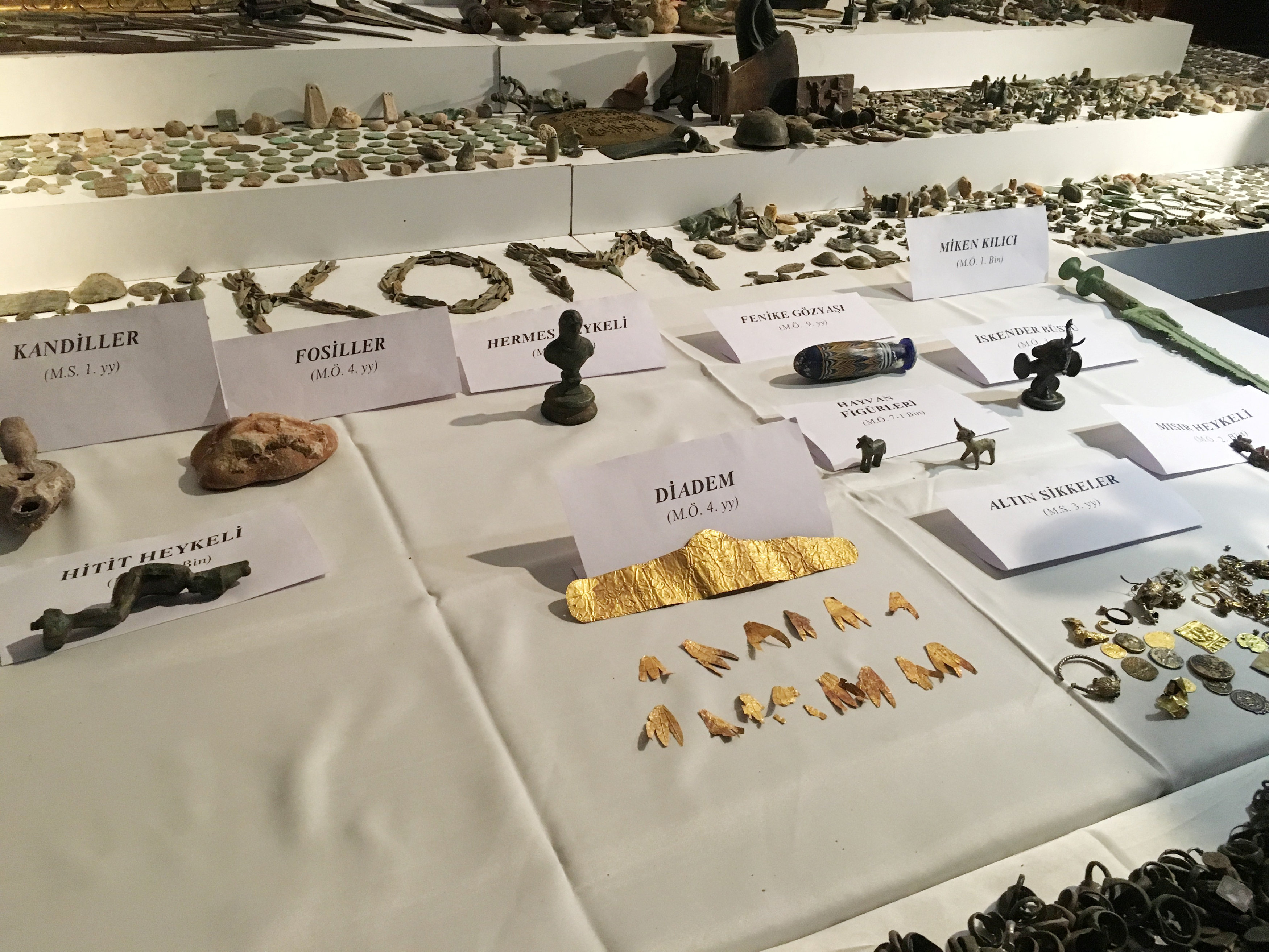
Or one story covering 4,400 individual antiquities returned to Italy from a warehouse in Basel.

They were the holdings of a husband-and-wife team of Swiss art dealers and were all recently excavated and illegal exported to Switzerland (ie, loot). The goods were seized in 2001 and only now, after the couple spent 7 years in court trying to stop Italy from getting its stuff back, is this motherlode going home.

More than half the objects were from the eastern Italian region of Apulia, an area that was heavily influenced by ancient Greek culture, said Guido Lassau, a Swiss archaeologist who worked on the case.

They include richly decorated vases and so-called kraters, large vessels that were used for mixing wine with water. The objects were stolen from upper-class tombs dating from the fifth to third centuries B.C., according to Lassau.

One item that looks like a ceramic mask modeled on a woman’s face retains the original water-soluble painting from about 300 B.C. [...]

Other items belong to the pre-Etruscan Villanova culture of northern Italy, and some of the bronze figures appear to have originated on the island of Sardinia.

The oldest are bronze daggers thought to be about 4,000 years old, said Lassau.

“This is a vast haul on a dramatic scale that would have saturated the market if they had been sold,” he said, adding that very few such items are available through legal channels.

That gives you an idea of the scale of these operations. Grave robbers (tombaroli) on the ground in Italy turn over an immense number of antiquities every year. These artifacts end up in huge warehouses in countries where they don’t ask too many questions, like Switzerland until recently or Germany.

Then they sit and wait while the dealers make a slow killing selling the pieces one at a time so as not to flood market, depress prices and raise suspicions. We don’t have any idea how many thousands of stolen antiquities are currently locked up in warehouses, but the mere two warehouses I know of in detail (this one and Giacomo Medici’s astonishing hoard in Freeport, Switzerland) contained just short of 15,000 looted artifacts worth a conservative $40 million. In two warehouses.

The sources of this raging river of loot — the in-country grave robbers and site plunderers — keep the flow constant. This is why repatriation efforts are so important: it’s not the sop to nationalist sentiment that museum directors like James Cuno think it is, but a way to discourage looting and archaeological site destruction by making it in the primary buyers for illicit antiquities’ interest to demand a clean record of ownership before purchasing any artifact.

Daughter of slave votes for Obama

Monday, October 27th, 2008

Texan Amanda Jones is 109. Her father was a slave until he was 12. At his encouragement, she has voted in every election since she first cast a ballot for Franklin Delano Roosevelt, despite all manner of harassment.

Amanda Jones’ father urged her to exercise her right to vote, despite discriminatory practices at the polls and poll taxes meant to keep black and poor people from voting. Those practices were outlawed for federal elections with the 24th Amendment in 1964, but not for state and local races in Texas until 1966.

Today, she filled in a mail-in ballot for Barack Obama. This is a great day.

US gives $13 million grant to restore Baghdad museum

Wednesday, October 22nd, 2008

As conditions in Iraq improve, more and more historical attractions are opening back up. Not the main one, though. The National Museum in Baghdad, so brutally looted 5 1/2 years ago, is still a wreck.

The US government is stepping up the plate and donating $13 million to restore the museum and support other archaeological endeavors.

U.S. forces came under widespread criticism in the immediate aftermath of the invasion for failing to prevent the looting of priceless relics from the museum, even while troops were dispatched to secure other sites such as the Oil Ministry.

“This is an investment not only in Iraq’s heritage but in the world’s heritage,” the U.S. ambassador in Iraq, Ryan Crocker, said. The money will be used for archaeology and museum training projects as well as the restoration of the museum.

Seems only fair. I wouldn’t mind if the number on the check were larger, but at least this nest egg should be enough to get the museum back on its feet.

Update: Paradise not to be paved after all

Sunday, October 12th, 2008

It looks like the Mayor of Rome has stopped construction on the Pincio parking lot.

Instead of a new 700 space lot, 500 new spaces will be added to the existing parking deck a few blocks away at Villa Borghese. Why didn’t they do that from the beginning, you ask, especially since the Borghese parking lot isn’t full most of the time as it is?

This editorial has a handy local croneyism explanation:

The original idea was to get cars off the street in the areas around Piazza di Spagna by selling the slots in the Pincio car park to residents in the historic centre, as well as to parliamentarians and their staff at the chamber of deputies and the senate. It was never made totally clear exactly who would be the beneficiaries of the 700 slots, but they were certainly going to be privileged people.

So. There weren’t going to be tourist rent-a-car and commuter carpools in that deck anyway. They were going to gut the Pincio so legislators and their clerks could park a block closer to work.

Breathing. Breathing. In with anger out with love. It’s over now.

Until the next time.

Breathing. Breathing.

Update: So much for that “State of Emergency”

Saturday, October 11th, 2008

Remember back in July when the Italian government declared Pompeii to be in a “State of Emergency”? At the time, I quoted them saying this:

The “state of emergency”, which the government said would last for a year, allows for extra funds and special measures to be taken to protect the site.

Makes sense, I thought. It’s about time, I thought. Pompeii needs all the extra funds and special measures it can get. Turns out my idea of extra funds and special measures differ drastically from the current Italian government’s.

My idea of extra funds is additional moneys added to the budget. Berlusconi’s idea of extra funds is slashing Pompeii’s preservation budget from $75 million last year to $15 million this year.

My idea of special measures is additional security and expanding the area under active preservation. The government’s idea is to rent space in the ruins of an ancient villa in downtown Pompeii for a theme restaurant.

Guzzo said he at first was unable to explain why—now—the Culture Ministry found Pompeii in sudden distress. Then he realized the attention was not on the ruins themselves.

The emergency was declared days before the Berlusconi government took aim at another financial woe — the nation’s sagging economy.

All arts and restoration funds were frozen, and more than $1.3 billion was slashed from Italy’s culture budget for the next three years.

In other words, that state of emergency thing was a ruse, some PR misdirection crap to make a decimation of government support look like a heroic defense. I’m so angry I could spit.

Officers! Arrest that tenor!

Monday, October 6th, 2008

Placido Domingo sang at Chichen Itza Saturday night. “The world’s greatest tenor at one of the Seven Wonders of the Modern World,” the publicity materials say. “The world’s greatest tenor should be in the slammer,” the archaeologists retort.

Domingo’s concert inside Chichen Itza violates a law that requires the ruins to be preserved to educate Mexicans about ancient cultures, said Cuauhtemoc Velasco, a leader of the archaeologists’ union.

“These monuments are not there so that rich people can hold events at them” said Velasco, noting the tickets cost between $45 and $900 in a country with a minimum wage of about $4.50 per day.

For present-day Mayas like Amadeo Cool May, who hosts a Mayan-language radio program, the concert “is an event for foreigners who come here on vacation. It is something completely alien to the Mayas, because of the ticket prices and the type of music.”

Judging solely from the sketchy info in the article, I would say the legal beef is a tad thin on substance. The concert is not going to destroy the ruins or keep them from educating Mexicans about Mayan culture.

The cultural argument, otoh, has some bite. The government in charge of protecting Mayan sites is basically selling them out to events that have no relevance to the Mayan community. I can see why they’d be pissed about that, especially when long-term health of the ruins can be compromised by excessive use.

Stolen Renoir recovered after 33 years

Sunday, September 28th, 2008

“Naked Woman” was stolen 33 years ago after the Milanese family who owned it brought it to a lab for minor restoration. The always-stellar Carabinieri art squad found it in a gallery in Riccione (northern Italy, close to the Austrian border) on a tip from an appraiser who had been asked to value it.

The appraiser being a, you know, expert in his field, spotted it as a stolen piece and reported it to the police, along with another painting the gallery owner had asked him to appraise, a purported Manet which turns out to be a forgery.

The gallery owner, who is either a keystone kriminal or blind, deaf and dumb, was arrested along with two other people who had had previous run-ins with the law.

The original owner has since died, but “Naked Woman” will most likely be returned to the family, as well as it should be since its provenance was confirmed by the daughter who recognized a spot where she had hit the painting with a ball when she was a little girl.

I don’t even want to know what her dad said when that happened. “No, honey. We don’t play bouncy-ball against the Impressionist master.”

The dying art of pub signs

Sunday, September 21st, 2008

Britain’s pubs are in decline. Many of them are owned by large corporations offering franchise fare and mass-market details. The smallholders are collapsing at a precipitous rate. Fifty-seven pubs close every month.

Their hand painted signs disintegrate with them.

Only the 30 independent pub chains and breweries in Britain are still ordering individually painted signs. The St Austell Brewery in Cornwall has a full-time sign painter and the Donnington Brewery at Stow-on-the-Wold in Gloucestershire is hanging painted signs at its 16 tied pubs. Whitbread ran a sign-painting studio in Cheltenham until 1991, but has given up brewing and now runs pub restaurant chains such as Brewers Fayre.

God knows what stamped polymer crap is swinging outside places where once hand-painted lambs and archbishops cavorted on wood and iron. Googling “antique pub signs” turns up a horror show of groomsman gifts and “what to get the frat house that has everything” tat.

The pub or inn sign tradition goes back to Roman times, when a vine around a pole signaled there were victuals to be had inside. Richard II made pub signs compulsory so the official Ale Taster could easily spot his charges, so there must have been an explosion of awesome after 1393.

Shelby White coughs up more loot

Thursday, September 4th, 2008

The vaunted Shelby White and Leon Levy collection has gotten a little smaller again. Earlier this year Shelby White returned nine looted artifacts to Italy.

Now it’s Greece’s turn to get a little of its own back.

The upper part of a marble funerary stele and a bronze krater, or large cup, dated to the 5th and 4th century BCE, were returned by collector Shelby White in August under a deal in which Greece pledged not to legally pursue the matter, it said.

“The culture ministry recognises that the antiquities were acquired by Ms White in good faith, and for this reason…no demands will be raised against (her),” a ministry statement said.

But Greece reserves its legal rights over other potential claims regarding items in White’s collection, it added.

Good call, because odds are there are a lot more goodies where these two came from. The Italians did the same thing, btw: allow Shelby White to claim “good faith” so she won’t get prosecuted like Marion True, former curator of the Getty Museum and regular receiver of stolen goods.

It’s a fig leaf. White and Levy knew full well they were buying shady shit from shady people. They just looked the other way like the Getty and the Met did.

For more information translated from the full Greek press release, see David Gill’s entry here.

They paved paradise…

Wednesday, September 3rd, 2008

… and put up a parking lot under the beautiful and historic Roman Hill known as il Pincio.

The new mayor of Rome opposes the plan on account of it sucks so hard I can barely describe the depths of its suckery, but the building has already begun and penalty fees to stop it now could soar into the $70 million range.

Pincio remains one of the most beautiful corners of Rome, home to the Villa Medici, where Galileo was imprisoned during his trials, and boasting great views across to St Peter’s and beyond. But if plans backed by Mayor Alemanno’s predecessor, Walter Veltroni, go ahead, Pincio will became a huge building site as diggers tear the guts out of the hill and replace them with a seven-floor underground car park with spaces for more than 700 vehicles.

The idea is that, after the dust settles, Pincio will look much as it does today. But that view was contested by Giorgio Muratore, a professor of architecture and one of a group of wise men appointed by the mayor of Rome to advise on the project. In an open letter he said, “This project is a monstrosity. That’s all there is to it. There are no possible compromises.”

One of the most grievous losses, he said, would be that of the panoramic piazza on the hill’s flat top, “a large part of which would be redefined merely as the roof” of the car park, with “large ventilator wells, extensive grilles, access stairs and emergency exits”. Tourists, instead of “enjoying one of the most enchanting panoramas on the planet,” would “walk among air vents fixed on the roof of a gigantic car park”.

I’m so mad right now I could spit. I spent hours in that park. It’s one of the most beautiful spots in Rome with one of the most beautiful views.

This idea blows goats. The notion that 700 measly parking spaces will alleviate the problem of parking in the Piazza del Popolo area is risible. It won’t do shit.

Oh! Oh! And there’s already a huge parking lot less than 500 feet from the Pincio, and it’s so underused they’ve recently sold part of it to turn it into a gym.

Hopefully the national government will step in. For sure they will find amazing Roman ruins while digging, and that should stop the work.