
Six early medieval Arabic silver dirhams and fragments of two more have been discovered in the woods near Elblag, northern Poland. They date to the first half of the 9th century, although may have been circulating more than a century after that.
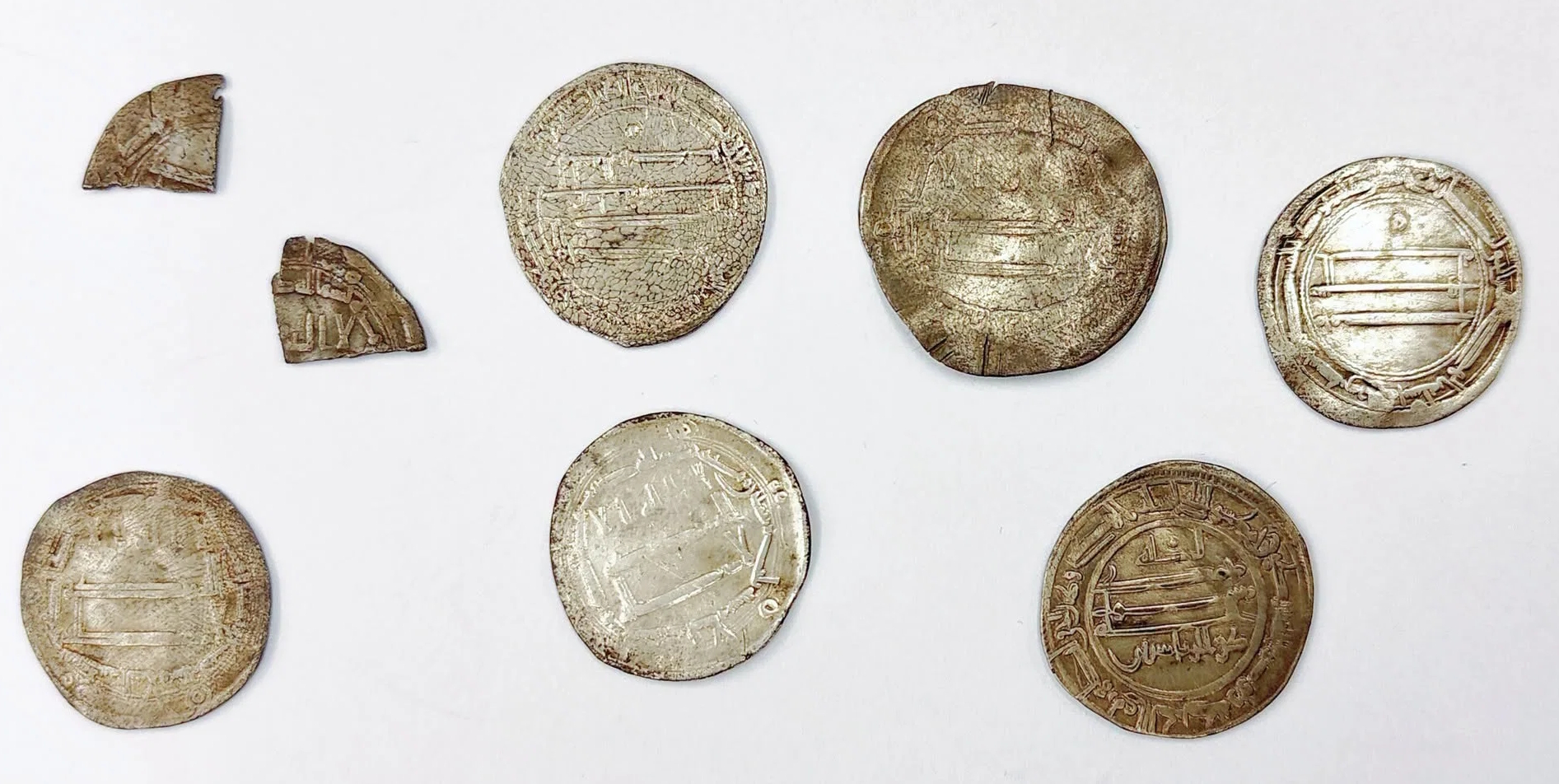
Archaeologists believe the coins may have belonged to merchants who were in the area to do business at the nearby Viking port of Truso, just six miles or so from Elblag. Truso was founded on Lake Druzno at the mouth of the Vistula river. It was one of several emporia of craftsmanship and trade established by the Vikings in the Baltic Sea area. Its raison d’etre was long-distance trade of goods from as far as away as southern Europe and Asia. The Vistula connected it to Baghdad Caliphate, as well as the Kievan Rus and Byzantine Empire.
Dr. Marek Jagodziński said that his research indicates that Truso was founded by the Danes on the border between Slavic and Baltic settlements as early as the late 7th century. The emporium itself operated until the early 11th century, and was then an important location in the entire network of such emporiums that had sprung up around the Baltic Sea. […]
The discovery and study of the Truso fragment provided a wealth of extremely valuable information revealing both the complexity of this site and its importance in the Baltic economic zone and long-distance trade. Increasing evidence indicates that Truso also maintained trade relations with the state of the early Piast dynasty. It was the development and expansion of this early feudal monarchy that indirectly led to the decline of the Truso emporium – in the 11th century, Truso’s function was taken over by the Piast city of Gdańsk, said Dr. Marek Jagodziński.
The coins are now undergoing conservation. Experts in medieval numismatics will examine and document them. When conservation and study are complete, the coins will go on public display at the Archaeological and Historical Museum in Elbląg.