13th c. rampart tower found in Breda

The foundations of a medieval tower that stood on the 13th century ramparts have been discovered in Breda, southern Netherlands. The medieval brick wall was found about two feet below street level. The surviving section of wall is semi-circular now, but archaeologists cannot determine whether the full tower was circular, semi-circular or horseshoe-shaped.

The earliest records of Breda date to the 11th century when it was a direct fief of the Holy Roman Emperor. It was granted a municipal charter in 1252 and the charter allowed it to build fortifications for its defense. The first defensive wall was an earthen rampart that encircled the city in the late 13th century. In the 14th century, a wall and a moat were added. On the east side of the city, the stone wall was built against the rampart instead of replacing it. That way defenders could walk the rampart and fewer stone battlements had to be built atop of the wall.

The location of the newly-discovered tower is squarely in the middle of the thick rampart, so not connected to the later city wall. Remains of Breda’s 14th century wall towers have been found before, but this is the first rampart tower ever unearthed.

The excavation is part of an ambitious redesign of Breda to make it a “City in the park,” a green metropolis of linked parks that connect the historic nucleus of the city with the outlying areas, combatting traffic congestion, heat stress, flooding and urban sprawl. The medieval wall plays a key role as a green wreath will be created around the historic center following the path of the ramparts that were demolished centuries ago to make way for the outward expansion of the city.

The rampart tower has now been reburied under a thick layer of sand for its own protection.

Medieval Madonna and Child returned to vivid color

After six years of painstaking cleaning and conservation, the 14th century wooden sculpture of a Madonna And Child in the Basilica of San Lorenzo in Florence has been restored to its original vivid polychromy.

Known as the Bentornata (“Welcome Back”), the Madonna and Child was carved by Giovanni di Francesco Fetti in around 1382 from a single pear tree trunk. Fetti used deep reds and blues for Mary’s gown with gilded edges. Baby Jesus’ wrap was all gilded and both mother and child have gilded blonde hair. Later repainting and varnishes, most recently in the 19th century, had browned, obscuring the brilliance of the pigments. The gilded areas had not been overpainted, but they were darkened by dirt.

The Basilica of San Lorenzo is an icon of Renaissance architecture and the burial place of the Medici family, the great patrons of Renaissance art and architecture. It contains masterpieces by Renaissance luminaries like Donatello, Bronzino and Michelangelo, including a secret hiding place where Michelangelo whiled away months as a fugitive by drawing on the walls. The Bentornata is one of very few medieval artworks at San Lorenzo, and it is all the more exceptional for being a rare work in wood by Fetti who was primarily a marble sculptor.

Conservation experts at the Opificio delle Pietre Dure (OPD) first analyzed the sculpture in depth to determine what materials to use to remove the overpaint and grime on the different colors. The flesh, blue, red and gilded areas all required different solvents to preserve the surviving original paint. Restorers then consolidated cracks in the wood and retouched the filled gaps to camouflage them. There were areas, particularly on Mary’s mantle, where the paint had to be re-adhered. The final seal coats also had to be different for the different color areas.

The analyses conducted during the restoration provided valuable information about the commissioning and quality of the work. The fineness of the modeling, the refinement of the polychromy, and the use of precious materials, such as gold leaf for the foliage and translucent lacquers on a silver base, confirm that the “Bentornata” was commissioned by an important figure of the time.

The statue has now been returned to the Basilica of San Lorenzo and is back on public display.

Last, longest Galloway hoard runic inscription translated

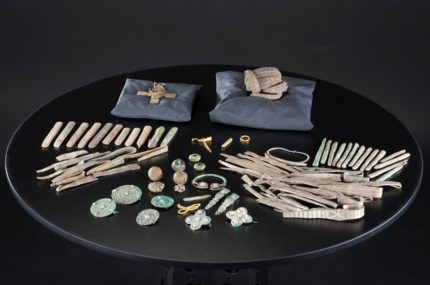
The question of who owned a hoard is usually a rhetorical flight of fancy, at best, but the Galloway Hoard is unique in that there were actual names inscribed on some of its artifacts. Written in Anglo-Saxon runic script (unusual for arm-rings of this type which were typically inscribed in Scandinavian runes) there were four inscriptions on the arm-rings found in the lower layer deposit of hacksilver and a fifth one found on an arm-ring near the hoard pit. Now, 11 years after the discovery of the largest and most varied Viking-era hoard ever discovered, the longest runic inscription has been translated, and it sheds new light on the question of who owned this treasure.
The fifth arm-ring inscription was the first to be translated. In 2019, Dr. David Parsons, a leading runologist at the University of Wales, deciphered the runes as reading EGGBRECT, the runic version of the Old English name Ecgbeorht (Egbert in modern English). The arm-ring was hacked, and the last rune squeezed onto it, so it was inscribed after it was cut. This discovery suggested that the people who deposited the hoard were culturally English rather than Norse, and may have even been locals from Anglo-Saxon Northumbria.

The other four inscriptions posed greater challenges. Three of them were abbreviated and therefore open to several interpretations. The lightest of the arm-rings was inscribed with the runes ED. It could mean “ēad” (riches, prosperity), or be the first two letters of a name like Edward or Edgar. Another light one bore the runes TIL, which could mean “good,” or be short for a name like Tilred. The third, which is twice the weight of the lightest one, is inscribed BER. Unlike the other two inscriptions, these runes do not form an Old English word. It is, however, the first syllable of several Anglo-Saxon names (Berric, Berwulf, Bercol), so it is likely an abbreviation of a personal name, which suggests the other two are as well.

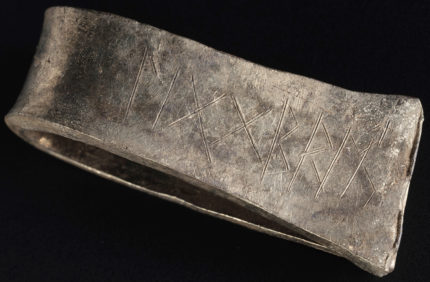
But it was the runic inscription on the largest of the arm-rings, the longest by far, that posed the greatest translation challenge. The arm-ring is unique in the hoard as it is decorated with a Hiberno-Norse stamped design; the other arm-rings with runes have no decoration. This one was also a finished ring, instead of thin, bent sheets of silver that were never completed. Dr. David Parsons was able to transliterate each individual rune, but the meaning of the inscription proved elusive.

Despite using clearly legible Anglo-Saxon runes like the others, it did not at first appear to contain a coherent message. It also has an odd sequence of the rune ɨ followed by i. The letter ɨ is used to represent the thirteenth rune ᛇ, the ‘velar fricative’ represented by ‘gh’ in words like ‘almighty’. In modern English this is silent, but in Old English it would have sounded something like the end of the Scots word ‘loch’. It is rarely if ever used at the start of a word, much less followed by another vowel. […]

The breakthrough for translation came when looking down the microscope, and it became clear the final rune had dots to either side. Centrally-placed dots like these, called puncts, could be used in medieval manuscripts to denote an abbreviation, or the name of the rune: in this case the F-rune which is called ‘feoh’, a word which also means ‘wealth’ or ‘property’. A new look at the inscription showed that there was possible word spacing in the runic inscription, allowing us to break it down into four words: DIS IS ƗIGNA F[EOH].

This gets us closer to one possible reading. If we allow for an odd pronunciation, it could be that DIS IS is an attempt at ‘this is’. ƗIGNA is more problematic – but the ‘gh’ in ‘almighty’ was sometimes written simply as ‘h’ in Old English. If ᛇ could be used for ‘h’ here, the text would read ‘higna’, a word which means ‘community’, particularly used for monastic or other religious communities.

With all these caveats in mind, the long inscription may well be understood as:

þis is higna feoh

“This is the community’s property.”

The runic inscription thus translated dovetails into the interpretation of the hoard itself as something that had multiple owners rather than belonging to an individual. The long inscription could be referring to the deposit, either the lower layer of hacksilver or the entire hoard, as the “community’s property.” The word “higna” usually refers to a monastic community, and the hoard contains some spectacular ecclesiastical objects, including a large pectoral cross and the lidded vessel.

Urgent conservation of tomb of Holy Roman Emperor Otto I begins

The tomb of Emperor Otto the Great in Magdeburg Cathedral in northeastern Germany is undergoing an urgent program of restoration and stabilization. The State Office for Monument Preservation and Archaeology Saxony-Anhalt (LDA) has found damage so severe, that time is of the essence to save this cultural site of great historical significance.

Otto I, also known as Otto the Great, inherited the title of Duke of the Saxons and King of East Francia (the part of the ancient Frankish Empire that basically corresponds to present-day Germany) from his father Henry I. While he died before being crowned emperor by the pope, Henry fought ably and successfully against other German tribes, Magyars and Danes to expand and strengthen the kingdom his son inherited. Otto picked up where his father left off, weakening the power of the feudal aristocracy, unifying Germany into a centralized state under his rule and conclusively defeating the Magyars. He then turned his attention to Italy, and in 961 conquered the Frankish Kingdom of Italy (Lombardy, Tuscany and Spoleto, a chunk at the calf of the boot). While he was in the neighborhood, he went to Rome and, inspired by the example of Charlemagne, was crowned Emperor of the Romans by Pope John XII. By some standards, Otto is considered the first Holy Roman Emperor, distinct from the Carolingian Empire of Charlemagne. He is certainly the first of the unbroken line of rulers that would hold the title until Napoleon conquered Germany and the last Holy Roman Emperor abdicated in 1806.

Otto I stayed in Rome for a decade, working to consolidate his power in Italy and to get the approbation of the Byzantine emperor. He returned to Germany in 972. He died less than a year later in Memleben. His heart was buried in St. Mary’s Church there and his embalmed body transferred to Magdeburg Cathedral where he was buried next to his first wife, Queen Eadgyth, granddaughter of Alfred the Great.

Otto the Great was laid to rest is a sarcophagus made of a single block of carved limestone with a coffer decoration on all four sides. The cover is a reused antique marble slab. When the cathedral was rebuilt in the 13th century, his tomb was moved to the inner choir where it has remained.

The tomb is regularly monitored by the Saxony-Anhalt Cultural Foundation and the LDA, and recent inspections have found damage to the exterior of the limestone sarcophagus and marble cover, mostly due to stabilization measures taken when the tomb was last opened in 1844 that had unintended consequences. The worst offenders are iron clamps installed to keep the thin walls stable. The iron is corroding and expanding, causing severe cracks that, left to their own devices, could break the sarcophagus and cover apart. More problematic iron comes from a wooden plank that was nailed to the inside of the sarcophagus in a confoundingly misguided attempt to strengthen the brittle wall.

Conservators are also concerned about the condition of the contents of the sarcophagus. The 1844 intervention revealed a wooden coffin containing human remains and textiles that had already been disturbed many centuries earlier. Cameras threaded into the sarcophagus have found holes and cracks in the wood, and the skeletal remains are no longer in their articulated original positions. Fluctuations in temperature and humidity in the environment of the cathedral penetrate the interior of the sarcophagus through cracks and joints.

The measures necessary to repair and stabilize Otto’s tomb can only be taken on site as the sarcophagus and contents are far too fragile to be moved. Instead, almost the entire high choir space where the sarcophagus is situated has been enclosed by wood panels to create an in-situ conservation chamber. The damage will be examined in exhaustive detail with a variety of non-invasive methods, then documented digitally and photographically.

The marble lid will have to come off in order to repair the damage and check on the wooden coffin. As soon as the lid is off, nobody will be inside the chamber without wearing full protective clothing to prevent contamination.

Fragment of gilded pre-Viking helmet found in Denmark

A fragment from a pre-Viking helmet that is one of the most magnificent ever found in Scandinavia have been discovered in Lejre, in the northwestern of the Danish island of Zealand. The fragment is gold-plated bronze adorned with red garnet gemstones and intricately engraved zoomorphic figure. The design of the animal figure — its pronounced teeth and large eyes — date it to between 650 and 750 A.D., the late Germanic Iron Age right before the dawn of the Viking Age around 800 A.D.

The helmet fragment consists of two adjacent pieces that fit together perfectly, forming most of the curved brown ridge. The pieces were discovered by two metal detectorists in the spring of 2024. The artifacts are classified as danafae (archaeological finds of precious metals) and therefore property of the state. The finders immediately handed them over to the National Museum of Denmark who documented the find with a quick turn-around so it could be loaned back to Lejre Museum for display.

For more than five centuries in the late Iron Age and Viking Age, Lejre was a royal seat and a major center of power. As there are no written records from the era, the only sources we have for the kings of Lejre are Icelandic sagas and eddas (13th century prose and poetry texts on Norse mythology), chronicles heavy on the legendary like the 12th century Gesta Danorum and poems like Beowulf. The literary sources cite Lejre as the first royal seat, the home of the Skjöldung or Scylding clan, the legendary first ruling Danish dynasty, but there was no historical evidence to confirm its significance.

Archaeological excavations stepped into the breach. The first remains of a royal hall were unearthed in 1986. Several more royal halls have been found in the 40 years since, including a massive one found in the 2009 excavation. At 200 feet long and 40 feet wide, it is the largest royal hall ever discovered in Denmark. It dates to the late 8th or early 9th century. These halls were where the ruler would sit on a high seat and receive his subjects and guests. The dates of the grand halls found there bear witness to Lejre’s status as a royal seat of ruling dynasties for 500 years.

Now the helmet fragment adds to the royal archaeological record of Lejre. The materials and craftsmanship suggest a ceremonial role rather than combat hardware, and Lejre was not a battle site in the Late Germanic Iron Age. The Danish elite converged there for religious and political purposes and for trade. There are decorative elements of the helmet fragment that are very similar to ones found in England and Sweden, suggesting Lejre’s helmet may have been an import.

The helmet emphasizes the grandeur and status that we see in Lejre’s hall buildings and funerary monuments from the same period. According to Julie Nielsen, it was a very special object dedicated to a king or a person who ranked highest in the site’s highly divided hierarchy:

“The deep red garnet has long been associated with strength. The detailed ornamentation on the helmet tells a story, a narrative, about the enormous power of the person who owned and wore it,” says the archaeological chief. […]

Archaeologist and senior researcher at Uppsala University John Ljungkvist has closely studied the helmet fragment from Lejre and highlights its unique construction:

“Where in other helmets we see three separate brackets that are put together, this helmet’s eyebrow arch is constructed in one piece. We haven’t found anything like this new variant of the exclusive helmet before.”

The fact that a helmet of that caliber could be produced is, in John Ljungkvist’s eyes, unique:

“It is craftsmanship of a very special quality – on par with the craftsmanship behind the famous helmet from the Sutton Hoo shipwreck in England.”