
Tomb of military leader in Augustus’ wars in Spain found in Pompeii

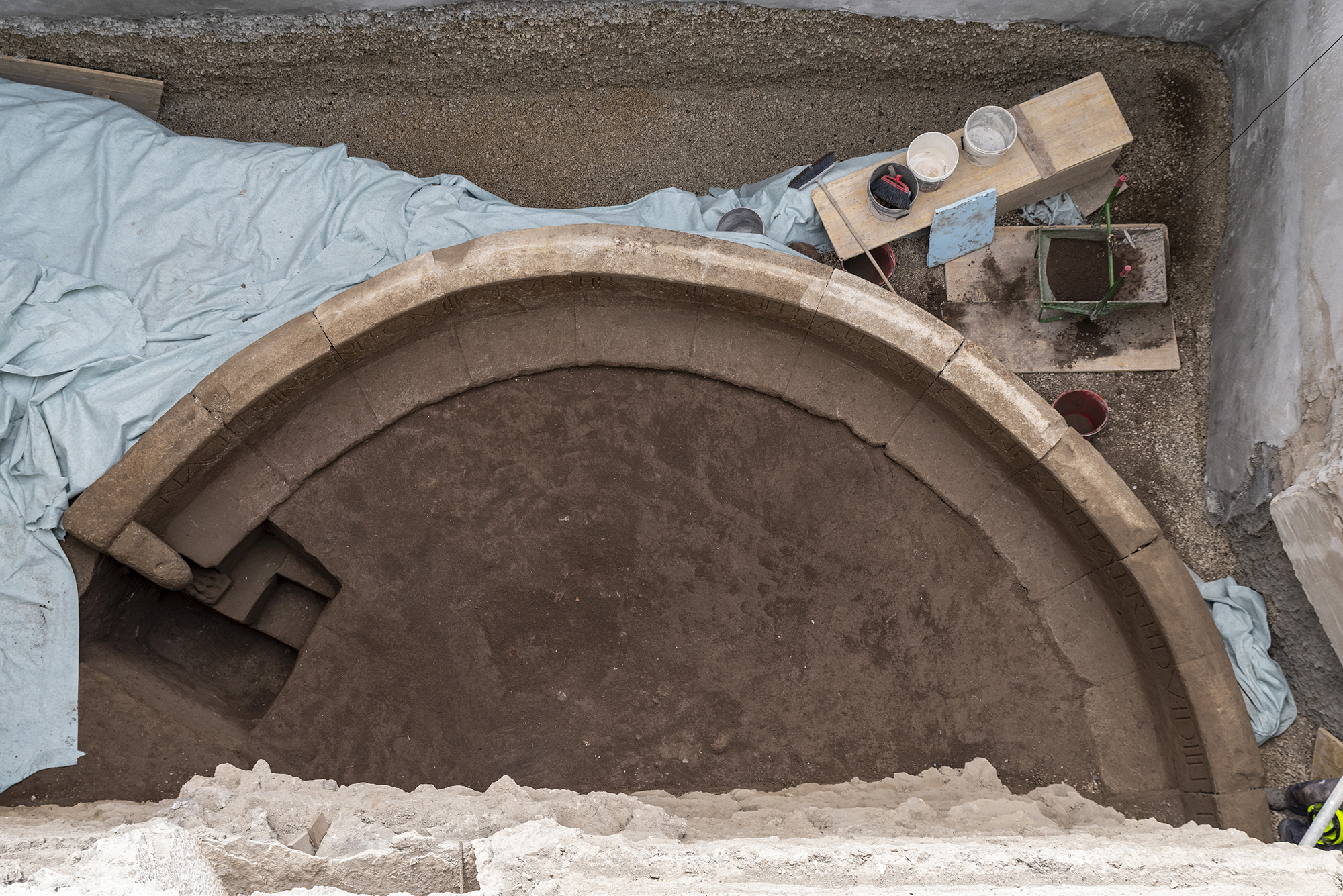
Usually when exciting new finds are made in Pompeii, they’re the result of planned excavations. This time, construction of a ventilation shaft on the building of San Paolino, built in the 1840s and now the headquarters of the library of the Archaeological Park of Pompeii, accidentally exposed the tomb of an important military official who served under the emperor Augustus (r. 27 B.C. – 14 A.D.) during his last wars of conquest in Spain.

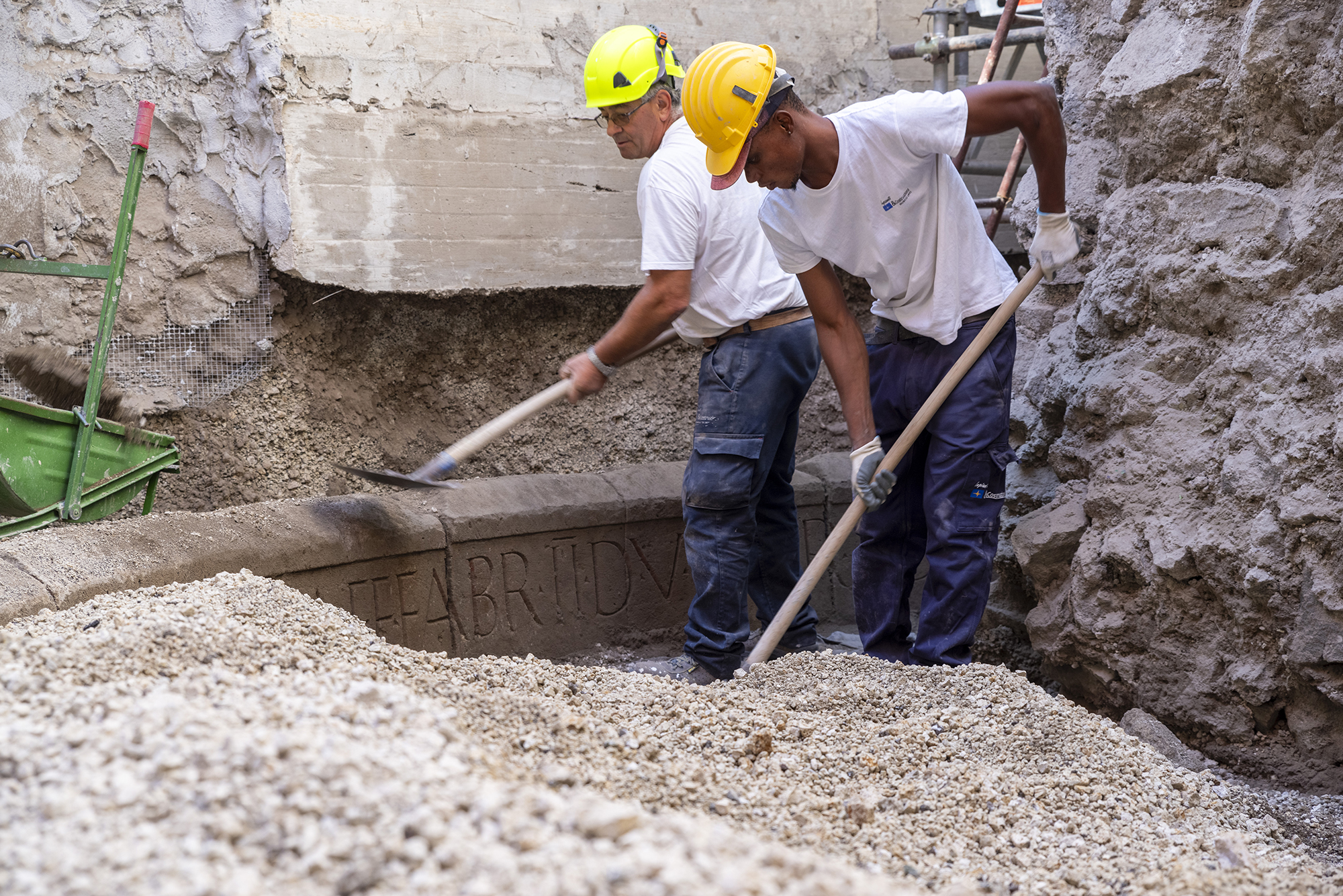
The construction first exposed two ends of a semicircular tomb of a type known as a “schola” tomb. Schola tombs have been found before in Pompeii. They consist of a semicircular bench made of volcanic tufa stone with lion paw terminals. The subsequent excavation revealed a large inscription on the curved back of the bench, expertly carved in very regular letters with remains of the original red paint inside them.

At the time of the eruption in 79 A.D., the tomb was decades old and so neglected that the monument was buried up to the bench. Even disregarded and forgotten, however, the inscription was still evident and legible when Vesuvius covered the city in death.

The inscription reads in large letters:

N(umerius) AGRESTINO N(umerii) F(ilius)
EQUITIO PULCHRO TRIB(une)
MIL(itum) PRAEF(ectus) AUTRYGON(um)
PRAEF(ectus) FABR(um) II D(uum) V(iro)
I(ure) D(icundo) ITER(um) LOCUS

It continues in smaller letters carved below the larger ones in the center of the back of the bench:

SEPULTURAE DATUS D(ecreto)
D(ecurionum)

This translates to: “To Numerius Agrestinus, son of Numerius, Equitius Pulcher, military tribune, prefect of the Autrygoni, prefect of the military engineers, Duumvir for the jurisdiction (i.e. holder of the highest magistracy in the city of Pompeii) twice, the place of burial (was) given by decree of the council of the city.”
Numerius Agrestinus appears in another inscription found in the necropolis of Porta Nocera, but it was created when he was still alive apparently by order of his wife, Veia Barchilla, a name of Spanish origin. Her husband’s funerary inscription, specifically the “praefectus Autrygonum” title, points to him having held important military positions during the Cantabrian Wars (29-19 B.C.), Augustus’ long and bloody conquest of the last independent Celtic peoples in Hispania, modern-day northwestern Spain. (The Autrygoni were tribespeople who inhabited northern Spain.)

After his stellar military career, he retired to Pompeii where he repeatedly held the highest office in the city, duumvir jure.

“Here we see the emergence of the network of power that connected the elites of the empire, whose members were asked to commit themselves in conflict areas, with the promise of economic rewards but above all of social prestige in the community of residence,” explains the director of the Archaeological Park of Pompeii, Gabriel Zuchtriegel . “Having held the highest office in Pompeii, the duumvirate, twice, and having been honored with a funerary monument on public land, are expressions of recognition and loyalty to someone who had literally fought on the front lines for the cause of the empire. The unexpected discovery of this monument is yet another example of how in Pompeii protection, research and enhancement are closely intertwined.”

You can really see the inscription, including the traces of surviving red paint, in this video which follows it in the round after it is exposed. It also conveys a particular challenge of Vesuvian archaeology: having to remove feet upon feet of lapilli, small pumice rocks that showered Pompeii in the first stages of the eruption.

Museum seeks info on Early Bronze Age axeheads

The National Museum of Ireland received two Early Bronze Age axes in the mail last month from an anonymous sender. They are flat axeheads dating to around 2150-2000 B.C. and are highly significant artifacts from Ireland’s prehistory. The museum is asking the public for any information they might have about the location and circumstances of the axes’ discovery.

The donor sent the axeheads carefully packed in styrofoam with custom cut-outs inside a box of Flahavan’s Irish Oaty Flapjacks (which are crunchy granola bar-like squares, not flapjacks in the American sense of pancakes). A letter was included but it was scant on detail, saying only that the axeheads had been discovered in the Westmeath area using a metal detector.

However, to fully understand and appreciate these artifacts, it’s crucial to know the exact location where they were found. The context of such discoveries helps archaeologists piece together ancient settlement patterns and cultural practices. For instance, hoards or collections of objects were often deliberately placed in specific locations for reasons that could range from ritualistic to supernatural.

With this in mind, we are appealing to the person who sent these axeheads to reach out to us. Any information about their discovery will be treated with the utmost confidentiality and used solely to verify the find location and its circumstances.

The National Museum of Ireland is currently participating in an international study of Bronze Age metalwork, aiming to trace the origins of the metals used in such artifacts. Details about the find spot of these axeheads could provide critical data for this research.

By Irish law, archaeological finds must be reported to the authorities, which was obviously not done in this case, and explains why the sender is keeping mum.

We also wish to remind everyone about the regulations surrounding the use of metal detectors for searching archaeological objects. Archaeological finds without a known owner are the property of the state and are preserved as part of our collective heritage in national and designated museums.

The museum isn’t the law, however, and they have no interest in pursuing the finder. They just want information, which can sent to their email address or phoned in at 01-6777444. (Cool number. It’s like a fake one from a movie.)

V&A acquires 12th c. walrus ivory carved Deposition

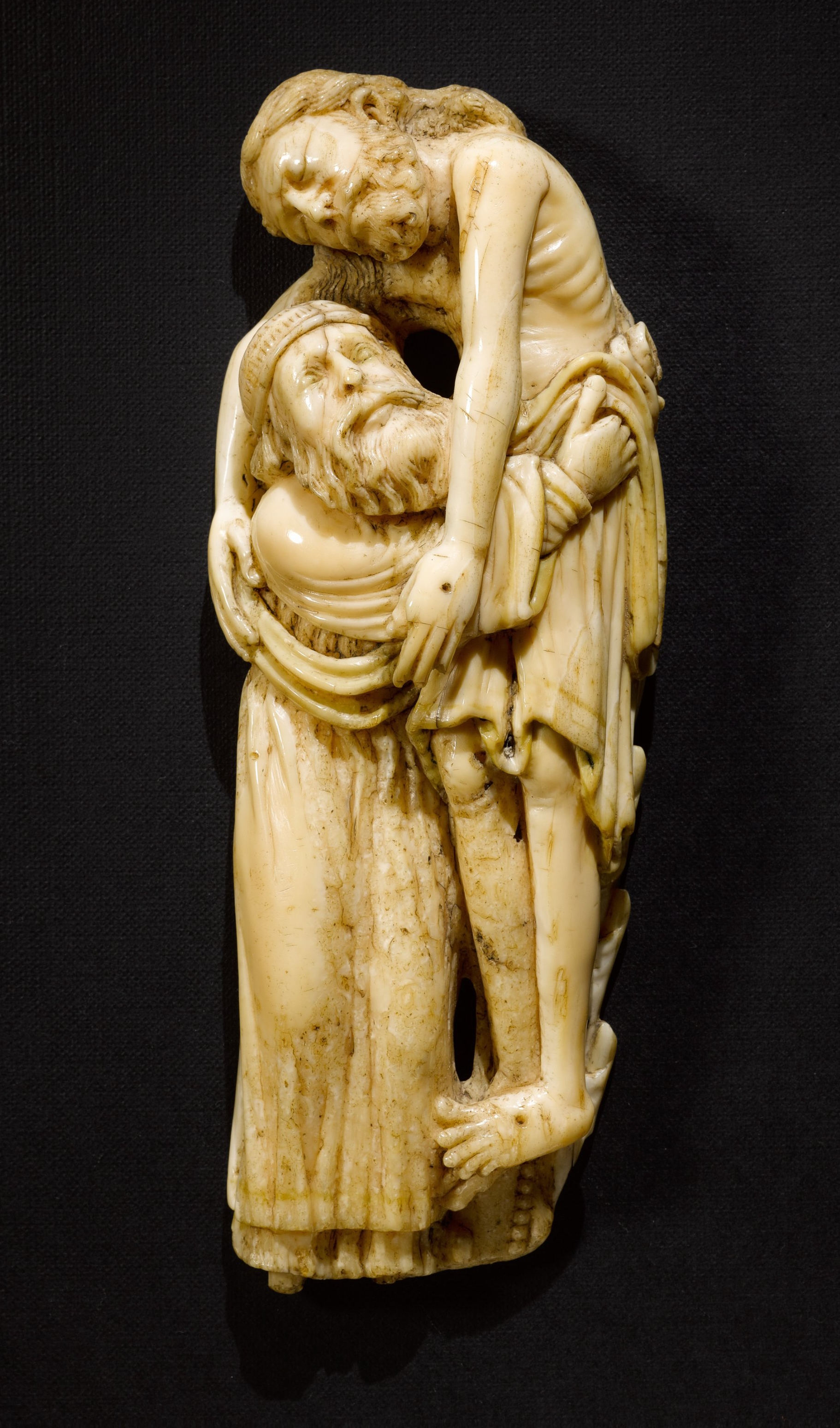
The rare 12th century walrus ivory carving depicting Joseph of Arimathea taking the body of Christ down from the cross that was acquired by the Metropolitan Museum of Art in a private sale last year has been sniped by the V&A.

The Romanesque carving was made between 1190 and 1200 probably in York. It was originally part of a much larger altarpiece of scenes from the Passion of the Christ. The carved details — the drapery, poses, the facial expressions — are masterful examples of skill in ivory carving. The English Reformation slashed and burned much of this kind of devotional art. Today the Deposition is widely considered one of the greatest surviving pieces of medieval British carved ivory.

Because of its great rarity, the exceptional quality of the carving and its cultural significance, the UK Arts Minister placed a temporary export bar on the Deposition to allow a local museum the opportunity to match the purchase price and keep the artwork in Britain. There was no question as to which local museum would throw its hat in the ring. The Deposition and a fragment depicting Judas at the Last Supper from the same lost altarpiece were on display together at the V&A from 1982 until 2022. The Judas fragment was donated to the museum in 1949; the Deposition was on long-term loan from collectors John and Gertrude Hunt, and only left the museum when their heirs decided to sell it.

The Deposition was exhibited once at The Metropolitan Museum of Art in 1970, and the Met was eager to make it part of its permanent collection when it was offered for sale. Sotheby’s negotiated the private sale, but it was clear from the beginning that the sale was contingent on an export license that was very likely to be barred. The Met set a high bar for any British museum to clear, paying £2 million ($2.5 million) for the seven-inch figure.

As soon as the temporary export ban was in place, the V&A launched a fundraising campaign to raise the large sum. Two grants (£700,000 from the National Heritage Memorial Fund and £350,000 from the Art Fund) got them more than halfway to the goal. Other non-profits, the museum’s own budget and donors near and far got the V&A to its goal.

Light conservation is now being conducted on the Deposition and it will go on display in September. It will be shown alongside the Judas fragment, in the V&A’s Medieval and Renaissance galleries.

Bronze Age axe found off Norwegian coast

A marine archaeologist has discovered a Bronze Age axe head in the sea off Arendal, southeastern Norway. The shape identifies it as a Middle Bronze Age piece, dating to approximately 1100 B.C. It is the first prehistoric metal artifact ever discovered in Norwegian waters.

Norwegian Maritime Museum archaeologist Jørgen Johannessen found the axe during a routine survey of underwater cultural heritage. At a depth of 40 feet on the edge of a reef, he encountered a pile of flint ballast, commonly used between the 16th and the mid-19th century to stabilize ships before being thrown overboard when the neared the shore. Then he spied the bronze axe inside the pile, and realized it most definitely did not date to 16th-19th century.

He recovered the object and experts examined it. It is a hollow socketed axe, also known as a celt. It was the dominant axe blade of the Nordic Bronze Age (1800-500 B.C.). It would originally have been mounted to an angled wooden shaft, with the angled end of the wood inserted into the open end of the axe head. This was an effective and parsimonious design that allowed the greatest function with the least amount of expensive and hard-to-obtain metal. It is 4.5 inches long, 1.85 inches wide at the widest point (the curved cutting of the blade), and weighs 11.5 ounces.

The site suggests that the ax has arrived there with a vessel. The question is when, and in what context. We have two hypotheses about how the hollow ax might have ended up there: the shipwreck hypothesis and the ballast hypothesis.

The shipwreck hypothesis is that the ax is the remains of a shipwreck over 3,000 years ago. It could come from a boat crossing from southern Scandinavia, or a local boat that sailed along the coast. If this hypothesis is correct, this is the first known shipwreck site from the Bronze Age in Norway.

The ballast hypothesis assumes that the ax was part of the ballast on a ship in the sailing age. The ax was then shoveled out together with the flint on the way to the port in Arendal, where a new load was to be picked up. In that case, the ax ended up on the seabed a few hundred years ago, either directly from an area in southern Scandinavia where flint is common along the coasts, or via ballast depots in other ports. In that case, the ax will be a loose find with no other context than the ballast flint it was found with.

Norwegian Maritime Museum archaeologists are returning to the find site this week to explore it further. They hope to find evidence of either of the two hypotheses, especially the Bronze Age shipwreck hypothesis which would be an unprecedented find.

Update: Heraclea Sintica statue shows his face

The larger-than-life-sized statue of a male deity found in the Roman-era sewer of the ancient town of Heraclea Sintica near Petrich in southwestern Bulgaria has shown his face. Archaeologists finished excavating the statue, which had been buried in the sewer face to the wall and covered with soil, revealing the face and the right arm. Unfortunately no right hand survived.

This is a young face with short hair. It’s definitely not a statue of the Atalante Hermes type which has a more mature face and thick, wavy hair. His build seems slighter too. It bears some of the characteristics of portraits of Roman emperors depicted as gods. It looks more like a young Caligula, Octavian or Gaius Caesar than any of the 2nd century emperors, but they certainly weren’t making statues of Caligula at that time. Having seen the full statue, excavation leader Dr. Lyudmil Vagalinski suspects it was made earlier than the initial 2nd century estimate.

In order to remove the statue from the sewer, exact measurements were taken and a custom metal carriage built inside the sewer. The statue was then lifted for packing in a secure crate. After six hours of hard work, the statue was removed from the sewer Friday, July 12th. It was raised with a crane to a track and then transported with police escort to the Petrich Historical Museum.