 The Upton Lovell Shaman, a gold worker who was buried with rich furnishings 4,000 years ago, the period when Stonehenge was constructed, has been identified by DNA analysis as a woman, unpending two centuries of presumed sex. She was also a gold metal worker and a religious leader in her community.
The artefacts date to about 1,800BC, a time when the ability of metalworkers to transform lumps of rock into molten metal would have given them a special – possibly even spiritual – position in society. Such roles, many had assumed, would have been reserved for men, but this narrative has been turned on its head by the latest analysis.
“It completely tears up previous assumptions,” said David Dawson, director of the Wiltshire Museum, which holds the remains. “It’s a fantastic revelation of the position of women in society. We’re so used to the assumption of men do everything, men are the leaders, men are the metalworkers. Here we have smoking gun evidence of a female metalworker. And metalworking was the space science of its day.”
The grave was discovered in Upton Lovell, a village 10 miles away from Stonehenge, in 1801 and excavated by antiquarian William Cunnington. Underneath a barrow bowl 40 feet in diameter and less than two feet high, Cunnington unearthed an oval cist burial chamber with the remains of one individual lying supine, head placed pointing north, and a second individual seated in the same grave. (These remains are now lost.) Because the primary burials was laid to rest with a stone axe and 17 perforated bone points on the chest, Cunnington assumed it was a man with the secondary burial his female companion.
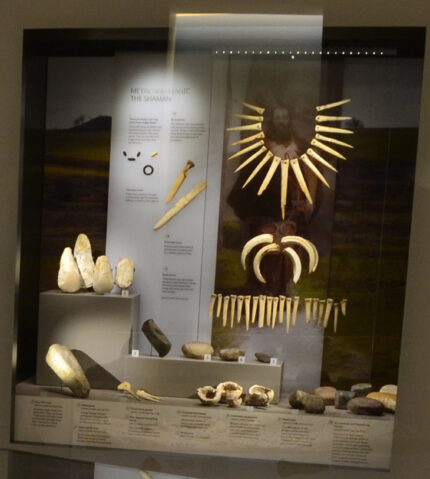
 He was dubbed the Upton Lovell Shaman because of the elaborate bone furnishings found in the grave — pierced animal bones decorating a ceremonial cloak, boar’s tusks adorning a pouch — suggest he performed a spiritual role. Other grave goods — a heavy dolemite stone battle axe, Neolithic flint axes already 1,000 years old at the time of the burial, smooth river stones, a battle axe broken in two — contributed to the presupposition that this was a man’s grave.
The grave goods of the Upton Lovell Shaman burial went on display at the Wiltshire Museum in Devizes. In 2000, the barrow was re-excavated with modern archaeological methods and technologies. The human remains were recovered and for the first time, traces of gold were discovered on one of the stones. In 2022, the objects in the burial were re-examined by researchers from the University of Leicester.
This new research has identified a further four stone objects with gold on their surfaces and characteristic wear traces, linking a wider suite of items from the burial to the goldworking process. It also demonstrates that these gold traces are ancient. The team suggests the tools were used to make multi-material objects where a core object was crafted in a material like jet, shale, amber, wood or copper and decorated with a thin layer of gold sheet.
Researchers also found traces of ochre on the surface of the Neolithic flint axes, which in addition to being a widespread dye and paint pigment, was also a fine powder used to polish metal. Traces of ochre were also found in four cups made from fossil sponges, as were adhesives so they were used as working containers, perhaps in metal polishing or as part of a tattooing set along with an a bronze awl found in the tomb. There were also touchstones, smooth, dark river stones that gold workers used to determine the quality of the precious metal just by wiping a tiny sample of it against them and assaying its purity by the color.
The Upton Lovell Shaman was DNA tested as part of a We Go Way Back, a new exhibition that opened last month at the Francis Crick Institute dedicated to what new ancient DNA research has revealed to us about our ancient and prehistoric ancestors.
Analysis of DNA extracted from the skeleton’s skull, tooth and toe bone revealed that they had XX sex chromosomes, typical in those who present as female. Analysis of the bones showed that she was probably over 45 years old when she died and had arthritis in her right wrist, consistent with lifelong use of metal working tools.
One large stone battle axe broken in two pieces was found in her grave. Heavy wear and tear on the two pieces indicate they were used as hammerstones. These are the tools she wielded to create thin sheets of gold, that ultimately gave her arthritis.
Lisa Brown, Curator of the Wiltshire Museum, said This groundbreaking research, using cutting edge techniques, shows the importance of making museum collections available for scientific analysis. We now have a whole new understanding of this burial, rewriting their story, breaking stereotypes, and putting women front and centre in our understanding of early Bronze Age society.

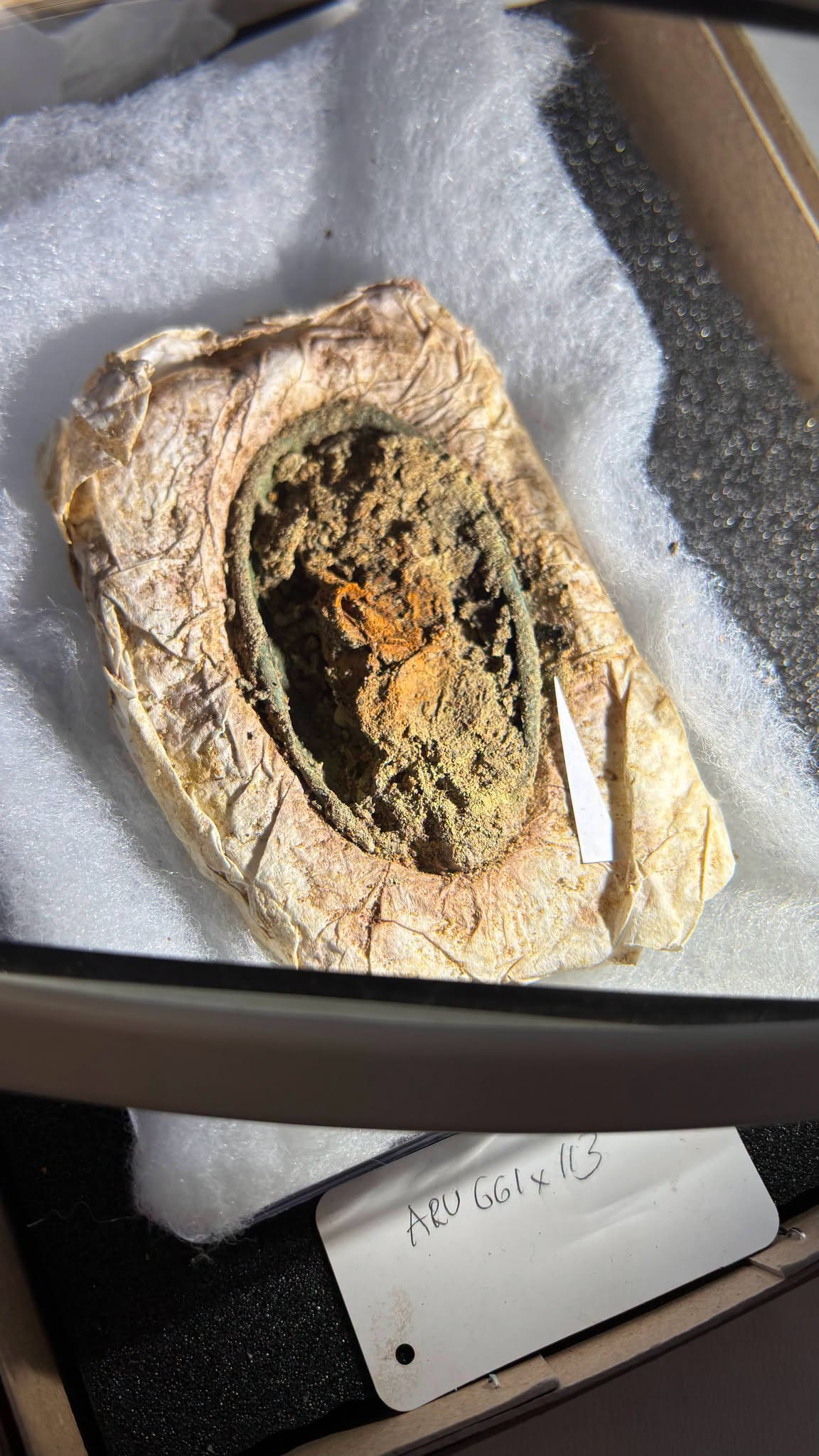
 An Iron Age shield boss containing cinerary remains has been discovered in a scrapyard in Hrubieszów, southeastern Poland. The center of a shield, also known as an umbo, reinforced the wooden shield and protected the hand of the warrior who held it from a strap in the center of the back right behind the boss. It dates to the 2nd century A.D.
 Włodzimierz Starykiewicz was looking for car and motorcycle parts when he came across a rusted circular piece with central spike shaped like a Hershey’s Kiss. It was so corroded and encrusted with dirt that it would have been easy to discount it as just some random part, but the finder thought it might be of archaeological significance. He immediately sent a photograph to the Father Stanisław Staszic Museum in Hrubieszów labelling it “A relic from a scrapyard!”
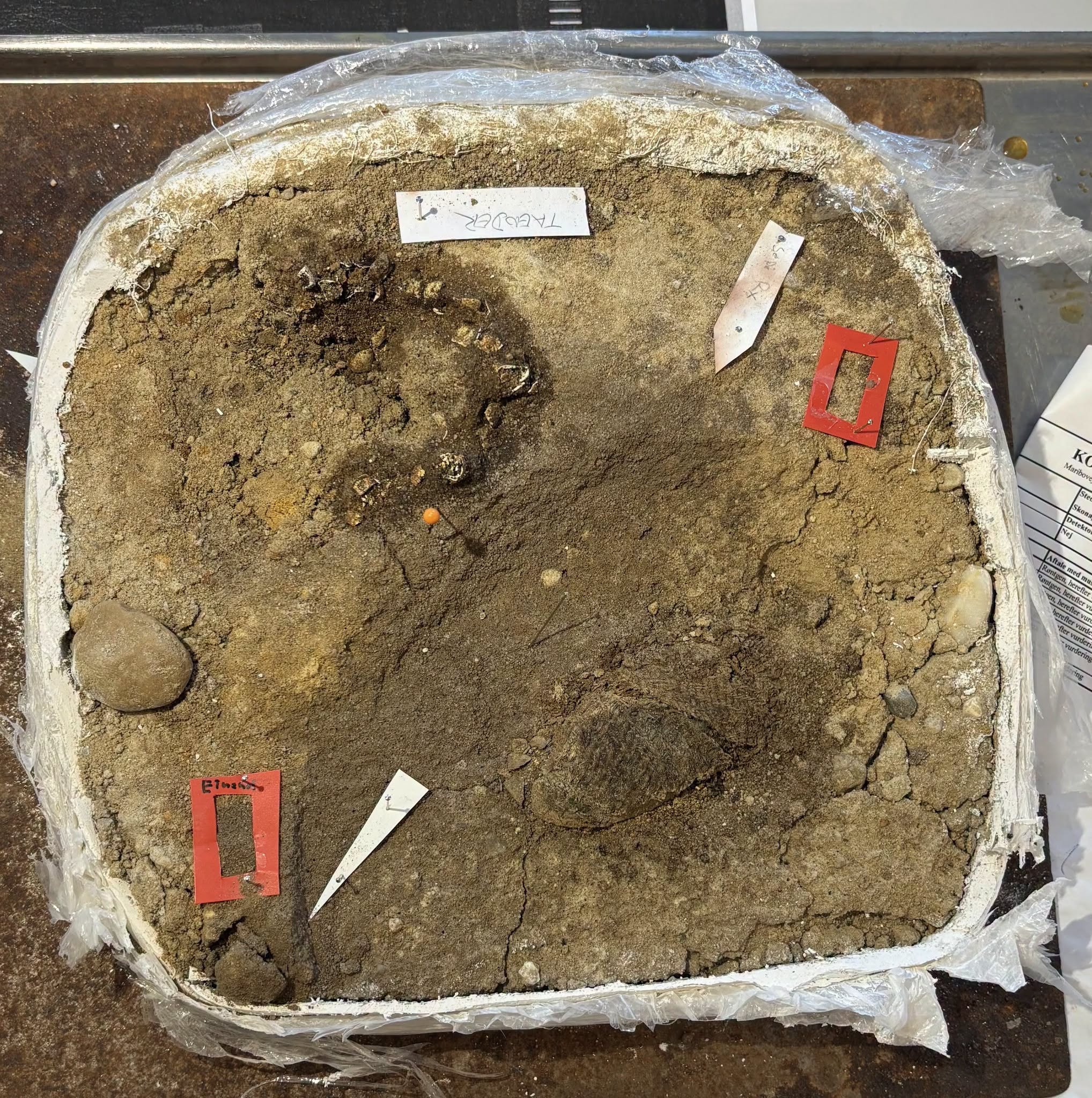
 They found that inside the concave umbo was compacted dried earth with remnants of crop stubble, suggesting the original context was a cultivated field. Włodzimierz prudently and deliberately kept the soil inside the object so that it could be micro-excavated once it was at the museum. This wise decision preserved not just organic crop traces, but also burned human bones inside the compacted soil.
 The iron surface also shows signs of having been exposed to high temperatures. The cinerary remains and the condition of the iron boss clearly indicate the shield was burned on the funeral pyre with a warrior of the Vandal community (Przeworsk culture). Unfortunately the grave is gone, disconnected from the shield boss that somehow made its way to the scrapyard, so there’s no way to track down what else might have been buried. Comparable burials from the period that have been excavated in their original contexts often include other weapons — swords, spearheads — and metal accessories — belt buckles, brooches.