Galloway Hoard rock crystal jar goes on display

The unique rock crystal jar decorated with gold filigree that was one of the treasures found in the Galloway Hoard has gone on display for the first time at the Kirkcudbright Galleries, less than 10 miles from where the hoard was discovered in 2014.

The Galloway Hoard was buried around 900 A.D., and contains an unprecedented assemblage of precious artifacts and materials from Ireland, Anglo-Saxon England, Persia and even as far as Central Asia. The gold filigree-mounted rock crystal jar was of Anglo-Saxon manufacture, and the quality of materials and craftsmanship places among the greatest examples of Anglo-Saxon metal work. A Latin inscription on the base reading H Y G V A L D E P : F A C : I U S S (“Bishop Hyguald had me made”) identifies it as having come from a Northumbrian cathedral treasury, although no bishop named Hyguald has been found in the patchy surviving church records of the 9th century.
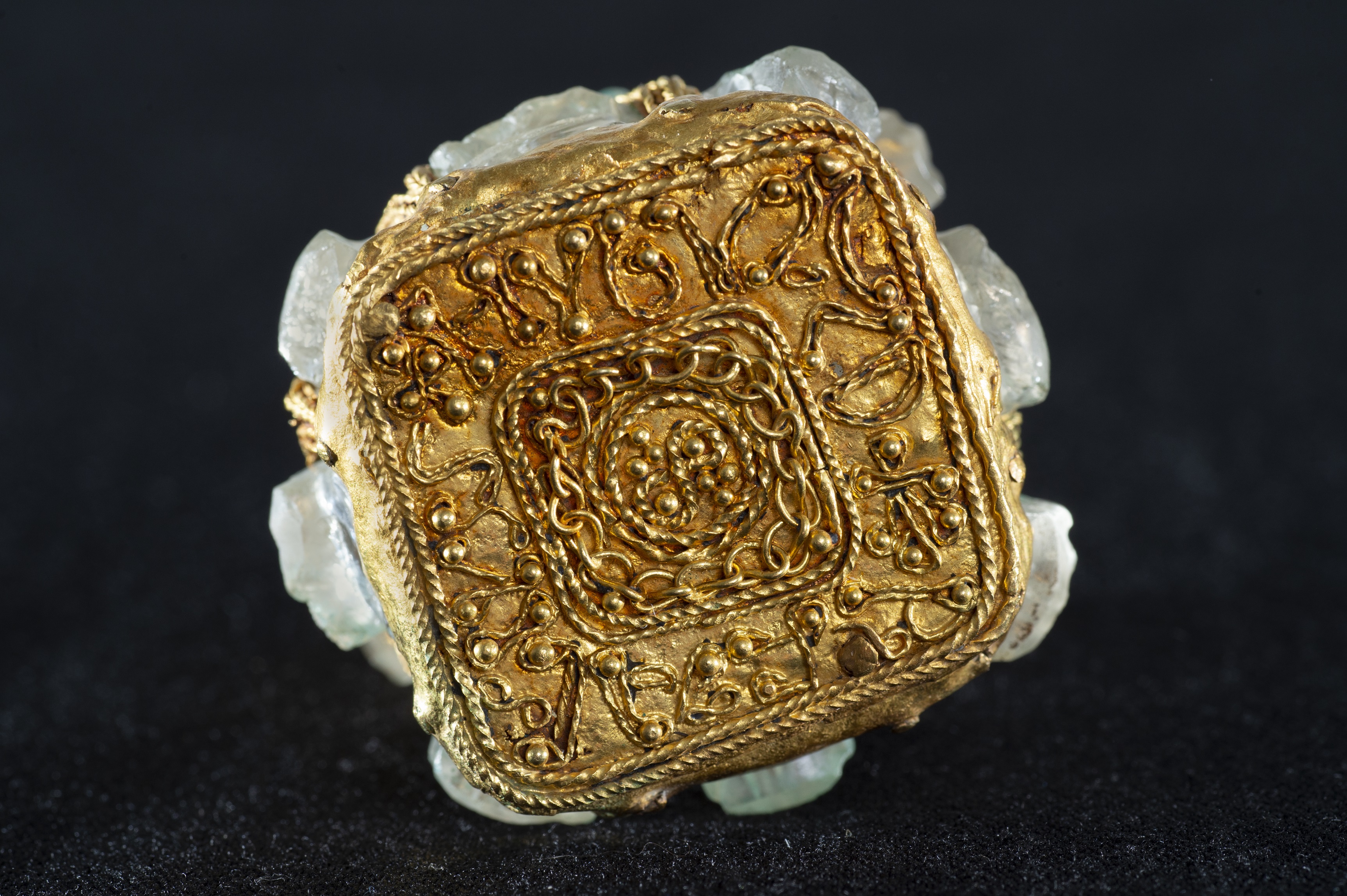
The rock crystal itself, however, long predates the gold mount. It was carved with lobes that when viewed upside down look like the acanthus leave layers of Corinthian column. The wear on the hard material and the great skill needed to carve it point to it having been made in the Roman Empire. It was the capital of miniature column — several of these objects are in the collection of the Vatican Museums — and bears a central drilled hole originally used to hold the column parts together.

It seems the carved crystal top, long separated from the rest of the column, was treasured as an heirloom for centuries. Hundreds of years later, it was flipped upside down and ornamented with gold in a unique filigree technique using spirals of twisted and plaited wire and granulation. The drilled hole was alighted with a gold spout. It was probably used to hold a small amount of liquid, a precious substance, perhaps a relic.
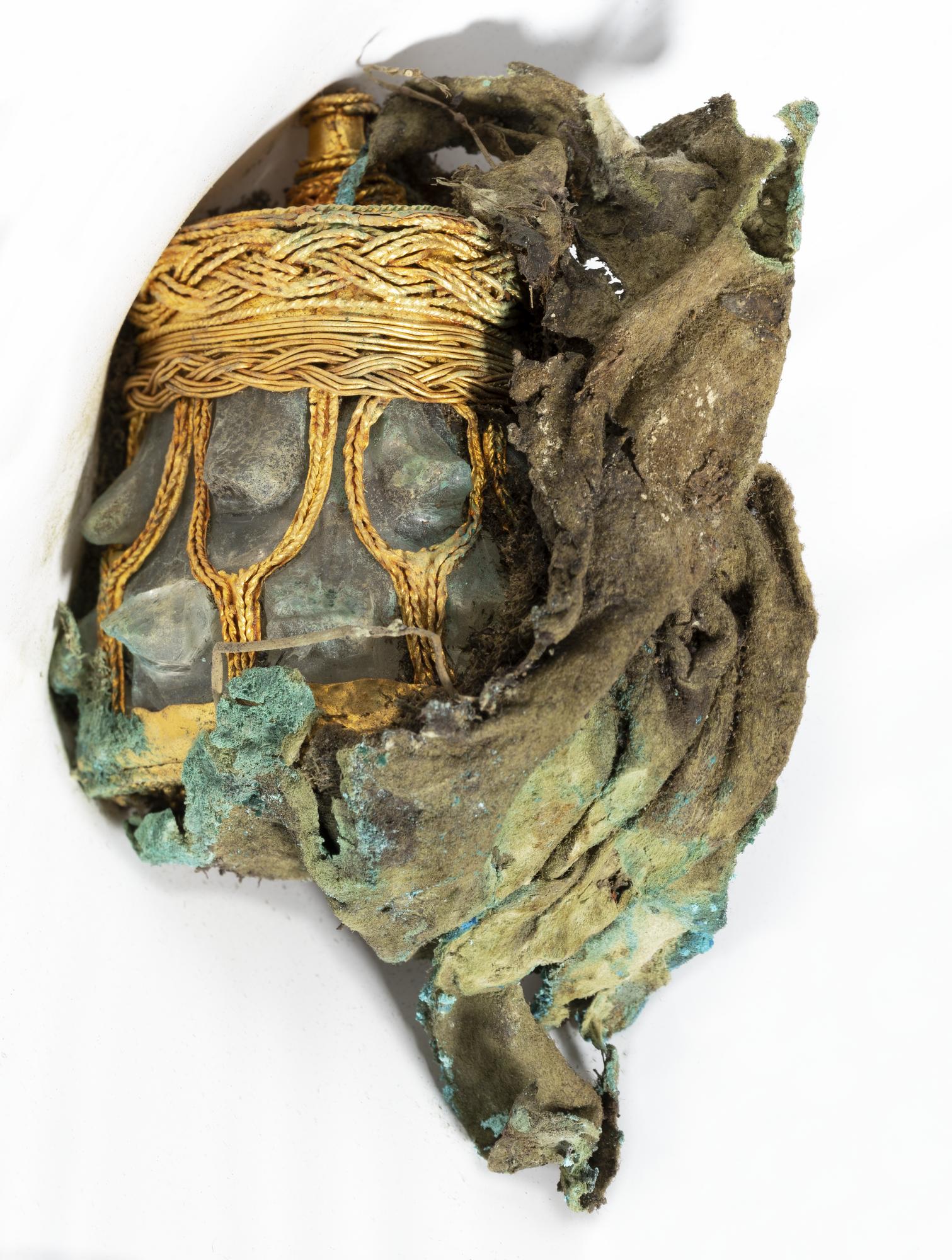
When it was placed in the fine silver pot with the other objects in the Galloway Hoard, the rock crystal jar was wrapped in linen, then placed inside a leather pouch lined with a layer of opulent samite (a decorated silk that originated in Asia or Byzantium).

Dr Martin Goldberg from National Museums Scotland said:

“The rock crystal jar is one of the highlight objects from the Galloway Hoard. From the beautiful rock crystal itself, originally carved in the form of a classical Corinthian column two thousand years ago, to the incredibly intricate gold decoration added hundreds of years later and including a clear inscription identifying its owner, this one object exemplifies the complex, connected and historic nature of the Galloway Hoard. The jar was the subject of international attention when we first revealed the inscription, and it’s great to be able to put it on display it for the first time in Kirkcudbright.”

Vives annos!

A small post to ensure you’re not left empty-handed today. If you have 17 minutes to spare amidst the festivities, this lecture from Ancient Rome Live on the Early Christian churches of Rome is a gift box of information about the evolution of Christian churches in Imperial Rome, complete with tours of the early churches that survive today.

Happy last day of Brumalia!

Six 13th c. silver coins found in Berlin’s Molkenmarkt

The continuing excavation of Berlin’s oldest square, the Molkenmarkt, has uncovered a rare cache of six 13th century silver coins. The coins were minted by co-ruling Margraves of Brandenburg-Salzwedel Otto IV and Otto V (1260/65-1293)

Five of them are intact one denier coins; the sixth is one half of a denier that was cut down the middle. The obverse side depicts the margrave standing between two domed towers supported by double arches. A crowned eagle is on the reverse.

Dr. Christoph Rauhut, State Conservator and Director of the Berlin State Office for the Preservation of Historical Monuments : “The coins found are an important testament to the consolidation of medieval Berlin in the 13th century. They can be documented for the first time in Berlin at the Molkenmarkt.”

The Molkenmarkt excavation is the largest urban excavation in Germany and has so far uncovered more than 700,000 artifacts, including 14th century reliquary figurines and a 17th century Japanese short sword. This year’s excavation also uncovered medieval footware  – a leather boot, leather shoe, a woolen stocking — in pristine condition.

The archaeological interventions at Molkenmarkt extend to an average depth of four meters, requiring the excavation of more than 88,000 m³ of “historical” subsoil. The effort is worthwhile: due to the complete surface sealing in the mid-20th century, the archaeological material has been almost entirely preserved, and the range of features and finds spans from the medieval founding of the town to the 20th century. These include – in addition to the “underground” town of the 18th to 20th centuries – a 50-meter-long and up to seven-meter-wide plank road (circa 1230), several fortified ditches from the 13th century, hundreds of wells and latrines (13th–18th centuries) with their corresponding finds, medieval cellar and house remains made of wood, as well as clay dome ovens and forges. Furthermore, several prehistoric, especially Stone Age, areas have been identified.

“Flowered carpet” mosaic re-emerges after 62 years

An exceptional mosaic floor from Late Antiquity has re-emerged 62 years after it was hidden in Aquileia, northeast Italy. Dubbed the “flowered carpet” because of its large central panel featuring a delicate floral composition made of multi-colored tesserae, it dates to the 4th century.

The flower carpet mosaic was first discovered in an excavation between 1962 and 1963 during construction of a Carabinieri barracks. It is 10.10 x 7.60 meters (33 x 25 feet), covering a surface area of 818 square feet. The floral center panel is bordered by a guilloche pattern. It is framed by a wider border of white with a thin double border of black tiles, and then again with a broad expanse of white, another thin black border, a thin white one and a final thick border of black reaching to the walls.

It was in extraordinary condition, with only small losses on the flowered carpet and guilloche border. The sections of lost tesserae on the border areas are limited as well, and the vast majority of the entire floor is intact. Evenly spaced pillar bases were found in place, and appear to have been supports for a cover added after the mosaic fell out fashion, as hard as it is to believe. It was likely a simple wood plank floor.

Archaeologist Luisa Bertacchi who led the 1962 excavation team ensured the mosaic was reburied to protect it from damage while the construction was ongoing. The barracks location was moved back to avoid building over the ancient masterpiece. Today the former barracks is being transformed by the Aquileia Foundation into a campus guesthouse with 24 beds for professors and students who are working at the site.

The floor has been covered again, but just to keep it safe over the winter. As soon as warmer weather arrives, the mosaic will be cleaned and conserved and will be put on public display in situ. A wall between the former Carabinieri barracks and the neighboring archaeological site — Roman estate with a luxurious villa — will be demolished so that the connection between the flowered carpet structure and the estate can be studied thoroughly. Archaeologists suspect it may have been one huge residence owned by a wealthy 4th century Aquilean.

Located in the modern-day Italian region of Friuli Venezia Giulia, Aquilea was founded as a military colony of Rome in 181 B.C. It rapidly rose in importance, and by the 2nd century had an estimated population of 200,000 people. In the 4th century when the mosaic was made, the city had an imperial palace and emperors living there. It was one of the empire’s most important cities, which put a major target on its back. It was invaded by the Visigoths under Alaric in 401 A.D., and Atilla the Hun all but razed it to the ground when they attacked in 452. That this mosaic survived the onslaught in such great condition is incredible.

Bronze Age mass burial found in Scotland

A Bronze Age barrow containing the cinerary remains of at least eight people buried in a single event between 1439-1287 B.C. was found in southwest Scotland. Five urns were buried packed tightly inside a pit, indicating it was a single mass burial, perhaps of a family group.

The barrow was discovered in an archaeological investigation during the construction of a new access route to Twentyshilling Wind Farm. In a pit in the center of a ring ditch were five urns in fragments. The burial pit and urns contain fill with a mixture of alder, birch and hazel charcoal. Some hazel nutshells were also recovered from the pit and the urns. The different woods, nutshells and grains suggest the cremation pyres were built with a variety of local woods and that the ritual may have included food offerings on the pyres.

One urn, which survived in 54 sherds, contained the cinerary remains of one adult and an animal. The second urn, composed of 245 sherds, contained the cremated bones of one adult and one adolescent. The third, consisting of 200 sherds, also contained the remains of an adult and a juvenile. The fourth urn, surviving in 350 sherds, contained the cinerary remains of one adult, plus grains of emmer wheat and barley. The most damaged vessel consisted of only 30 sherds in poor condition, but the fill was still packed in the space well enough to identify the remains of one adult, one juvenile, plus willow charcoal and a grain of barley. Additional human remains were found when the fill of the burial pit was sieved.

The ring ditch also contained a mixed assemblage of alder, birch and hazel wood charcoal with traces of hazel nutshell. Moderate size stones on top of the fill are believe to be the remains of cairn erected over the burial pit.

This is an unusual cremation burial for the period and location, and contributes new information on the Bronze Age funerary practices in southwestern Scotland.

The bodies of the deceased at Twentyshilling had not been left out for a lengthy period of time to partially decay, as is common in other barrows. This also indicates that they were interred at once, rather than over a longer period of time. At Broughton in the Scottish Borders, another barrow GUARD Archaeologists have excavated in recent years, the bodies of the deceased had all been exposed for a long time prior to cremation indicating an extended period of time between death and interment. And at Broughton as in many other Bronze Age barrows in Scotland, the burials were inserted over a protracted period, not all at once.

This was not apparent at Twentyshilling, perhaps because the local community here had less time to perform the burial rituals. The Bronze Age in Dumfries and Galloway may have been a time of particular stress as other burials, such as at Blairbuy in the Machars show evidence of famine and abandonment.