Unique bronze votive cart found at Tartessian site

A unique bronze votive miniature cart has been unearthed at the Tartessian culture site of Casas del Turuñuelo, in Guareña, southern Spain. It is the only example of a bronze chariot like this ever discovered in the Iberian peninsula. The only comparable examples have been found at Etruscan sites in Italy. It dates to the 5th century B.C.

The cart is decorated on the front with an image of the underworld river deity Achelous. Two griffins are depicted on the sides. Two bearded Atlantes with raised arms support the cart. Excavation co-director Esther Rodríguez:

“We have found some in Etruria, such as the one in the Orvieto museum, but they are very different from the one at Turuñuelo, except for the structure: a solid bronze platform on wheels. There are some sources that mention this type of votive chariot, but this is the first time we have seen it.” Thus, possibly transported from Etruria, with a central axle system made of iron that allows the wheels to turn and a frame with decorative cordage, the chariot presents unique elements. For example, the skirt worn by the figures supporting the chariot, which harks back to the Egyptian world. Or the fact that the river deity—present in the Greek culture of the time, but also in Etruria—is sticking out its tongue.

“That’s why at first we thought it was a Gorgon [the terrifying deities of the underworld], but it isn’t, because it has horns. Until now, in fact, no Achelous had appeared with its tongue sticking out. Guiomar Pulido [another member of the excavation team] believes it may be a kind of hybrid between an Achelous and an underworld deity, because of that somewhat Dionysian expression,” the archaeologist adds.

The Bronze Age Tartessian culture (8th-4th century B.C.) at its peak occupied much of today’s western Andalusia, Extremadura and southern Portugal. It was renowned for its metalwork, influenced by Phoenician techniques and the cultural object spread throughout the Mediterranean by Phoenician traders during the Orientalizing Period (8th-7th centuries B.C.).

This is the 8th year of excavations at the Casas del Turuñuelo site. Previous campaigns discovered the largest mass sacrifice of animals in the ancient western Mediterranean and the first figural depictions of Tartessian people. This season’s dig took place in April and May and focused on the tumulus 295 feet in diameter and 20 feet high which covers a large building that was deliberately sealed and buried in the late 5th century B.C. This is the main building at the site, a sanctuary used for religious purposes that is unique on the Tartessian archaeological record.

The cart was found in a room next to the banquet room, so-called because of the remains of the final feast before the closing of the building were discovered there. Because of its location, archaeologists believe the cart was used in the banqueting rituals, perhaps to make embers or burn aromatic resins. The space also contained two bronze braziers, a cauldron and the handles of a podanipter, a foot basin that was used to wash feet before rituals and celebrations.

The excavation of the tumulus unearthed evidence of the strong Tartessian links to Mediterranean commerce during the Bronze Age. In addition to the votive cart, archaeologists uncovered ceramic, alabaster and more than 200 ivory fragments incised with mythological creatures, animals and human figures. The ivories are typical of Phoenician design, and the ceramics and alabaster were likely imported from Greece and Egypt.

Casas del Turuñuelo is in the Guadiana river valley, 30 miles from the nearest seaport. That so many high-end trade goods made it to this site in the interior of the peninsula underscores the importance of the city and the wealth of its residents.

Roman shrine to Minerva found in Spanish quarry

A rare shrine to Minerva has been discovered carved into the rock of a sandstone quarry Campos del Paraíso, Spain. It dates to the 2nd century A.D.

It is a small aedicula (shrine) carved in the shape of a temple with two columns supporting a triangular pediment. The figure of the goddess was carved in the center, but the sculpture is heavily weathered and hard to make out.

“The goddess Minerva appears carved as the main figure, although erosion of the rock in this area makes it difficult to see the scene. Even so, despite its significant deterioration, its identification can be supported by the preserved volumetric and schematic composition, as well as by certain formal features still perceptible and the spatial arrangement of the relief remains,” [the study authors] point out.

Minerva is depicted in the quarry with her most common classical iconography: frontally and in a recumbent pose, standing and dressed in a long tunic or peplos , wearing a helmet and armed with a spear in her right hand, and carrying the aegis with the gorgoneion (protective symbol). Her left hand rests on an oval-shaped shield. Also visible on the shield is a little owl ( Athene noctua ), a bird symbolically associated with the goddess and an emblem of “wisdom, intelligence, and insight.”

The votive dedication inscribed below the shrine is still legible and confirms the deity worshiped at the shrine. Two lines of text read:

MINERVAE DOMINAE PLOTI / VS VIGOR CVM SVO COMITATO

Which translates to: “To Minerva Domina, (dedicates) Plotius Vigor with his entourage.”

The Plotius family was a plebian family that boasted senators and magistrates in its ranks going back to the Roman Republican era. References to Plotius family members have been found in many inscriptions in Spain. In this context, it appears Plotius Vigor was a local administrator or leader in the quarrying community. The phrase “cum suo comitato” could refer to a work crew or to a military detachment assigned to oversee the quarry area.

“The ancient quarry, transformed into a place of devotion, shows how Roman religion was not only expressed in the great urban or peri-urban sanctuaries, but also in rural and productive enclaves where the community, the workers or their promoters sought the protection of the divinity and left inscribed on the rock both their veneration of the goddess and the material memory of their vow.”

Researchers from the Don Felipe de Borbón y Grecia Mining History Museum at the Polytechnic University of Madrid have published the find in the journal MANTVA. It is in Spanish, and can be read here (pdf).

Anglo-Saxon die stamp of horned figure found in Kent

A rare 6th-7th century Anglo-Saxon die stamp discovered in Kent, southeast England, is the first of its kind found in England. Its discovery may rewrite the history of metallurgy in England and the origins of iconic artifacts like the Sutton Hoo helmet.

The complete copper alloy die stamp was discovered in 2024 by metal detectorist Stephen Newbury near the village of Lynsted. It depicts an anthropomorphic figure wearing a headdress with horns that curve towards each other terminating in birds’ heads. Beneath the horns are two large triangular ear pieces. The figure is wearing is a bead-bordered belt. The legs are bent at the knees and separated in a pose that suggests leftward movement, maybe walking or dancing. He holds two spears, points upwards, clutched in the right hand and a sword, blade downwards, in a sheath in his left. What looks like a sword-ring is attached to the pommel.

It is a patrix, a die stamp used to make Pressblech foils. Pressblech was a form of die stamping that unlike the typical technique, used a patrix, a positive image with the figures stand out in relief from the background rather than a matrix where they recede. The foil, precious metal like gold or silver for the highest quality pieces, copper for others, was placed over the patrix, protected with a layer of leather or lead or some other thick material that was also soft enough to let the image come through, and then hammered to impress the design onto the metal.

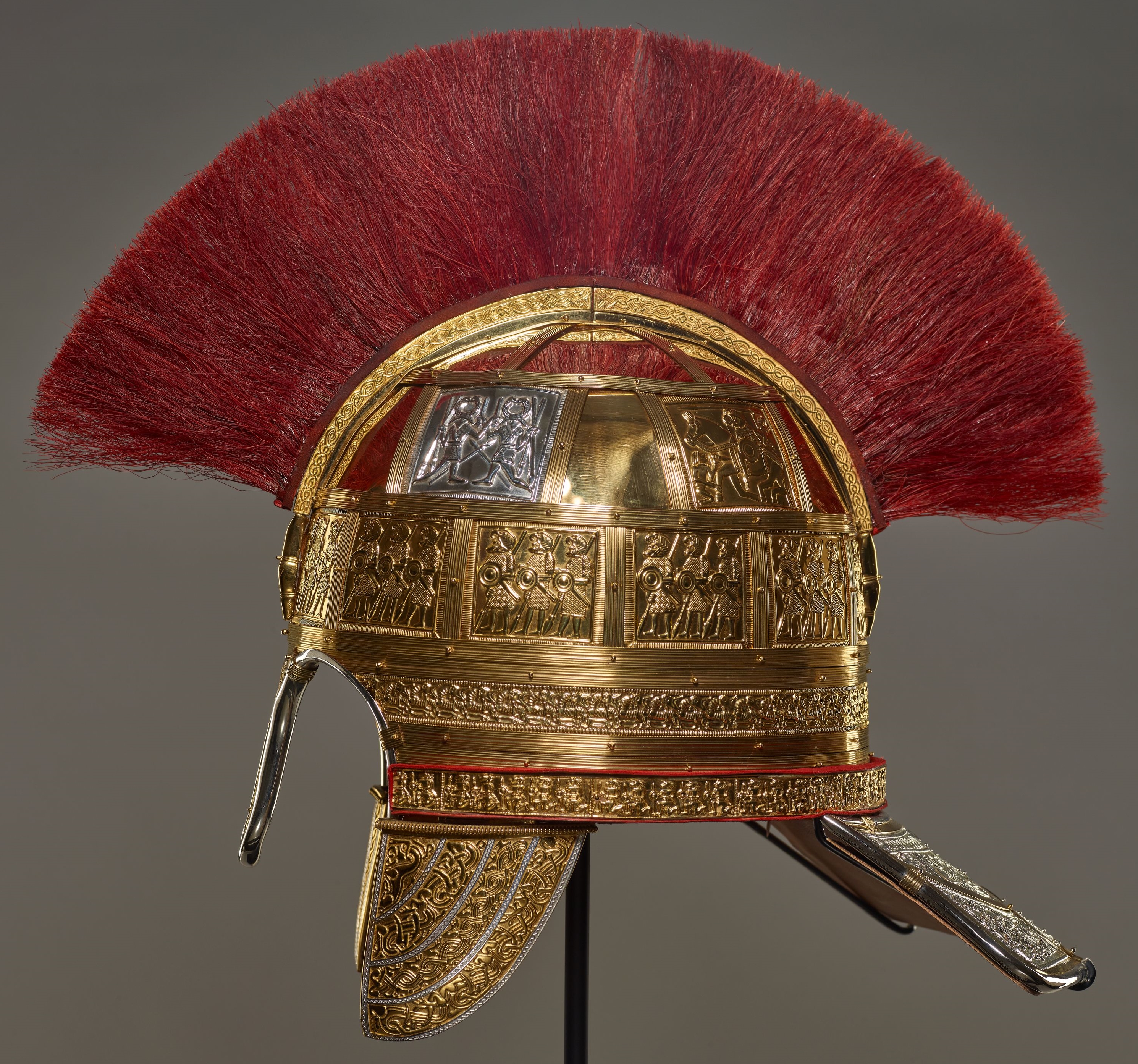
Pressblech foils were used to adorn elite armory like the helmets in the Sutton Hoo ship burial and Staffordshire Hoard. Some of the pressblech foils on the Sutton Hoo and Staffordshire Hoard helmets include a pair of figures that share striking features in common with the Lynsted die stamp. They wear the same horned headdress with bird-head terminals and long triangular ear flaps. They each hold two spears in one hand a sword in the other, although their spears point down and swords point upward. Their legs are bent and posed as if in movement.

These figures are known as “weapon dancers” and may have had some connection to the worship of Odin. They are most commonly found decorating foils, brooches, pendants and, more rarely, dies Denmark, Sweden and England.

Before this discovery, both the Sutton Hoo and Staffordshire Hoard helmets, the only Anglo-Saxon era helmets with pressblech foils found in England, were thought to have been imported, made in Sweden or Denmark. While their foils do not match the Lynsted die, its existence is evidence that in fact such refined examples of high-end metallurgy could have been manufactured in England. Of course, the die itself could have been imported, but the iconography does diverge in a key way from depictions of the horned figure found on Scandinavian artifacts: the spears point upwards, a feature found in English examples of the horned figure.

KCC finds liaison officer and Kent officer for the Portable Antiquities Scheme Dr Andrew Richardson said: “This small but remarkable find provides important evidence that helmets like the Sutton Hoo example could have been made in Kent, highlighting the skill and connections of early medieval craftworkers in the county.”

The die stamp has been declared Treasure and will now be assessed by the valuation committee. Once its market value is determined, a local museum will have the opportunity to acquire it for that sum. The Beaney House of Art and Knowledge in Canterbury is hoping to secure it for display close to where it was found.

Curse tablet with rare Greek inscription found in the Netherlands

An unusual lead curse tablet has been discovered in Heerlen, the Netherlands. It measures 9.3 x 4.8cm (3.7 x 1.8 inches) and dates to the second century A.D. Most of the curse tablets found in this part of the Roman Empire were written in Latin, but this inscription is in Greek written in the Egyptian style.

Curse tablets, called defixiones in Latin and katadesmoi in Greek, invoked the aid of underworld deities to “bind” an enemy or rival in business, court, sports or love. The curse would then be hidden in a place deemed to have the best access to the chythonic gods. The Heerlen tablet was discovered in a pit under the town hall square. The inscription was deciphered at the Institute for Papyrology of Heidelberg University using RTI (reflectance transformation imaging) technology, and its text is unusual both in language and in its targets.

What is particularly noteworthy about the tablet is the invocation of various deities and demons in the Egyptian style, composed in ancient Greek, since most curse tablets found in Northern Europe are written in Latin. In addition, the Heerlen curse tablet contains a group of three magical symbols, known as “Characteres”. According to Dr Ast, these were likely used to convey the desired message to the supernatural powers. They are followed by the names of two men and two women, who are referred to as fellow slaves. “The tablet served either as a curse against these four slaves or as a curse in their name against an unnamed person,” according to the Heidelberg papyrologist.

The composition of the group of people on the tablet is also unusual, according to the researcher, because it includes two men with Latin names and two women with Greek names. “It cannot be ruled out that one of the two women was the author of the inscription and had brought the supposed ability to communicate with divine powers through such curses with her from Roman Egypt,” says Dr Julia Lougovaya, Research Associate at the Institute for Papyrology.

When the study of the tablet is complete, the artifact will go on display at the Heerlen Museum.

Mosaic with rare depiction of river god found in Aspendos

Figural mosaic panel depicting the personification of the Eurymedon River, 3rd century A.D. Photo courtesy Andalou Agency.Archaeologists have uncovered a mosaic with a rare depiction of a river god in the ancient Greek city of Aspendos, in southern Turkey’s Antalya province. The mosaic dates to the 3rd century A.D. and has a central panel featuring a youthful Eurymedon, personification of the river the city was built on.

The founding legend of Aspendos dates the city back to 1000 B.C. when it was established by Greek colonists from Argos. Whatever the kernel truth in that origin story, by the 5th century B.C., Aspendos was minting its own silver coins and they were widely accepted throughout the Greek world for their reliable quality. Its location on the Eurymedon River just 10 miles from the Mediterranean coast made it an important stop for traders, and the city became wealthy from the trade in salt, olive oil and wood.

Ruled variously by Lydia, Persia, Macedonia and its descendants, Aspendos fell under Roman control in 190 B.C. Today its best-preserved remains date to the Roman imperial period, including the theater which is the best-preserved Roman theater in the world.

The mosaic was discovered in the East Square of Theater Street, the street that connects the theater to Aspendos Acropolis. The surviving mosaic floor is large, an estimated six meters wide and 25 meters long (20 by 82 feet), extending from the East Square to the city walls. About 7.5 meters (25 feet) of its length have been uncovered so far. Archaeologists are continuing to excavate the rest of it.

The figural panel depicts Eurymedon reclining the river, his arm propped on an amphora that has water flowing out of its mouth into the river. He is draped in a robe of vivid moss green, and fish swim in front of his extended leg. He holds a river reed in his right hand, and wears a crown of reeds or grasses. A variety of geometric patterns border the panel, including guilloche, floral scrolls and triangles, squares and peltas. A second large panel consists only of black and white geometric designs.

The structure the mosaic adorns is believed to have been a pool when it was built in the 3rd century. It was later divided into rooms after the building was damaged in an earthquake in 262 A.D.

The find points to a decorated urban area where water carried both practical and symbolic meaning. In a city closely tied to its river, such an image would have been immediately recognizable. […]

The mosaic was made with small stone pieces known as tesserae. The color transitions, balanced proportions, and detailed treatment of the figure suggest skilled craftsmanship.

River gods were familiar figures in Greco-Roman art, but examples in Anatolian mosaics are limited. That makes the Young Eurymedon mosaic especially important for understanding how local geography and civic identity were expressed in Roman-period art.