
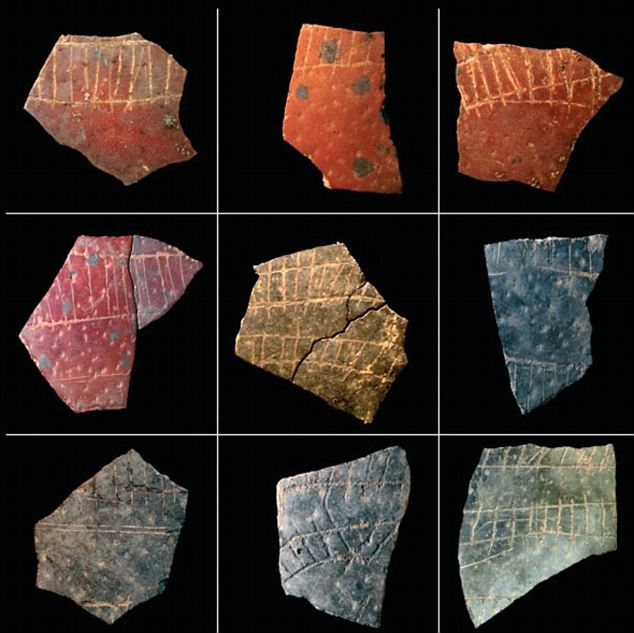
 Say that 20 times fast. :giggle: But seriously, folks, researchers studying the Diepkloof Rock Shelter in the Western Cape of South Africa have found hundreds of engraved ostrich fragments.
These fragments are 60,000 years old, far older than the earliest writing. The symbols engraved are regular lines and hatches and so many in number that archaeologists think they may be communicative, or at least symbolic, rather than just decorative.
“What is extraordinary at Diepkloof is that we have close to 300 pieces of such engravings, which is why we are speaking of a system of symbolic representation,” Dr Texier said.
The team, which includes Dr Guillaume Porraz from the University of Tubingen, tried themselves to recreate the markings using pieces of flint.
“Ostrich egg shells are quite hard. Doing such engravings is not so easy. You have to pass through the outer layer to get through to the middle layer,” Dr Texier explained.
Some of the engraved cross hatchings and parallel lines are similar to later known symbols for water. The ostrich eggs seem to have had spouts, which could indicate they were used for transporting water, a technological breakthrough for early man.
The fragments are also intentionally colored. They aren’t the natural color of the ostrich eggs nor is an external pigment applied. The team was able to reproduce some of the colors by baking fragments of shell in a fire.
Before these ostrich fragments, 30,000-year-old cave painting like those at the Lascaux Caves were thought to be the oldest evidence of written human communication. If we can confirm a communicative symbolism in these etchings, we’ll push that major milestone 30,000 years further back.
Just in time for Easter! :boogie:
OMG you should totally make some for your Easter Egg hunt! That would be the nerdiest thing you’ve ever done. I would be very proud.
I love that they colored them! Cool
I’m amazed they got so many different colors from baking the shells. They really look tinted.
😉 amazed how vivid archaeology is !
That’s the best part. 🙂
I’ve tried baking ostrish egg shells and it’s only turned out orange shades…… How did they get the different colors without some form of coloring??? Really, I’d love to know! DANIELLOFFREDO@YAHOO.COM
I’m afraid I have no idea on the details beyond what the article said, that different firing temperatures and cooking times resulted in different colors.
This is the most fascinating information I’ve read in a long time. The ostrich seems very sacred and ancient regarding it’s reverence from humankind. The date, 60,000 years old, merits great respect- not unlike each of these magnificent animals alive today.