 A new museum dedicated to the Roman epic poet Virgil has opened in Mantua, Virgil’s hometown, in a newly-restored 13th century palace. Visitors to the museum will have the opportunity to see art and artifacts related to Rome’s poet laureate in eight galleries, each dedicated to a different aspect of Virgil’s life and work, in a setting that is itself a rediscovered gem of medieval art.
 Publius Vergilius Maro was born a few miles from Mantua on the Ides of October, 70 B.C. From a family of some means in what was then Cisalpine Gaul (the Roman province of Gaul “on this side of the Alps”), Virgil was highly educated and published his first collection of poetry, the Eclogues, around 38 B.C. Its success garnered him entre into the literary circle of Octavian’s supporters. He wrote the Georgics between 37 and 29 B.C., then turned to his greatest masterpiece, the Aeneid, written in the last ten years of his life (29-19 B.C.). He died of illness in southern Italy and was buried in Naples, but Mantua was still very much on his mind in his final days. He wrote his own epitaph that was inscribed on his tomb: “Mantua me genuit; Calabri rapuere; tenet nunc Parthenope. Cecini pascua, rura, duces.” (“Mantua gave birth to me, Calabrians took it away; Parthenope [the Greek name for Naples] holds me now; I sang of pastures, farms, and commanders.”)
Mantua has boasted of its beloved native son since antiquity, a devotion that was amplified in the High Middle Ages when Virgil was a keystone of the intellectual and cultural revival known as the Renaissance of the 12th century. Dante made Virgil his guide and role model through Hell and Purgatory in the Divine Comedy.
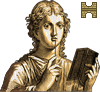
 Built in the thick of this revival in 1227, the Palazzo del Podestà was the seat of municipal administration for Mantua for hundreds of years. Virgil has always been part of the fabric of the building. It was called the Palazzo Virgilio at one point. A 12th century statue of Virgil in medieval doctoral robes with a writing desk on his lap adorned a niche in the façade. That has been moved into the museum now. The other niche holds a statue of the Virgin Mary, just to convey the elevated status the poet held (and holds).
 It has been home to several museums, a courthouse, even a prison since its retirement as a government building, but was heavily damaged in the two major earthquakes that struck Northern Italy in May of 2012. In 2017, the city embarked on a comprehensive campaign of repair and restoration of the huge palace which covers 97,000 square feet of space in 227 rooms on seven levels. The project cost 24 million euros and was completed at the end of 2023. Over the next year, part of the renovated palazzo was converted into a museum dedicated to Virgil.
 In the immediate aftermath of the 2012 earthquakes, a hidden treasure emerged during emergency shoring up works: medieval murals of high quality covering whole walls of the palazzo. They were explored, stabilized and conserved during the restoration project.
The images depict the months of the year through work scenes and astrological references, creating a bridge between the harmony of natural time and human life. This illustrated codex, with high didactic value, offers a visual experience capable of captivating both experts and casual visitors.
Alongside the Cycle of the Months, the walls of the Upper Masseria house frescoes depicting scenes from chivalric and mythological tales, including armigers in battle and centaurs. An enigmatic soldier with capride legs could represent, according to the hypothesis of Veronica Ghizzi, the museum’s director, a variation on the iconography of King Arthur, a symbol of mad and disorderly undertakings, in stark contrast to the harmony celebrated in the Cycle of Months.
The theme of nature, central to the Cycle of Months, relates directly to Virgil’s Georgics, where the poet celebrates agricultural labor as an instrument of peace and cosmic order. Virgil’s vision, which contrasts the harmony of celestial time with the chaos of human conflicts, finds a perfect representation in the medieval cosmology reproposed by the frescoes. The museum tour also allows visitors to see heraldic frescoes from 1473 and, in the Arengario, a frieze about a meter high, laid on white plaster, with insignia from the time of Federico II Gonzaga.
The Virgil Museum is not limited to frescoes, however: visitors can admire a number of artworks and artifacts related to the poet. Notable among these are the Virgil in the Chair, a 13th-century polychrome sculpture, and the Throne of Virgil, an artifact from the 2nd century BC. Also of great interest are Gonzaga coins bearing the poet’s effigy, a fragment of a 1540 fresco depicting his face, a bust of Virgil from the first half of the 16th century, and ancient volumes of his works. Each piece on display helps tell the story of the unbreakable bond between Virgil and Mantua, a connection that the museum aims to make tangible and accessible to all.


The Virgil Museum officially opened its doors on December 7th.
If I ever make it to Mantua – I’ll have to visit this place. I love that centaur carrying the soldier. I wonder what Virgil would think of winning the history lottery and being remembered/celebrated over two thousand years after his death.
A well-deserved museum! Thanks for all the great articles and photos!
Being from near Gräfenberg myself, I had no idea about the Bavarian nobleman Wirnt of Gräfenberg, who between 1202 and 1205 wrote an epic, entitled ‘Wigalois’, about the adventures of Gawain’s son, the name being a corruption of Guinglain le Galois.
Marrien lives in the Valley of Marvels and is revered by the humans who live nearby. He is described as having the upper body of a man and the lower body of a horse, i.e. not necessarily a goat, and he has knowledge of herbs and medicine.
When the hero, Wigalois, arrives in Marrien’s valley, he is attacked by a group of centaurs. Marrien comes to his aid and defeats the other creatures. He becomes a mentor, teaching him about the ways of the world and helping him on his quest.
There even are connections from what is today northern Italy to Bavaria/ Franconia. The Duchy of Merania was a fiefdom of the Holy Roman Empire from 1152 until 1248.
In 1180, Frederick Barbarossa transferred Merania to Berthold, the son of the count of Andechs, probably in order to maintain a balance of power and rank between the House of Andechs and the House of Wittelsbach.
…I found this excerpt in English:
Now listen more of this strange child,
Whose heart was pure and meek and mild,
For his father was a centaur,
Half man, half beast, a wondrous power,
Born and raised in that same land
Where Wigalois did first take stand.
The day he was born to this world,
He went to his father’s house unfurled,
A dwelling high upon a mount,
Where he was given full account
To serve his father faithfully
And never stray from loyalty.
And as he grew in strength and might,
He learned the ways of knighthood right
And all the laws of chivalry,
So that when he returned to see
His land once more and take command,
He led with wisdom at his hand
And all could see his worth and skill,
As he fulfilled his duties still.