An exceptionally rare runestone has been discovered in the village of Sandur on the Faroe Island of Sandoy. The stone had been built into the floor of a building in the archaeological site of Á Sondum. The runes have not yet been interpreted, but a runeologist is scheduled to examine the stone in August.
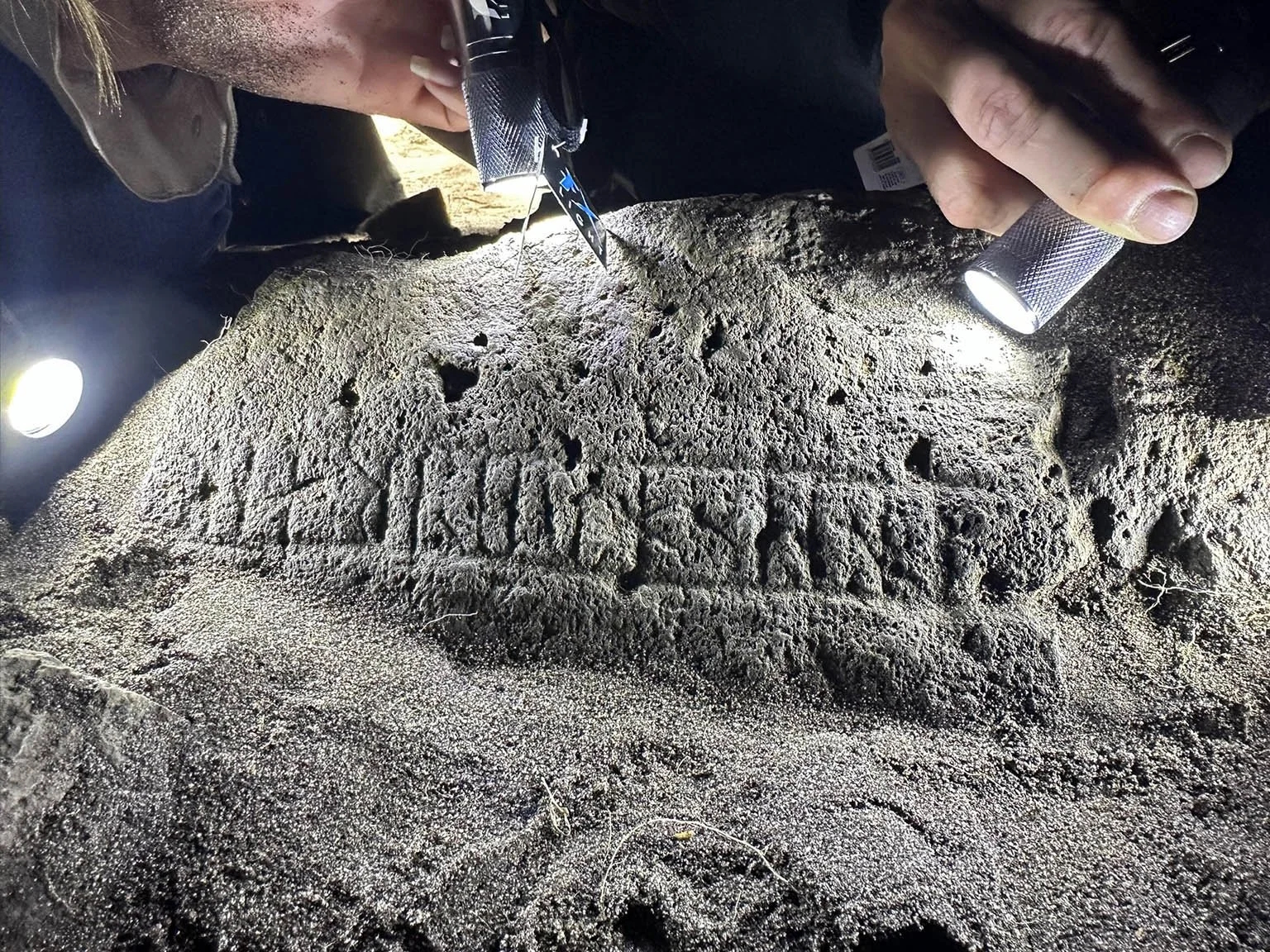
Meanwhile, National Museum archaeologist Helgi Michelsen believes part of the inscription reads “Her hvílur” which is Old Norse for “Here lies.” If that’s accurate, the stone may be a grave marker. Other artifacts found in the July excavation include Christian artifacts which suggest the building was a medieval oratory (prayer chapel), so a burial there would make sense.
The building faces east and west, and has an entrance at the west end. These architectural features are common in medieval prayer houses and chapels. Faroese examples of east and west-facing prayer houses with an entrance at the west end are the prayer house at Bønhúsberg in Mykines, Bønhústoft in Leirvík and the toft down at Bakki at Velbastaður.
Located in the North Atlantic Ocean north of Scotland, southeast of Iceland and west of Norway, the Faroe Islands show evidence of settlement going back to the middle of the 4th century and appears to have been populated by the 7th century.
Settlers from Norway and ones of mixed Norse and Gaelic heritage from Norse communities in Ireland and the Hebrides began to arrive in the early 9th century. They built farms, reared livestock, fished, gathered food, relying on imports from other Norse colonies for essential goods like timber, metal and tools. The settlers established a parliament based on the Norwegian model and local parliaments were established in largely self-governing regions.
Christianity was introduced to the Faroes by Viking chieftain Sigmundur Brestisson around the year 1000. He had been converted by King of Norway Olaf Tryggvason and brought Christianity to the islands as a stalking horse for centralized Norwegian rule. Local chieftain Tróndur í Gøtu was the main local of resistance, although he finally converted under violent duress, and it was only after his death in 1035 that the Faroe Islands were brought under the Norwegian crown as a tributary country. The islands became their own independent bishopric in the 12th century.
The stone has been moved to the National Museum for conservation under controlled conditions.
Indeed, there are more runes, and they even might be upside down (note e.g. the ᚱ!) – I wonder about the shape of that stone (the top of a column, maybe?), and why the letters were not transcribed first, in order to come up with a possible meaning.
Á Sondum is located in the village of Sandur, on Sandoy island. The 11th century, Sandur coin hoard contained 24 coins from England, 5 from Denmark, 1 from Hungary, 17 from Norway, but a whopping 50 coins from Germany (trade in sheep wool? sand?)
Boulders, stones, rocks, cliffs, and man-made tunnels – these are important aspects of the topography across the Faeroe Islands. Open air graves marked by a circle of big stones with a larger stone in erect position depicts the person buried was an important soldier died fighting. Similar is the grave setting for an elderly person but the larger stone in the middle is flat and not erect depicting that the incumbent died peacefully of old age.
In the latest Sandoy findings, the statues of Mary and Infant Jesus do suggest that migrating Catholic monks from Ireland and Scotland landmasses could have been the earliest settlers on the Sandoy island prior to the arrival of the Vikings.
Historically speaking migrant missionaries are known to carry religious articles with them to derive spiritual solace in times of hardships and later to use such devotional objects for spreading their brand of spirituality among the neophytes.
Runestones such as the Kirkjubøur stone found in the Saint Olav Church, the Sandavágur stone found in the Sandavagur Church and the Fámjin stone located in the Church of Famjin – they are connected to the early Faeroe Church History.
The meanings behind the runic inscriptions carved on the stones could very much be some sort of prayers, spiritual admonitions, and rules for smooth on-going-ness and togetherness, that for the modern secular mind that is well-versed in freedom and human rights mindset, could look more like magical formulas.