Export barred on tiny rare Anglo-Saxon mount

A tiny Anglo-Saxon decorative mount has been barred from export by the UK’s Department for Digital Culture, Media and Sport. It is approximately 1,400 years old and made of gilded copper-alloy. It depicts a four-legged, long-snouted animal that looks like a horse with his head down. Those four legs are what makes it so rare. Typically Anglo-Saxon ornaments from this period are so stylized that they don’t have simple anatomical outlines like that.

The mount was discovered in Holme Hale, Norfolk, by a metal detectorist in 2024. Even though it is tiny, just 3cm (1.2 inches) long and weighing five grams, it is finely detailed and the gilding is preserved almost over the entire obverse side. The reverse is ungilded and has the pierced stubs of two lugs, indicating it was originally attached to something.

Despite its historical significance, the object was either deemed not to qualify as official Treasure, or it was released back to the finder. It was the finder who applied to the government for an export license after arranging a sale overseas.

The Reviewing Committee on the Export of Works of Art and Objects of Cultural Interest (RCEWA) determined the mount met the criteria defining it as a national treasure whose connecting to British history makes it important to keep in the country, if at all possible.

RCEWA committee member, Helen Jacobsen said:
“Physical artefacts play a hugely important role in enabling us to study the lives and cultural practices of the early medieval period. This object is of particular significance for research into the early Anglo-Saxon kingdoms because of its unique form and very rare imagery. Further study will shed light on its function and on the transmission of artistic styles, materials and iconography in southern Scandinavia and eastern and south-eastern England during the late 5th and 6th centuries. It will be a huge loss if it cannot be saved for the nation and I hope very much that a home can be found for it in a national museum.”

The temporary export ban gives a UK museum or gallery until November 3rd of this years to raise £1,054, plus £40.80 VAT ($1,480) to acquire the item and keep it in the country. If a purchase agreement is signed even though the fundraising hasn’t reached the goal yet, there will be a three-month extension to the ban.
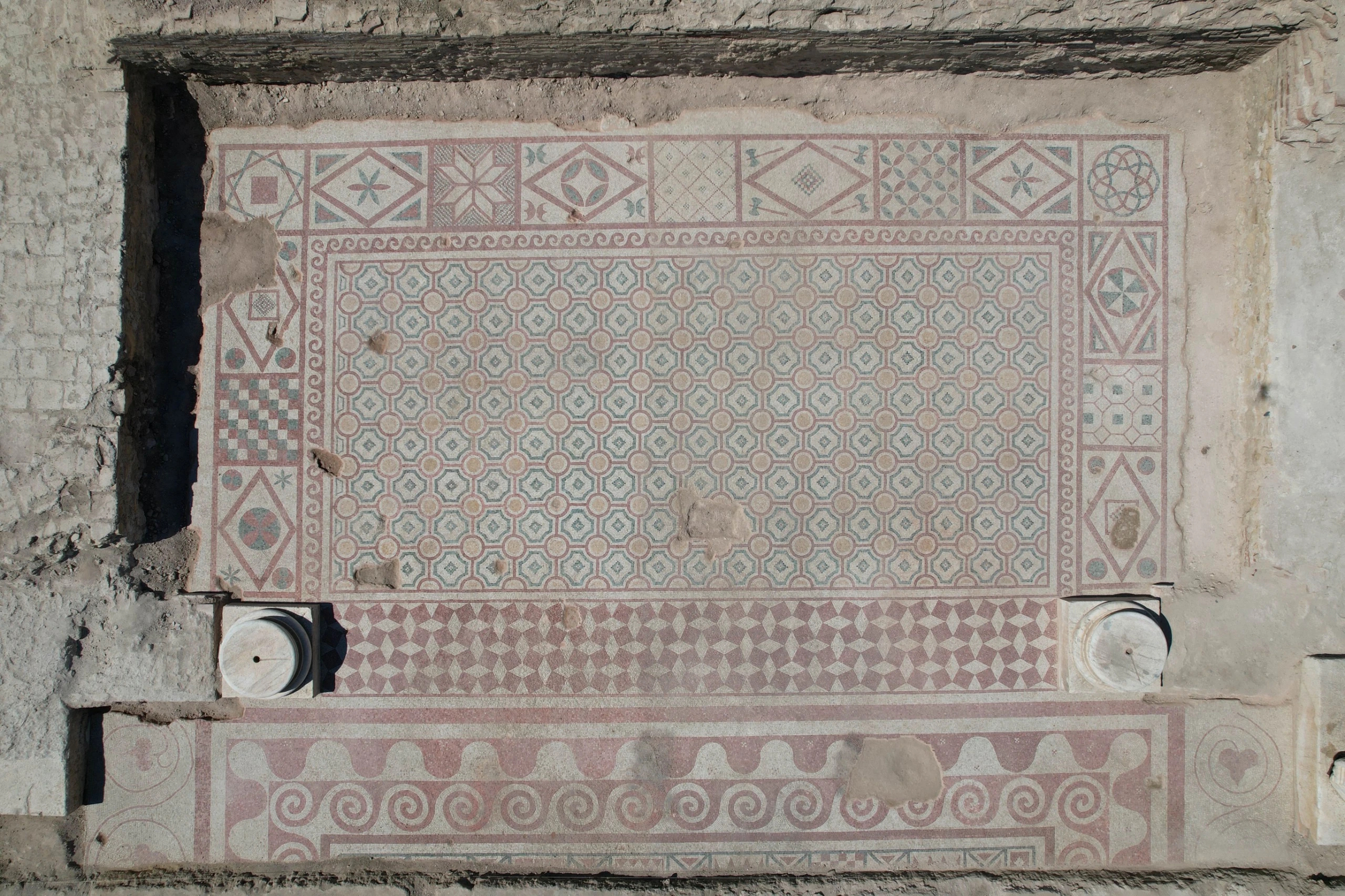
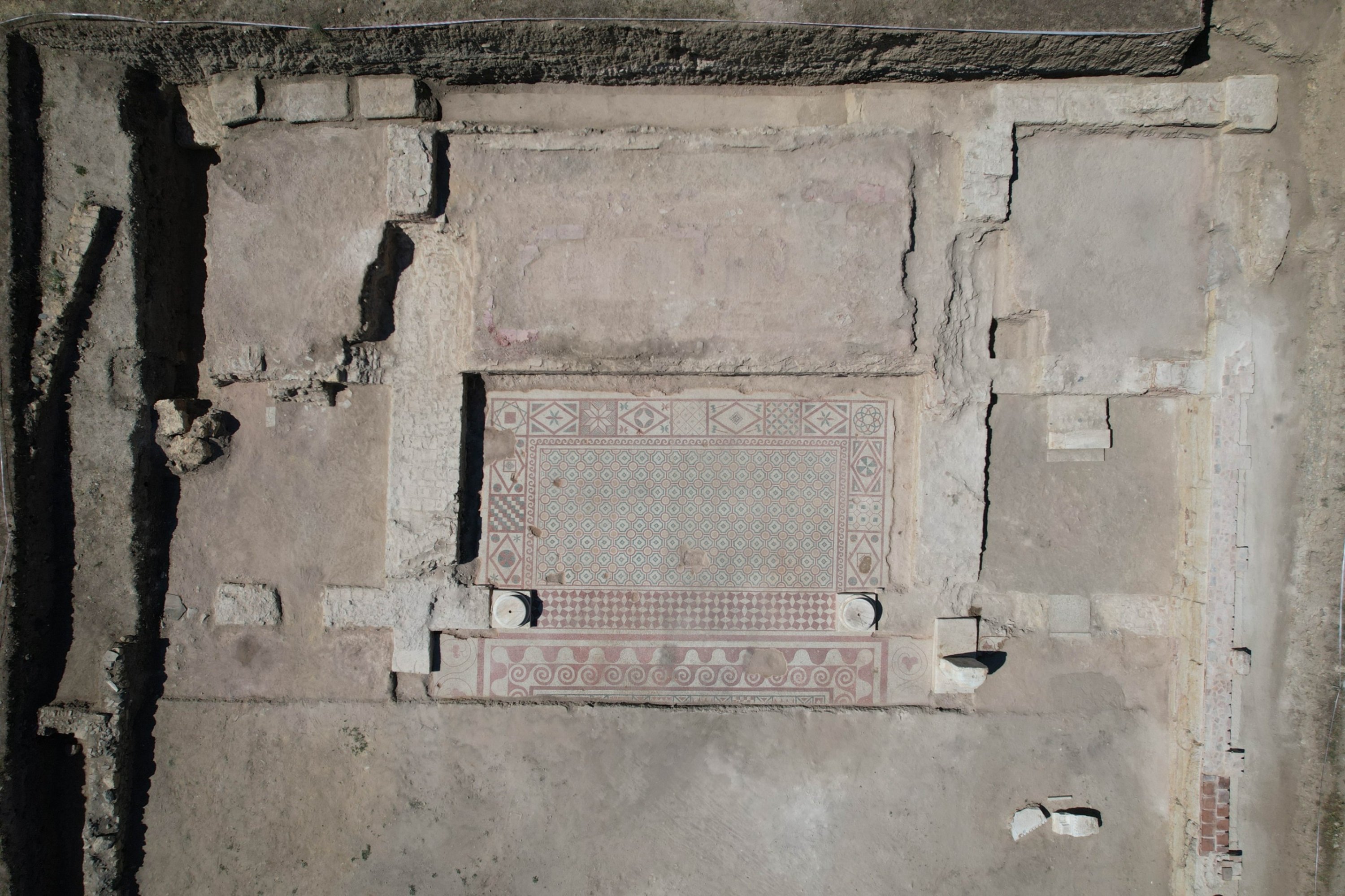
4th c. mosaic floor, 2nd c. Eros head found in Pompeiopolis basilica

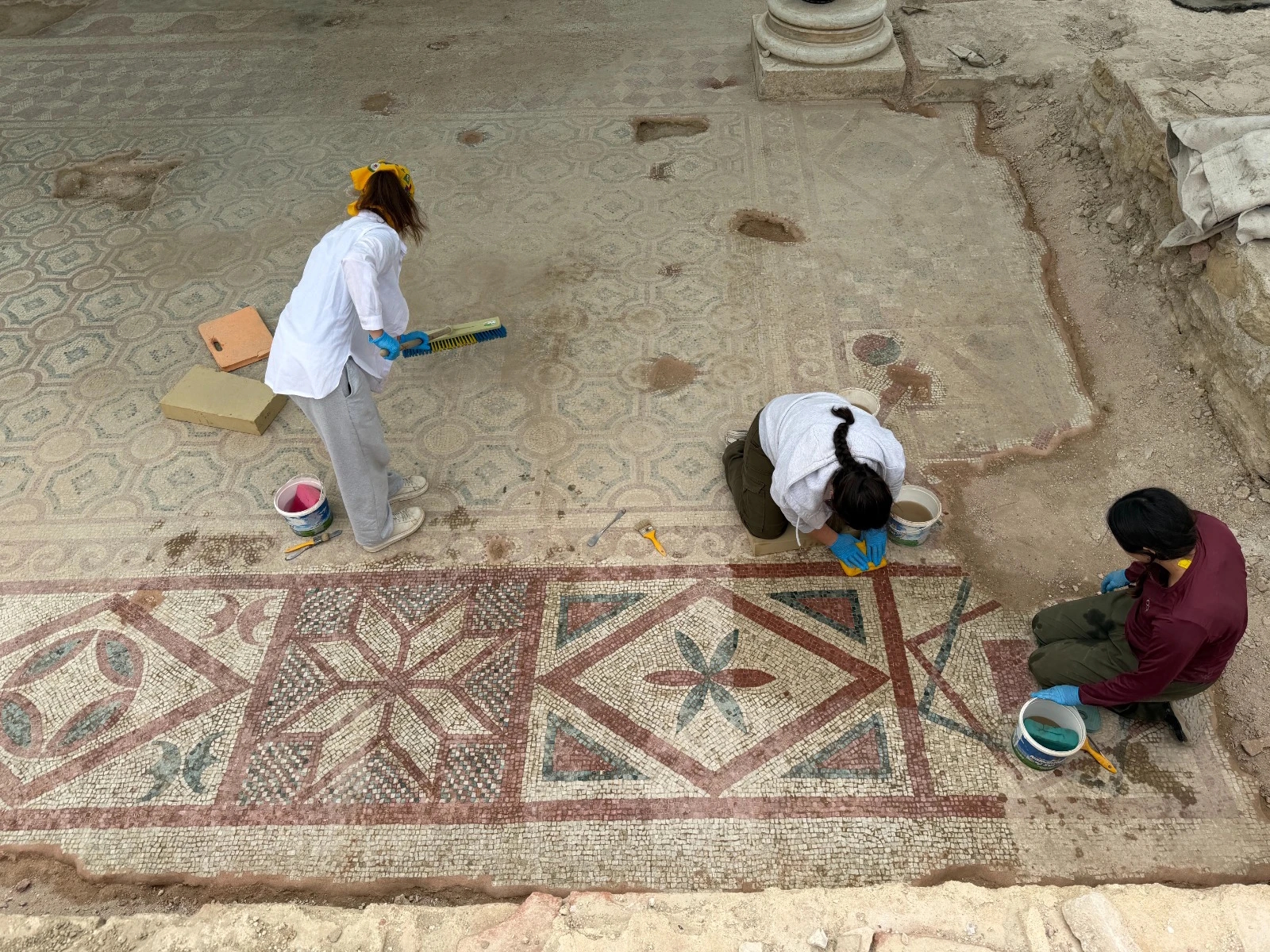
An intricately patterned mosaic floor in beautiful condition has been unearthed in ancient Pompeiopolis, on northern Turkey’s Black Sea coast. The mosaic is about 105 square meters (1,130 square feet) and is decorated with intricate geometric patterns, including double-headed axes, wave motifs, diamond shapes, overlapping rings, hexagons, spirals and more. It dates to the 4th century A.D.

Pompeiopolis was the capital of the Roman province of Paphlagonia in the 2nd century A.D. Between 150 and 160 A.D., a basilica was built in the provincial capital. This was a large public building where civic business was transacted. Constantine used the floorplan of the traditional Roman basilica for the original St. Peter’s in Rome, and other Christian churches followed in his footsteps.

Historians believe that Pompeiopolis became an episcopal see in the 4th century, and the basilica would have been repurposed into a church shortly thereafter. It remained a religious center until the 13th century when the region was conquered by the Seljuk Turks.

The 105-square-meter mosaic belongs to that second life of the building. Dated to the 4th century, it decorates the basilica’s central nave. Ersoy has noted that the pavement isn’t complete — more of it likely lies beneath still-unexcavated ground — and that conservation work has focused on stabilizing what’s already exposed before digging further. In other words, 105 square meters is what’s been documented so far, not the floor’s original size, which was almost certainly larger.

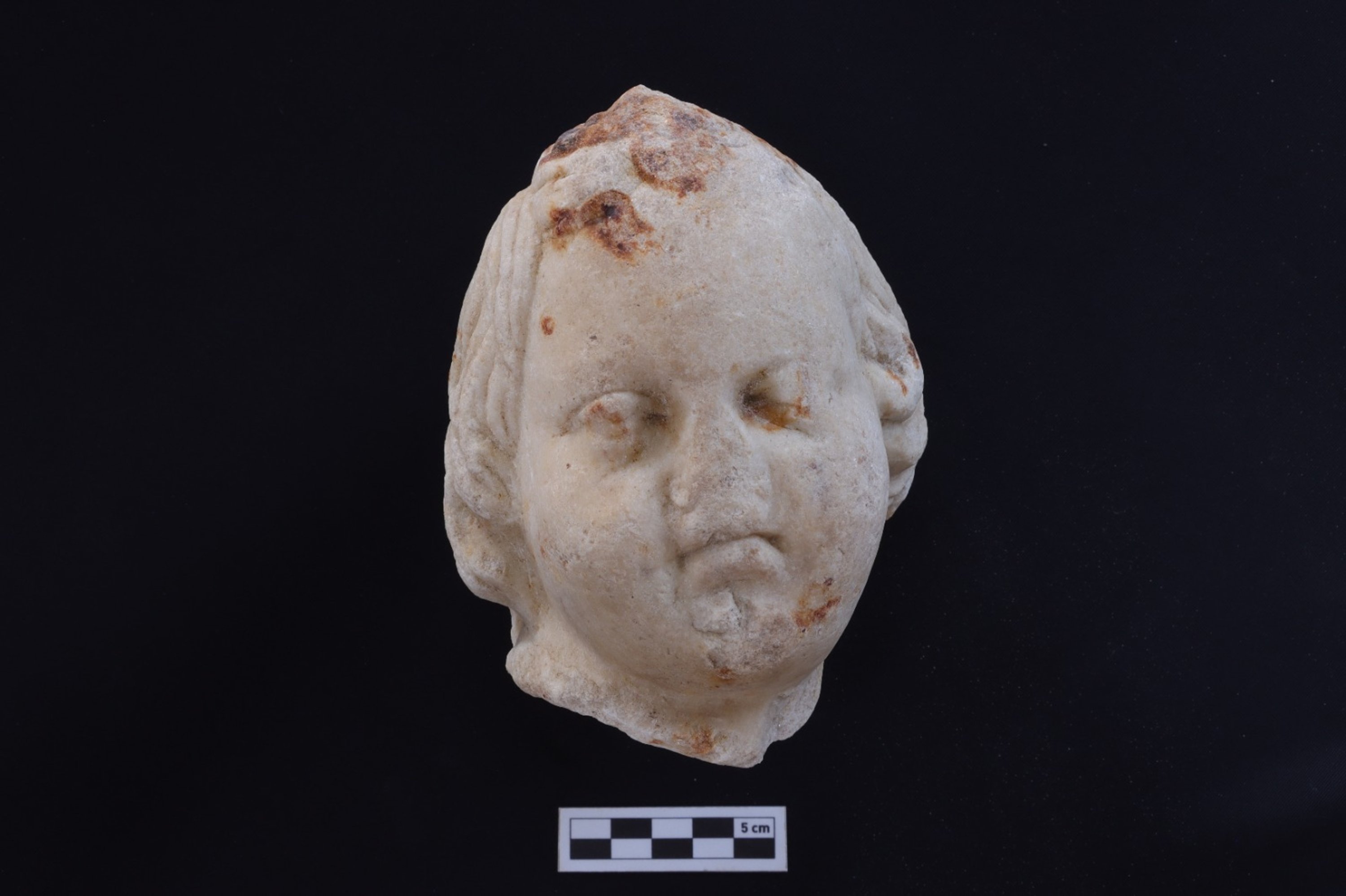
The excavation also uncovered the head of an Eros statue in the basilica. It dates to the second half of the 2nd century A.D., so before the building was a church. It was found in the pastophorium, a small side chamber next to the altar where liturgical objects were kept.

A statue of a pagan god of love, tucked away next to a church altar, says something about how these transformations actually worked: older material wasn’t always destroyed when a building changed hands between religions. Sometimes it was simply moved out of the way. For researchers, the piece now offers concrete evidence about the artistic and cultural life of Pompeiopolis during the Roman imperial period, when several local families rose into the senatorial aristocracy at Rome.

Largest Roman wall mosaic revealed under Trajan’s Baths

The largest ancient wall mosaic in the city of Rome, and probably the largest in the Roman world, has been revealed to the public for the first time with the opening of the new Museum of the Baths of Trajan. Known as the “Muse and the Philosopher,” the mosaic adorns a huge wall on the Oppian Hill overlooking the Colosseum. It is 10 meters high and 16 meters wide (33 x 52.5 feet) and depicts an architectural structure believed to be a two-tiered theatrical background (the scaenae frons) with columns, walls that looks decorated with inlaid marble, statues and figures including Muses, a bearded philosopher and Apollo himself.

The Baths of Trajan was an enormous bath complex built by the Emperor Trajan in 109 A.D. Covering an area of 80,000 square meters (15 acres), the complex was the first Roman bath to create an outdoor park for people to use, along with the bathing and athletic facilities that were customary. It used the remains of Nero’s opulent Domus Aurea palace as its foundation. The mosaic wall dates to the 1st century and is not believed to have part of the Domus Aurea, but many of its tesserae are missing, likely taken for use during the construction of the baths. Most of the Great Mosaic was discovered in 2011, but recent excavations have uncovered a new section that shows a view of maritime villas on a Roman port in absolutely incredibly detail. It’s not clear whether this is a real port being depicted or an ideal one.

The excavation of the mosaic is not complete yet, but cultural heritage authorities decided to open the underground gallery and exedra of the Baths of Trajan to the public for the first time this weekend. For now, admittance will be limited to a few days a week and only to small groups of ticketed people. Tours will be guided and free and charge, but must be reserved ahead of time.

Also in the same structure is the largest wall fresco ever discovered from the Roman era. Dubbed the Painted City, it presents a bird’s eye view of a city encircled by walls and towers. The buildings inside are painted in perspective.

Complete with high walls, towers, gates, a theatre and golden statues, the city is surrounded by the sea. Bustling neighbourhoods are painted in such detail that the windows of houses are clearly visible. “If it did exist, it was extremely important,” Claudio Parisi Presicce, Rome’s heritage chief, said.

It was first unearthed in 1997 and has now been restored. A walkway connecting to the spaces has been built above the room so people can see the works up high. The museum also houses huge lead pipes (fistulae) that supplied water to the Baths of Trajan.

Pyramid of Cestius reopens to visitors with new lighting

The Pyramid of Gaius Cestius reopened to the public last week after three years of renovations. Scheduled admissions are being offered free of charge through the end of October both by day and in the evening so visitors can see its bright white marble cladding illuminated by a new lighting system. The interior has new lighting as well. The restoration project also improved accessibility at the entrance gate, stairs and pathway to the pyramid. It renovated the green area of the park and most importantly, it refurbished the spaces inhabited by the iconic feline community at the base of the pyramid.

The funerary monument was built around 12 B.C. in the Ostiense necropolis outside the Servian walls of Rome on the ancient consular road that led to the sea port city of Ostia. Pyramids were all the rage after Augustus’ conquest of Egypt in 30 B.C., and ancient sources record several of them in having been built in Rome. This is the only one to survive.

It was commissioned by the former praetor and tribune of the plebs Gaius Cestius to hold his ashes in a single inner chamber, modestly painted white walls and small frescoes of winged Victories and ceremonial vessels. Due to a sumptuary law passed by the emperor Augustus in 18 B.C., there were no lavish grave goods, much to the disappointment of the looters who tunneled into it in the Middle Ages.

It was constructed of brick-faced concrete clad in brilliant white Carrara marble slabs. About 100 feet square at the base and 120 feet high, the pyramid has a far steeper incline and sharp point than the great Egyptian monuments that inspired it. The poet Shelley aptly described it as “one keen pyramid with wedge sublime… Like flame transform’d to marble.”

When the Aurelian walls were built in the 3rd century to encircle the expanded perimeter of the city, the pyramid was in their path, so it was simply absorbed into the walls. This fluke of location is why it is the only vanity pyramid to still standing today.

Exceptional private bath found in imperial palace tower

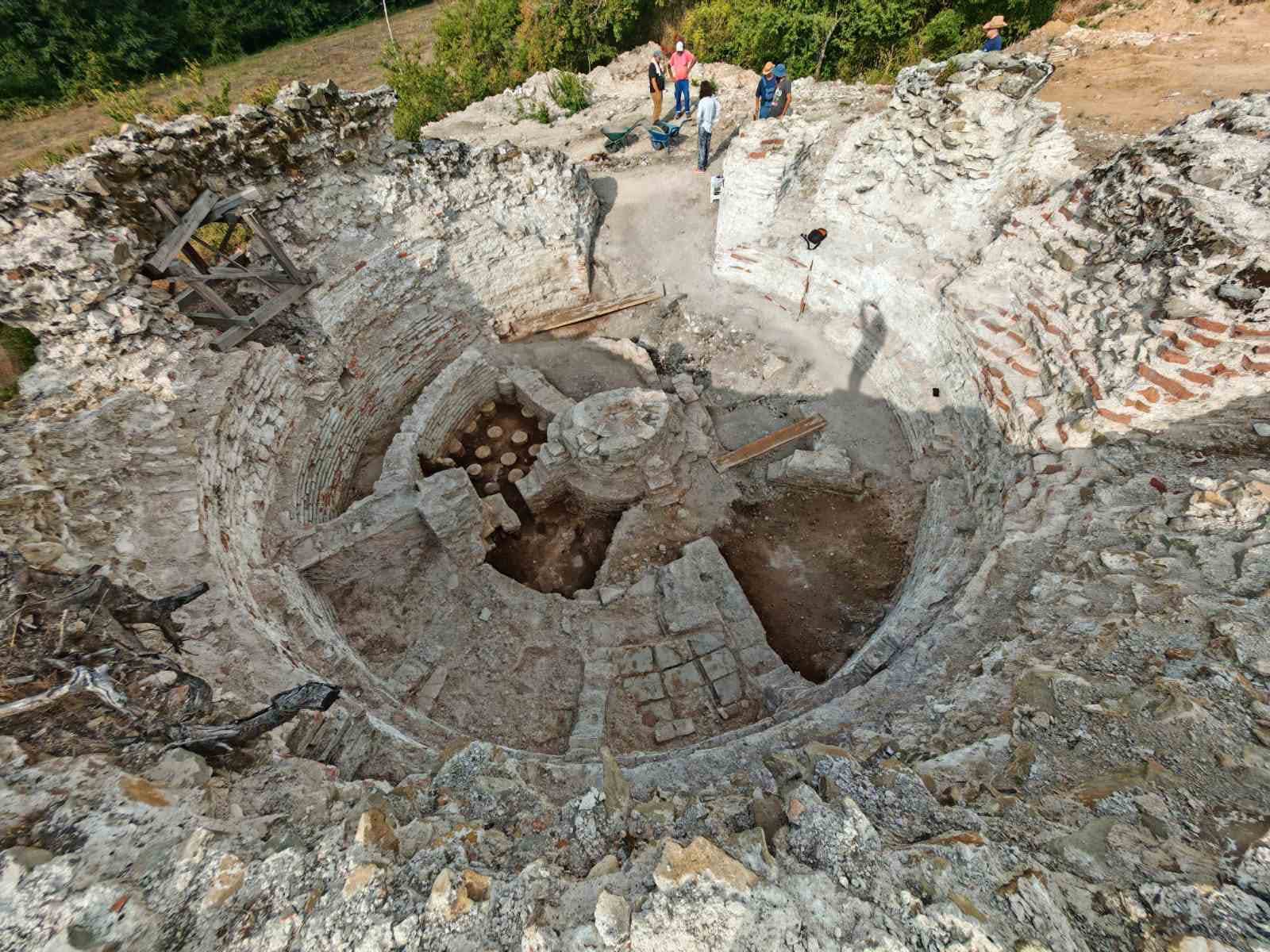
A unique private bath has been discovered at the fortified palace of Roman Emperor Maximinus Daza at the Vrelo-Šarkamen site, near the town of Negotin, Serbia. The imperial balneum (private bath) was located in the bottom floor of the palace’s southwest tower, part of the defenses of the villa. There is no other known example of a private bath installed in a defensive tower in Serbia or anywhere else in the former Roman Empire.

What makes this bath so unusual is its design: it is circular, like the tower itself, and was divided into two areas: an equipment room that contained all the heating mechanisms and a suite of rooms with three pools and a sudatorium (sauna or steam room). The technical section contained a praefurnium, the furnace chamber used to heat the floors of bathing rooms. The base of the copper boiler used to heat the water for the hot pools was discovered there, although the boiler is gone, probably melted down for reuse in antiquity.

Of particular importance is the exceptional state of preservation of the hypocaust system, with its circular pilae, through which hot air circulated under the floors of the various rooms. This level of preservation of the heating system, along with the very discovery of the imperial balneum, represents an extremely rare archaeological find and provides invaluable data for understanding the operation of the thermal complex. […]

The personnel in charge of maintaining the bath and feeding the praefurnium accessed the technical sector of the tower from the western side, through a monumental entrance. This layout allowed the service area to be separated from the part of the balneum intended for the residence’s occupants.

Born in Felix Romuliana, near modern-day Gamzigrad, Serbia, in what was then the province of Dacia, Maximinus Daza was adopted by Galerius, his maternal uncle when he became Augustus of the eastern Empire in 305 A.D. (The Tetrarchy, the system that divided the Roman Empire into an Eastern and Western Empire each ruled by a senior emperor (Augustus) and a junior emperor (Caesar) was established by Diocletian in 286 A.D. to stabilize government after the Crisis of the Third Century.) Maximinus Daza was Eastern Caesar under Galerius from 305 A.D. until 310 A.D. He began to style himself Augustus a year before Galerius died, but divided the Eastern Empire with Licinius and was constantly in conflict with him. Daza was defeated conclusively at the Battle of Tzirallum (modern-day Turkey) in April, 313, and died a few months later.