2,500-year-old iron fibula found in Poland

A rare heavy bronze brooch dating back 2,500 years has been discovered near the village of Śniatycze in the Lublin Voivodeship of southeastern Poland. It is only the fifth fibula of this type to be found in Poland, and the only one of them not to have been found in a grave of the Lusatian culture.

Discovered by a metal detectorist working with the official permission of the Provincial Office for the Protection of Monuments in Lublin, the fibula is 7cm (2.8 inches) long and 2.4 cm (1 inch) wide at the widest point of the almond-shaped bow. The top surface of the bow is decorated with two parallel lines. One end of the bow bends down into a sheath for the fastening needle. The sheath then bends back upwards and is topped by a button shield 1.4 cm (.6 inches) in diameter. The spring and needle are lost, but the rest of the brooch is intact.

The shape, massiveness and decoration identifies it as an ornament of the last period of the Lusatian culture, the Hallstatt D period (ca. 550-400 years B.C.).

‘This find is of great importance to archaeologists. Both from a conservation point of view, because we have a new archaeological site and it may be a Lusatian culture cemetery, and from a research and cognitive point of view’, says Wiesław Koman, an archaeologist from the Zamość branch of the Provincial Office for the Protection of Monuments in Lublin.

The metal detectorist who found the fibula also found two medieval weapons in the same location: an iron flail head and an iron battle axe.

Scientists date the flail head, an early medieval weapon, to the 11th-13th century. The object has a rounded body, approx. 7 cm long and approx. 2.7 cm thick, and a large hole for attaching a rope or strap. There are visible signs of damage on its surface.

The iron battle axe is dated to the 13th-15th century. The weapon is 15 cm long, has a slightly arched blade – up to 6.7 cm – and a head measuring 3 by 2.5 cm. Scientists assessed the condition of the axe as very good.

Archaeologists plan to return to the site to survey it thoroughly. The artifacts discovered thus far will be transferred to the Zamość Museum.

17th c. Japanese sword found in bombed out Berlin cellar

German archaeologists made an unexpected discovery in an excavation of Molkenmarkt, the oldest square in Berlin: a 17th century Japanese short sword. It was found in the winter of 2022 in the former cellar of a residential building destroyed in World War II. At that time, archaeologists thought it was a military parade sword, and only realized its far more exotic origins after conservation uncovered its details.

The cellar had been filled in with war rubble during the reconstruction of the street. When the Berlin State Office for Monuments archaeologists cleared the rubble and reached the cellar floor, they found all kinds of military gear — harnesses, bridles, stirrups — and one heavily corroded sword. The objects were sent to the Museum of Prehistory and Early History for conservation and analysis.

Restorers cleaned the surface of dirt, corrosion materials and char from World War II bombs, revealing that the “parade sword” was in fact a Wakizashi, a Japanese short sword. It had been severely damaged by heat, but remarkably, the wood grip, fragments of textile wrapping and ray skin still survived. The face of Daikoku, one of the seven gods of luck, was found engraved on the slender handle ferrule.

X-rays showed that the blade, now 10 inches long, had been shortened and the handle was likely added later. The imaging also showed two holes in the tang, but only one of them had a pin and was being used to attach the handle to the blade. This suggests the shortened blade is significantly older than the handle, perhaps even dating back to the 16th century.

How the Wakizashi, the possession of which was once reserved for dignitaries as a status-related weapon, ended up in a filled-up basement of a Berlin residential and commercial building can only be speculated at this point. Perhaps the sword was a gift from the Takenouchi Mission in 1862 or the Iwakura Mission of Japanese ambassadors who visited Europe and the rest of the Western world eleven years later to build relationships and gather impressions. The spatial proximity of the Molkenmarkt with its surrounding aristocratic palaces to the Berlin Palace suggests this. Wilhelm I received the Japanese embassy of the Takenochi Mission in the palace when he was still king, and in 1873 when he was emperor he received the embassy of the Iwakura Mission. However, the origin of the sword cannot be linked to the biographies of the then house owners of Stralauer Strasse at Molkenmarkt.

The sword went on display for the first time at Berlin’s Samurai Museum last night for a few hours as part of the Long Night of Museums, and will soon be exhibited at the PETRI Berlin archaeological museum.

Copper Age cist tomb unearthed in Valtellina

Archaeologists have unearthed a prehistoric cist tomb at the site a new primary school gym in Berbenno di Valtellina, a town in northern Italy’s Lombardy region. The tomb contains the remains of at least two individuals and preliminary dating indicates it is at least 4,000 years old.

The cist, the first of its kind found in the Valtellina area, is a rectangular cut lined with stone slabs. One of the slabs is much older than the tombs: it is around 5,000 years old and is a stele, shaped and engraved with several objects that suggest it represents a male type. It may have originally been part of a standing stone alignment in a sanctuary. The burial was originally surrounded by a stone circle and likely a mound.

“It can certainly be said that what is emerging from the excavations represents one of the most important archaeological discoveries ever made in Valtellina – says Stefano Rossi, archaeologist of the Superintendency – Several artifacts recovered since the nineteenth century had already indicated that human presence in Berbenno dated back at least to the Bronze Age, but these new findings move the frequentation of the area back at least a thousand years. In particular, the stele statue constitutes the most western testimony of this important cultural phenomenon, dating back to over five thousand years ago. I thank the municipal administration that, understanding the importance of the site, is working to deal with the costs and delays caused by the excavation operations. I am sure that the current inconveniences will be amply repaid by the importance of these findings”.

Update: Museum acquires Roman gold bracelet found by 11-year-old boy

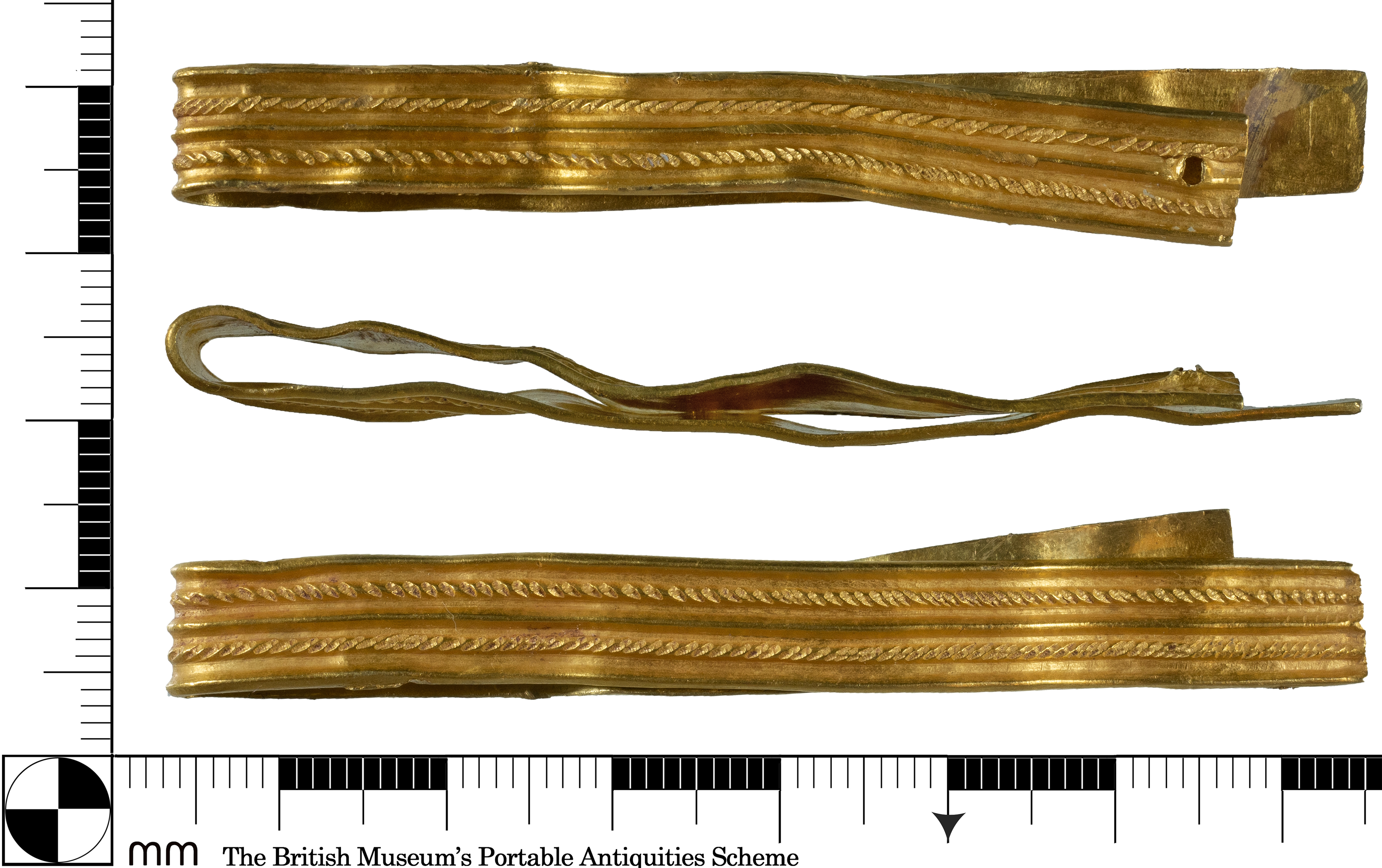
The Novium Museum in Chichester is the proud new owner of the Roman gold bracelet discovered in 2022 by an 11-year-old boy walking the dog with his mother. The gold jewel dates to the 1st century A.D. and is a rare cuff of the armilla type, a battle honor given to Roman soldiers for bravery. Most of the ones that have been found are bronze; this is only the fourth gold example recorded in the Portable Antiquities Scheme database.

It was Rowan Brannan who spotted the glint of gold, and Rowan who insisted it was real gold and took it home over the objections of his mother. Rowan researched it further when he got home, and with the support of a metal detecting family friend, he reported it to the local Finds Liaison Officer. Archaeologists confirmed not only that it was real gold, but that it was an authentic Roman artifact.

The armilla was declared official treasure at a Coroner’s Court earlier this year. Rowan and his mother Amanda were kept in the loop throughout the process. The British Museum’s valuation committee then determined its fair market value, and a local museum close to the find site was given the opportunity to acquire the piece for the assessed value. That sum would then be split between the finder and the landowner.

The Novium Musem was able to raise the money with a grant from Arts Council England/V&A Purchase Grant Fund. The armilla will go on display at the museum on September 10th.

Chichester District Council leader Adrian Moss said:

“Acquiring this bracelet for The Novium Museum’s collection will help shed light on military attitudes, including how Roman soldiers were rewarded for their bravery, gallantry and service, particularly with regards to the Roman invasion of Britain in AD43.

“This piece will widen our museum team’s understanding of Roman life locally and allows us to tell a different story from the Roman period.”

Roman wood wells found at Iron Age settlement site

An excavation at the site of future highway improvements in Cambridgeshire has unearthed two Roman wooden wells so well-preserved they reveal an engineering failure and its correction. The first well collapsed; the second was built with reinforced walls to keep it from suffering the same fate.

A team of archaeologists from the Museum of London Archaeology (MoLA) found the wells during an excavation of a known Iron Age settlement that was founded around 350 B.C., long pre-dating the Roman conquest. After the Roman occupation began in 43 A.D., the sleepy farmstead shifted to industrial activity. The team found a large gated enclosure containing archaeological evidence of metalworking and carpentry.

The new activities required water, so the Romano-Britons set to digging a new well. They had to dig a lot — almost 28 feet down — to reach water for the first well. They built a square timber well but it collapsed before it was ever in use. The wooden ladder was left inside and the well abandoned. The second time around, they only dug down 21 feet, and they used flat wooden boards to line the well. It also had stones at the base to filter the water drawn from the thick clay soil. It too eventually was abandoned. It contains offcuts, wood chips and sawn branches, evidence that the former well was being used as a dump by carpenters. The quantities of discarded waste wood attests to the presence of a substantial industry here.

The contents of the well will now be carefully studied by specialists. Some of the larger pieces of wood even have decoration, including horizontal lines and crosses, which could offer a clue as to what was being produced here.

While work is ongoing to uncover exactly what the Roman carpenters were making, MOLA archaeologists have found evidence which suggests the workshop was part of a wider trade network. At the very south of the site, the team has identified a likely Roman road. This would have connected the site with major Roman routes, so they could have supplied large settlements such as Godmanchester, and nearby villa rustica (Roman countryside estates).