Phallus fingernail cleaner found in Gloucestershire

Of the many, many, MANY Roman phallus finds I’ve written about over the years, this is a first: a Roman nail cleaner on one end and a phallus on the other. It was discovered near Cheltenham in Gloucestershire, during a preventative archaeology excavation ahead of improvements to the M5 highway junction.

The fingernail cleaner has a flat blade, rectangular in cross-section, with a groove running down the center of its full length that opens to a double-pronged terminal. The forked end was used to clean under fingernails. The top of the blade is mounted to the base of the phallus, welcomed by a pair of spherical testicles. The shaft the phallus tapers in slightly from the wider base, then widens again at the glans. A hanging loop is mounted on the top side of the phallus about midway down the shaft.
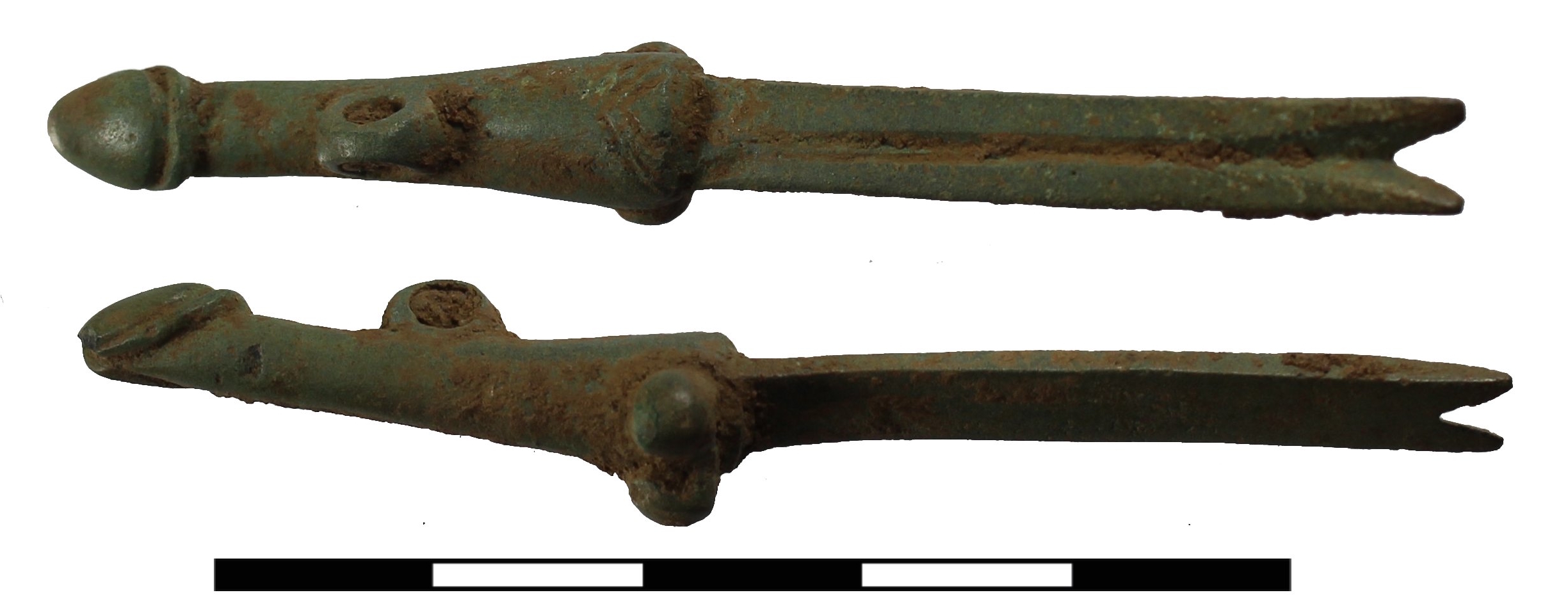
This type of cleaner dates to around 300-400 A.D. and examples of them have been found in Gloucestershire, Leicestershire and Lincolnshire. None of them had a phallus attached however, which makes this tool perform a double function. It’s both a fingernail cleaner and a talisman that protects the wearer. In Roman culture, phalluses were believed to hold apotropaic powers: the power to ward off evil, curses and bad luck.

A second notable late Roman artifact was unearthed near the phallic manicure tool: a copper alloy belt buckle. A long rectangular plate of sheet metal was bent around the flat part of a D-shaped buckle and riveted together at the ends with two rivets. This design allows the buckle to rotate in the looped plate and move comfortably when worn.

The plate is decorated with a border of overlapping dots to create what looks like a straight line. Open circles with dots in the center are stamped all along the border lines. The center of the plate is stamped with the same circle and dot motif, but this time they’re placed in rows of two and three and connected with straight lines. This gives it a foliate, vine-line look. The apex of the curved side of the D is also stamped with circle and dots and a lozenge shape.

Tiny mammoth ivory bird figurines found at Hohle Fels cave

The Hohle Fels Cave in the Swabian Alps of southwestern Germany has yielded two more mammoth ivory figurines: tiny birds that despite their small size are carved with intricate anatomical details. One of them is a bird at rest, the other with wings outstretched, although one of the wings has broken off. They weigh just 1.3 and .7 grams each and may have been carried as talismans by the hunters who occupied the cave 40,000 years ago.

The newly discovered birds are remarkably small. At two centimeters long, one centimeter wide, and half a centimeter high, the bird with outstretched wings is even the smallest of all the Ice Age artworks known to date in the World Heritage region. Most other Ice Age figures measure between three and nine centimeters. Despite their small size, the birds are exceptionally well-crafted: the resting bird has striking round eyes, the other a distinctive beak, and parallel markings on its wings that represent the bird’s plumage. “Here, the mammoth tusk wasn’t simply used to create some simplified form of a bird’s body,” says [research director Professor Nicholas Conard from the Department of Prehistory and Early History at the University of Tübingen], “here, precise observations of nature were translated into figures whose wealth of detail even allows for an examination of which bird species is depicted and what it is doing.”

While the majority of the Ice Age animal figurines are depicted in a static pose, the bird figurines exhibit specific behaviors. Professor Conard’s team interprets the resting bird, with its outstretched, flattened posture, head drawn close to its body, and legs tucked in, as possibly brooding. For the animal with the widely spread wings and elongated neck, interpretations range from flying or landing on the water to threatening or displaying courtship. Just as the animals’ body language cannot be definitively determined, so too can the species of bird. They may be ptarmigan, whose bone remains are frequently found in the region’s archaeological record; however, the researchers are also considering other pheasant-like birds such as the capercaillie or certain birds of prey.

This discovery brings the number of carved birds found at the UNESCO World Heritage site in the Achtal valley to three. (A water bird was discovered there 25 years ago.) No birds have been found at any of the other three Paleolithic sites in the area even though a plethora of other carved animals are represented.

The Hohle Fels cave is home to some of the most extraordinary Paleolithic ivory artifacts including the Venus of Schelklingen, the oldest known human figurative art, the world’s oldest flutes and a unique rope-making tool. The birds will be displayed at the Blaubeuren Museum of Prehistory and Ice Age Art, the museum built near the Stone Age caves to showcase the artifacts found there, until April 3, 2027.

Evidence found of final battle between Rome and indigenous Catalonians

Archaeologists from the Autonomous University of Barcelona (AUB) have discovered a Roman military camp from the final battle of the indigenous Iberian Ceretani revolt at Collet de Jovell in the eastern Pyrenees Mountains of Catalonia. The battle location was previously believed to have been further west, but the artifacts found at the site conclusively link it to the final suppression of the Ceretani in 39 B.C., shifting the last fight firmly into ancient Cerdanya, their ancestral territory.

Cassius Dio wrote about the uprising and its brutal consequences in Roman History, Book XLVIII, Chapter 42:

There was another [revolt] on the part of the Cerretani in Spain, and they were subjugated by Calvinus after he had met with a preliminary success and also a reverse, — the latter through his lieutenant, who was ambushed by the barbarians and deserted by his soldiers. Calvinus undertook no operation against the enemy until he had punished these deserters; calling them together as if for some other purpose, he made the rest of the army surround them, and then put to death every tenth man in two centuries and punished many of the centurions, including the one who was serving in the primus pilus, as it is called.⁠ After doing this and gaining, like Marcus Crassus, a reputation for his disciplining of his army, he set out against his opponents and with no great difficulty vanquished them.

The Calvinus Dio is talking about was the governor of Hispania Citerior, Gnaeus Domitius Calvinus, and the punishment he inflicted on the troops who fled was the infamous decimation. In this case Dio claims it did the trick, as the Ceretani uprising was rapidly suppressed after the ambush.

The recovered materials—including both clavi caligae (iron studs from Roman legionary sandals) and other militaria (sling bullets, fibulae, coins, etc.)—date the site to the second half of the 1st century BCE. However, the discovery of two inscribed sling bullets has allowed for much more precise dating. Researchers identify the inscription preserved on two of these bullets—CN(eus) D(omitius)—with Gn. Domitius Calvinus, Augustus’s representative in the province of Hispania Citerior in 39 BCE and commander of the troops that fought against the Ceretani. The team’s main hypothesis is that the site corresponds to a Roman military camp linked to the fighting during that episode, situated at a strategic point of access to the Cerdanya plain.

This clash was not just the last fight of the Ceretani revolt. It is the last documented armed conflict between any of the indigenous peoples of Catalonia and Rome. After their defeat, Ceretani settlements were targeted for destruction by Rome and abandoned.

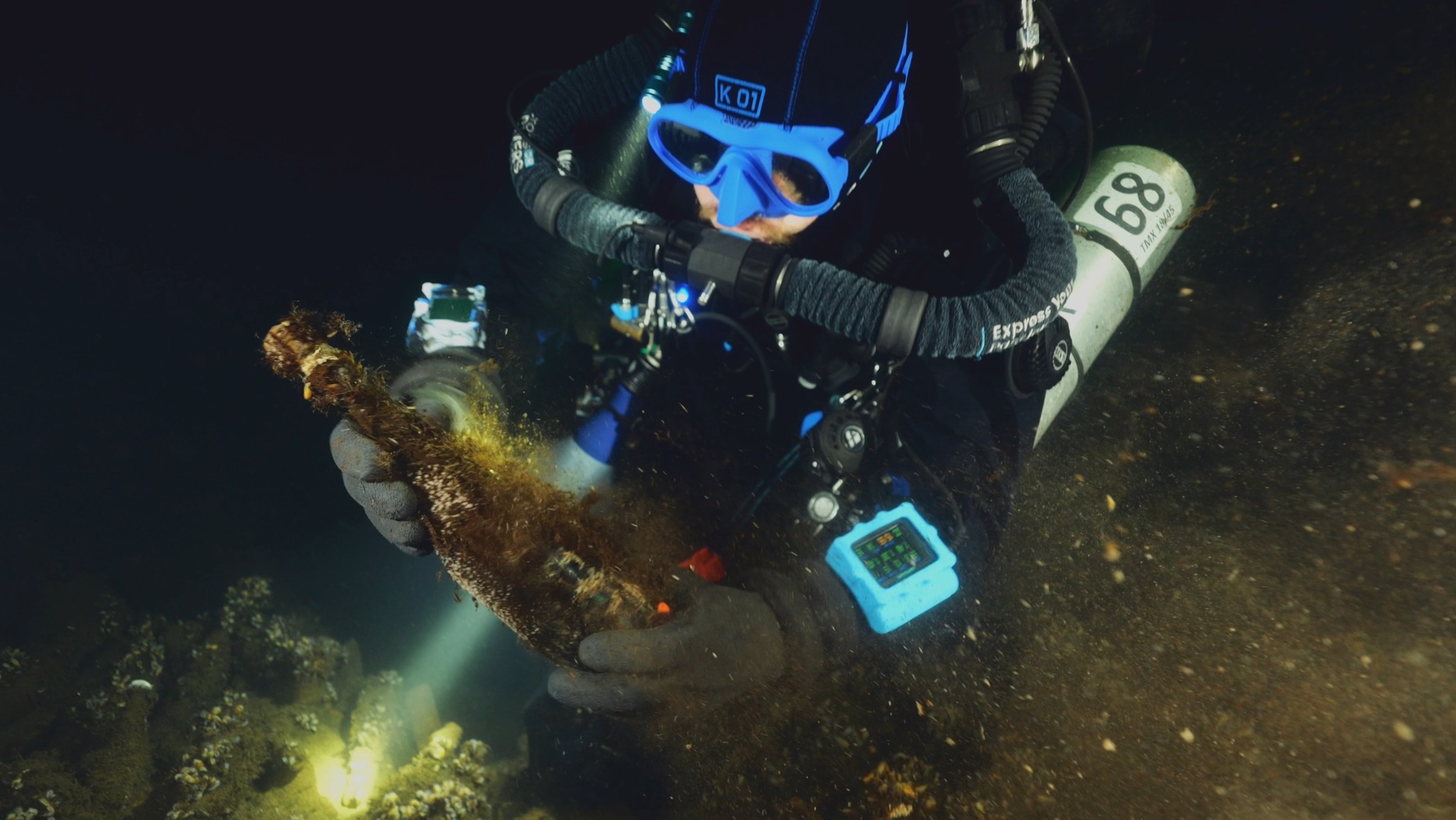
Update: Baltic shipwreck champagne was destined for Tsar Alexander II

Meticulous research into the bottles of champagne found in a shipwreck discovered in the Baltic sea south of the Swedish island of Öland in July 2024, has uncovered that they were destined for the table of Tsar Alexander II.

The well-preserved remains of the 19th century ship were found 190 feet deep by technical divers from the Baltictech Association. The ship stayed upright when it sank to the seabed, and the cold waters of the Baltic were ideal storage conditions for dozens of glass wine bottles and stoneware Selters mineral water bottles.

An expert in historic pottery identified the stamp on the Selters bottles as the emblem of the German Duchy of Nassau which the company used on its labels between 1836 and 1866. The cork on one of the Champagne bottles bore the faint imprint of Louis Roederer Champagne House of Reims.

Baltictech returned to the wreck site for a follow-up dive in 2025. They recovered a ceramic plate of the British Davenport company which could be dated to 1856. Since the plates didn’t linger in inventory, the ship must have begun its ill-fated voyage in late 1856 or early 1857.

All of this information helped Baltictech researchers to identify the ship as one sent by Adolf, Duke of Nassau, to Tsar Alexander. It was laden with champagne, mineral water, wine leather hides and porcelain. The champagne was an official state gift for the Tsar, who had ascended the throne when the Baltic was under blockade by Britain during the Crimean War. When Russia signed a treaty that ended the war in 1856, the blockade was lifted and heads of state like the Duke of Nassau hastened to reestablish relations.

The team reached out to Louis Roederer to find out more about the bottles, perform chemical analyses of the liquid inside the bottle and advise them on recovering a few samples. As luck would have it, one of Roederer’s champagne experts, Peter Liem, is also an experienced technical diver, so he was able to go down to the wreck and point specific bottles to recover. One was tested in Sweden, and several sent to Louis Roederer Champagne House in Reims for analysis.

The champagne contains 110 grams of sugar per liter and 12% alcohol and it is not just still drinkable, according to Peter Liem, it is “glorious:”

[P]atinated, authoritative, and immeasurably complex, this wine is not only alive, but downright vibrant and delicious to drink. It’s reminiscent of shiitake, saffron, kombu, saddle leather, cigar box, roasted coffee, with a fervent vitality and piercing intensity like a great amontillado. We believe that it’s from the 1857 vintage, although we are continuing to try to verify this for certain: if so, it was on its way to Tsar Alexander II in St. Petersburg.

Baltictech has requested a permit for a third exploration of the wreck. They hope to locate the ship’s bell and to excavate deep into the lowest levels of the cargo hold, looking for objects mentioned in the ship’s manifest that have yet to be found.

Archaeologists find gold in rubble at Vindonissa

The excavation of the site of Vindonissa, the first Roman military camp in Switzerland, has uncovered remains from the early formative period of the ancient camp, including the southern timber-and-earth wall, the legionary barracks building and the forge of the field smithy.

The southern defensive wall, located 230 feet from the wall of a later fortress, is long enough to give archaeologists new evidence of the size and layout of the first camp. The barracks was discovered in the west of the site under a later road. It was a structure 30 feet wide and at least 100 feet long. It had regularly-arranged rooms and ante-chambers. This was where the first legionaries who arrived in Switzerland lived before the construction of the permanent fortress.

Other structures found include the remains of a small building just inside the first camp wall that was likely a small workshop. Next to it was an even older building from Vindonissa’s first phase containing the hearth of a field forge.

Notable artifacts were discovered in debris layers outside the later permanent fortress walls. They include coins ranging in date from the Roman Republic through Late Antiquity, blacksmithing equipment, leatherworking tools and one stone of a Roman mill. Two metal fittings believed to be the handles of a scalpel, one carved in the shape of animal head, are now being conserved in the restoration laboratory.

One of the coins was unexpectedly valuable: a gold aureus minted during the reign of Tiberius. Coin finds at the site are typically bronze and silver. Another valuable object is a carnelian intaglio carved with an image of Victoria, goddess of victory, holding her staff and wreath.