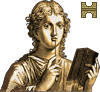
 A new examination of a small Viking-era gaming piece in the collection of the National Museum of Denmark has found that the hairstyle is so detailed that researchers believe it depicts a coiffure that was actually fashionable in the 10th century.
“It’s exceptional that we have such a vivid depiction of a Viking, even a three-dimensional one. This is a miniature bust and as close as we will ever get to a portrait of Viking,” says Peter Pentz, who is a curator at the National Museum.
Just three centimeters (1.2 inches) high, the piece was discovered in 1796 in a 10th century horse burial mound in Viken near the Oslofjord, southern Norway. It is carved from a walrus tusk and depicts the head and chest of a man with a thick moustache, long, braided beard and sideburns. His hair is parted in the middle and has a wave of the side that exposes his ear. The back of his hair is cropped short.
“Hitherto, we haven’t had any detailed knowledge about Viking hairstyles, but here, we get all the details – even the little curl above the ear is marked. This is the first time we see a figure of a male Viking with his hair visible from all angles. It’s unique,” says Peter Pentz.
 The arms are damaged, but the beard identifies it a type of carving known as beard-stroking or beard-pulling figurines. The new study proposes that they are kings in the Norse strategy board game hnefatafl. The pulling of the beards symbolizes masculinity, fertility and kingship.
This is one of the first objects catalogued by the National Museum, number 589 out of what are now more than two million objects in the museum’s collection. Held in storage for 200 years, figure is currently on display as part of The Wolf’s Warning, the museum’s exhibition on Viking seeresses.
The hair probably remained, but already by the 11th century, those Vikings seem to have changed significantly 😟️ …
The ‘Gesta Hammaburgensis’ report that…
“Where in the beginning they served their unspeakable sorcerers, now with the apostle they believe in Christ and the Cross. Also, they are the most content of or mortals, as regarding food and morals they are utmost diligent in parsimony and modesty. Apart from that, they have such awe for priests and the church that they wont regard as christian, who does not daily visits Mass and gives. However, baptism and Confirmation, as the dedication of altars and the ordination in general, has to be paid for amongst them as amongst the Danes. That is, I presume, due to the greed of their priests, and as the barbars are not used to tithe or refuse it, they are bound to other things that they need to offer. Among them, that is for sure, their signs of perfect morals, are solely corrupted by the avarice of the priests.”
“Nortmannia, the province at the farthest end, is consequently put at the farthest end of this book. Today, that region is referred to as Norguegia. (…) Without envy, they live next to the Swedes, while they are, not without impunity, at times challenged by the Danes, who are needy as themselves. Therefore, in lack of basic things, they roam the whole world and bring back goods from the farthest lands, keeping in this way up with the shortcoming of their region. However, having accepted Christianity and due to education in better schools, they by now learnt to love peace and truth, and to be content in modesty, moreover, to distribute what they collected, not as before to collect what had been distributed.
Frank, are you human or an AI bot? Your comments are nonsensical.
I confess, I might be a dishwasher with a terribly wrong upgrade 🤖️
Yes, the order is entirely random, as certain –and even more random– phrases are not accepted on here. In addition, I am from abroad.
The referenced chapter of the 11th century ‘Gesta’ is 4.30, and should you have a question, don’t be shy.