
Egyptian vase found in Pompeii fast food kitchen

A glass paste vase decorated with hunting scenes that was produced in Alexandria has been discovered in the thermopolium of Regio V in Pompeii. This type of large blue-glazed faience situla has typically been found as a garden ornament in the wealthy homes of Pompeii, but this one somehow made its way into the kitchen of a fast food joint.
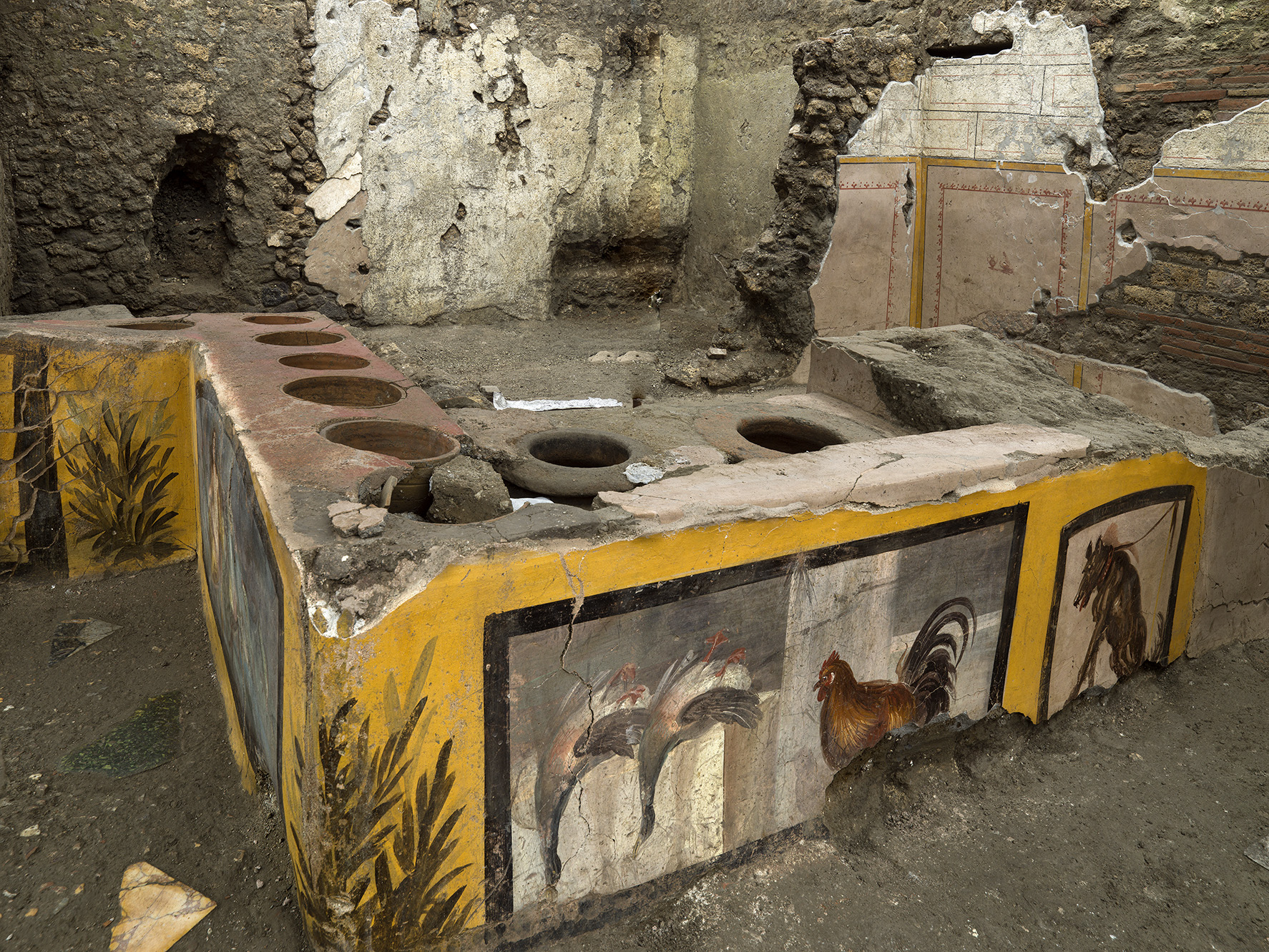
First discovered in 2019, the ancient street food stand’s vivid frescoes made it unique among more than 80 snack bar-type establishments frequented by Pompeii’s poorer residents. The main counter and service area was excavated in 2020/2021, and in 2023, the adjoining spaces began to be excavated.

Archaeologists uncovered a service room and on the floor above it, a small two-room apartment, one of which had walls frescoed in the IV style with faux architecture painted in perspective. The floor was painted yellow. The room was furnished, and some of the objects had polychrome marble inlays. Highly ornamented wooden boxes contained personal belongings. Archaeologists think the thermopolium’s manager or owner may have lived in the apartment.

The kitchen on the ground floor was preserved virtually intact. Cooking tools including mortars and pans and numerous wine amphorae from all over the Mediterranean were found still in their original locations.

At the time of the eruption, the room adjoining the Thermopolium served as a service room. The interior spaces appeared to be organized in a functional manner: a small bathroom was located next to the entrance overlooking Balcony Alley, while an area was intended for the storage of amphorae and containers for preserving liquids. The remaining area housed objects used for food processing, cooking, and storage.

Among the most significant artifacts found here is the finely decorated faience situla, a valuable testimony to the intense commercial and cultural exchanges that characterized Pompeii.

Poignant mourning necklace from Titanic goes on display

A black glass necklace that was unknowingly salvaged from the wreck of the Titanic 25 years ago has gone on display at Titanic: The Artifact Exhibition in Orlando, Florida. The fragile bead necklace was hidden inside a concrection, a hardened sediment, corrosion materials, sand, rock and ocean debris fused together by water pressure.

It was recovered by RMS Titanic, Inc. divers in 2000 just as a sample of wreckage fragment. All of the visible artifacts had already been removed at that time. A recent review of the wreckage samples in storage, however, found signs that there might be an artifact within the concretion. The careful micro-excavation of the lump revealed that it contained petite heart-shaped and octagonal black beads. It emerged in sections, strands of beads still strung as well as individual beads broken off of the threads.

Analysis of the material found that it was French jet, an inexpensive imitation of jet that became hugely popular during the Victorian era as mourning jewelry. Jet is a semi-precious stone made from fossilized wood, particularly wood from the monkey puzzle tree. Victoria wore jet jewelry to the funeral of her beloved husband Prince Albert, and then wore it almost exclusively for the rest of her life. Her life-long deep mourning for her husband set the fashion for wearing jet jewelry at every level of society.

The best jet in England was found in Whitby, Yorkshire, whose craftsmen produced jet pieces with a high-gloss polish. With the explosion of demand for the product, by the end of the 19th century Whitby’s finite supply of jet dwindled and jewelers turned to other sources. French jet was just black glass, so it was easy to work with, shiny and cheap.

RMS Titanic, Inc. researchers scoured the records for any reference to the necklace. Whoever owned it was certainly a passenger in mourning, but no further information could be found. No insurance claim was ever filed for it, which doesn’t necessarily mean that its owner survived the catastrophe because the necklace may have never been insured in the first place as it is made of inexpensive glass.

“There was a certain drama and beauty in how sorrow was made visible,” Ray and her colleague Ross Mumford, research and content specialist with RMS Titanic, Inc., explained over email. “This necklace offers a rare, tangible link to that world: it gives us a once-in-a-lifetime glimpse not only into the style and craftsmanship of the time, but also into the emotional landscape of the people aboard Titanic.”

Rare furry sealskin manuscript may be Norway’s oldest book

Eight parchment pages bound in furry sealskin recently donated to the National Library of Norway may be the oldest book in Norway. For decades the book was at the Hagenes farm in Bergen, passed down through the generations, until the family decided to give it to the National Library earlier this year. According to family lore, the manuscript originated in a monastery in Western Norway.

Library conservators examined the book for condition issues, and quickly realized that it was unique. It is a book of religious songs that dates at least to the 13th century and may be even older. Norway was fully Christianized by 1200, with cathedrals, parish churches and monasteries. They had strong ties to Christian hierarchies and communities elsewhere in Europe.

There used to more pages, but only eight survive to the present. Pages are made of calf skin, which was frequently used to make parchment, but the sealskin is much rarer binding. Even rarer is for there to be surviving fur on the skin. Samples of the binding and parchment have been taken for protein and DNA analysis to confirm the animal origins.

“With DNA we can determine the age of the materials, which seal species was used for the cover, and where the animal that became the parchment lived,” says [conservator Chiara] Palandri.

Some seals swim far, others stay in one area. If the cover is from a specific seal species and the calf turns out to have grown up in Norway, then the origin becomes clear.

Library conservators reached out to experts in other countries for input. A French binding expert pointed to the sealskin as evidence that the book was produced in a Nordic country if not in Norway itself.
The way the Latin in written also points to the book having been locally made. The Latin script has a rustic, simple quality. This was not the elegant hand of someone making books for the elite, but for practical usage.

The songs in the book are sequences, songs that were sung to celebrate a particular saint or feast/holy days on the ecclesiastical calendar. They would be sung by a cantor or the priest during mass.

Norway embraced the Reformation, becoming Protestant by 1537. Old Latin books were no longer deemed of value, and with the advent of the printing press, manuscripts were cannibalized to use their parchments as premium bindings for printed volumes.

“A lot of our oldest cultural heritage has not been preserved,” says [head of the Visual Media and Conservation section at the National Library Arthur] Tennøe.

That makes the little book that has now arrived at the National Library all the more valuable.

“We have so few writings from this period, and our research often relies on fragments of manuscripts. When we heard that several handwritten pages had come in, still in their original binding, it was unbelievable. This will greatly expand our knowledge base,” says [University of Bergen professor of medieval Latin Åslaug ]Ommundsen.

She especially appreciates that it appears to be a book meant for use.

“Early modern book collectors were usually interested in luxurious works with gold, beautiful illustrations, or rare texts. This book feels incredibly authentic. It’s the kind of thing a priest or cantor would carry to use in church,” says Ommundsen.

“A simple practical book like this would not always catch a collector’s eye. That’s why there aren’t many of them from this period, not even in the rest of Europe,” she says.

CT scan reveals name on 16th c. sword

CT scans of a 16th century sword from Jena in Germany have revealed a name engraved on the blade, hidden by a thick encrustation of rust. The inscription reads “Clemes Stam,” the name of the Solingen swordsmith who made it.

The blade was one of four surviving swords interred in the graves of the Collegiate Church in Jena where faculty, students and their families were buried in crypts between the late 16th and early 19th centuries. The church was destroyed by an allied bomb at the end of World War II, and the four swords were recovered from the rubble.

For seven years, researchers at the University of Jena have been analyzing the objects recovered from the Collegiate Church. Archaeologist Enrico Paust suspected there might be an inscription, but did not have the technology to penetrate the heavy corrosion layer to see inside to the blade, which is larger than the usual sample. He enlisted the aid of industrial research institution INNOVENT e.V. to virtually break through the barrier.

The “EasyTom 150-160 X-Ray Micro& Nano-CT” computed tomography scanner from the French manufacturer RX Solutions, available at INNOVENT since the end of 2022, represents a good compromise between sample size and resolution.

On the one hand, relatively large samples up to 70 cm in height can be measured; on the other hand, a relatively high resolution (voxel size <1 μm) is possible, as is necessary, for example, for examining circuits.

The rapier did indeed fit into the sample chamber, raising hopes that the rapier could be “virtually” “unwrapped” from the corrosion layer and a potential inscription revealed.

The scan was able to peel back the encrustations in layers, first revealing the remains of a sheath on the blade. Under the sheath, imaging revealed evidence that the blade had been manufactured by welding different types of steel together. The inscription was then inlaid into the blade steel with individually crafted letters made of copper sheeting just 0.6 mm thick.

Comparable weapons from the period 1580 to 1620 can be found in the German Blade Museum in Solingen. Weapons of this type could and were only permitted to be carried by members of the upper class. The Solingen workshop supplied the European high nobility with exclusive weapons and also crafted weapons for the Spanish king. The Jena rapier stands out from weapons with stamped inscriptions due to its elaborate inlay work.

Such a rapier in Jena could only have belonged to a rector or a student of noble birth.

Rediscovered 14th century fresco cycle opens to public

An extraordinary masterpiece of medieval fresco has been rediscovered and restored in the Santa Maria della Scala Museum Complex in Siena. The Thebaid, a cycle of frescoes created by Lippo Vanni in the early 1340s, returns to public view on Friday, November 7th.

The frescoes had been whitewashed over centuries ago. The first signs that there was surviving painting underneath the whitewash emerged in 1999 restoration. Two years later, the removal of a false ceiling revealed large intact portions of the frescoes, albeit mostly covered in layers of whitewash. It took another 20 years for the complete uncovering and restoration of the surviving frescoes to begin.

The Thebaid is an epic poem by the 1st century Roman poet Statius that recounts the mythological civil wars of Thebes in several episodes. It wasn’t hugely popular in antiquity, but it was very influential in the literature of the Middle Ages. There are no mythological scenes or any references to the ancient epic in the fresco cycle, however. Like the poem, it is episodic in layout, but the Thebes it depicts is the one in the Egyptian desert where the early Christian hermits known as the Desert Fathers live lives of repentance, prayer, manual labor and ascetism.

It decorated the entrance hall to the headquarters of the Compagnia dei Disciplinati (“Company of the Disciplined”) religious confraternity in the cellar of the Spedale di Santa Maria della Scala, one of the oldest hospitals in Europe located in front of the Cathedral of Siena. The Compagnia dei Disciplinati was a lay brotherhood devoted to public charity, prayer and repentance through observance of strict rules and an austere lifestyle. They employed the flagellum, the whip, to scourge themselves while repenting their sins. The brothers mortified their flesh in the oratory, the room next door to the frescoed entrance hall. The examples of virtuous hermits and saints on the walls helped them prepare spiritually for their penitential self-harm.

The iconography was drawn from the “Lives of the Desert Fathers,” a late 4th century A.D. combination travelogue and hagiography that was translated from ancient Greek into the vernacular around 1330 by the Pisan friar Domenico Cavalca. The frescoes were painted barely a decade after the translation brought the ancient text to refreshed prominence in Tuscany.