Etruscan urn’s polychromy restored after 1966 Florence flood

The Bottarone Urn, an extraordinary Etruscan cinerary urn with a sculpture of a married couple on the lid, has been comprehensively restored to vivid polychromy 60 years after it was caked in mud from the 1966 Arno River flood of Florence. The major new conservation has restored the natural luminosity of the alabaster and revived the intensity of its original painted colors and patterns. The diagnostic examinations also identified for the first time the presence of Egyptian blue pigment.

Bottarone Urn after restoration. Photo courtesy the National Archaeological Museum of Florence.

The urn dates to between 425 and 380 B.C. and is exceptional for the quality of its material — alabaster with delicate grey veining — and artistry, both in the carving and in detailed polychrome painting. Its subject matter is also unusual for the period. The lid depicts a man reclining on a kline (the daybed/dining couch) holding a patera in his left hand and reaching his right arm out to embrace his wife. She sits up with her feet on a pillow in the act of removing her veil. Etruscan sarcophagi with married couples on the lid were a popular motif in earlier periods, but when this one was made, cinerary urn lids typically featured semi-recumbent individuals or the deceased with a winged female demon.
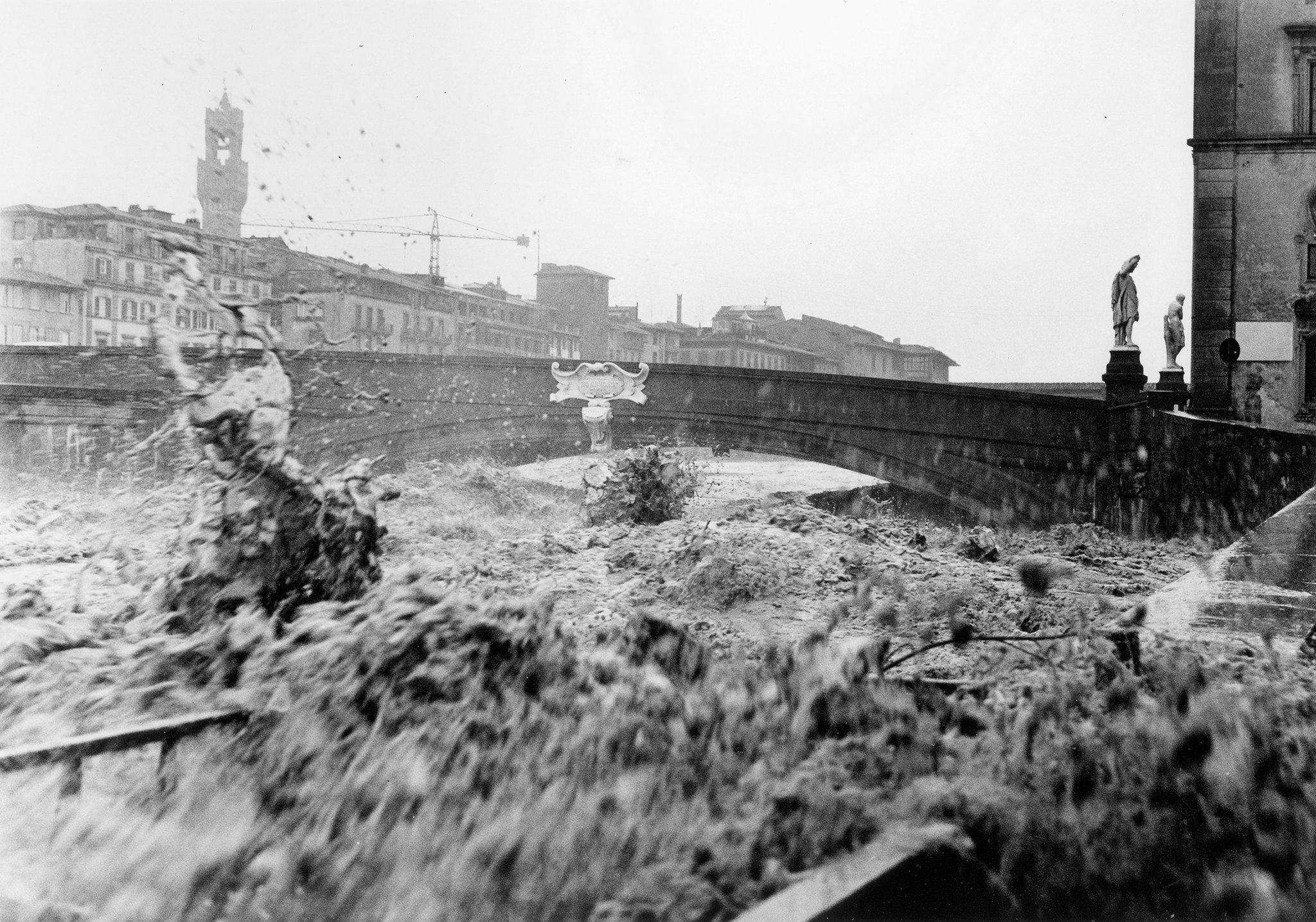
It was discovered in 1864 in Bottarone, a small village in the province of Perugia, and after passing through several private hands, it was acquired by the National Archaeological Museum of Florence (MAF) in 1887. It was on display on the first floor of the museum on November 4th, 1966, when the Valdarno damn burst and the Arno River poured into Florence. At the high water mark in the Santa Croce neighborhood, it reached a height of 6.7 meters (22 feet). A hundred people lost their lives and thousands lost their homes and livelihoods.

The destruction was incalculable. Florence is not particularly prone to flooding, so they had to go back centuries to 1557 to find a flood as bad as this one, and the city had collected a lot of art, books and artifacts since then. As estimated 600,000 tons of toxic sludge from mud, sewage, oil and naptha invaded the city, damaging or destroying millions of books, manuscripts, archives and about 14,000 artworks. Thousands of volunteers known as Mud Angels came to Florence from all over the world to help sift through the mud for precious fragments of artworks and clean them off as best they could with rudimentary materials in makeshift facilities.

The toll the flood took on Florence’s immense cultural patrimony spurred the development of new technological and methodological approaches to conservation. It was a tectonic shift on the whole premise of restoration, permanently abandoning the reconfigurations and harsh treatments that began in the Renaissance and flourished in the Grand Tour era into the non-invasive preservation outlook that defines conservation today. The pioneer in this new approach, the Center for Archaeological Restoration of Tuscany, was inaugurated that very year in the same building as the National Archaeological Museum. The new laboratory was immediately put to use documenting the damage, cleaning toxic flood sludge and getting artifacts to the point of stability as much as possible without making the mistake of taking on ambitious restorations beyond its capabilities at the time.

The mud reached more than six feet high inside the National Archaeological Museum, and hundreds of artifacts were damaged by the catastrophic event. The Bottarone Urn took a direct hit from the muddy waves when they struck the building. Its first post-flood treatment was completed and published in 1969. The mud was cleaned, but in an attempt to protect the surface, a sealer was applied that over time has darkened. The painted surfaces had grayed, obscuring the original intensity and variety of the color, and the head of the male was becoming structurally unsound. With the condition of the urn increasingly precarious, it was removed from public display for its safety.

In 2022, the urn began undergoing a comprehensive new scientific study and conservation.

The intervention led to major results, including the identification and mapping of Egyptian blue, as well as ochre and cinnabar, allowing for a more precise reconstruction of the work’s original polychromy. “The imaging investigations yielded exciting results: we identified the Egyptian blue and were able to map the polychromy, imagining the urn in its original appearance,” said Giulia Basilissi, Conservator Restoration Officer at the Museum.

The urn is on display this weekend at a special exhibition dedicated to its 60 years journey from disaster to renewal at the Palazzo dei Congressi before it returns to the National Archaeological Museum.

Centurion’s tombstone reused in someone else’s grave

Grave markers from Roman soldiers reused in later tombs have been discovered near Svishtov, northern Bulgaria. They were discovered by accident when a tree was uprooted on private property, revealing ancient graves. The subsequent rescue excavation uncovered two cyst graves made out of limestone slabs, one brick and stone chamber grave and one pit grave, all inhumations, and one cremation burial.

The site proved to be the Western necropolis of the Roman military camp of Novae. Located on the right bank of the Danube, Novae was one of the key fortresses defending the Moesian Limes (the northern frontier of the province of Moesia). It was built around 45 A.D. and housed the Legio VIII Augusta until they were replaced by Vespasian with Legio I Italica in 70 A.D. Legio I Italica garrisoned Novae for the next 350 years at least.

Both of the cyst graves feature funerary markers reused as building material. One of them contains the partially preserved tombstone of Legio I Italica centurion Gaius Valerius Verecundus was engraved with a wreath of which only traces remain and an inscription that describes him as having been “heavily pressed by fate.” It was placed at the back of the rectangle on its side. Another tombstone in the cyst belonged to Legio I Italica veteran Marcus Marius Patroclus from Iconium in Asia Minor, today the city of Konya in Turkey. His funerary marker is engraved with depictions of signa, or military standards. One of the slabs used to form a roof is the tombstone of Aelia Basilia erected by her brother Publius Aelius Bassus, also a Legio I veteran. The epitaph describes her as a “most virtuous sister” (soror pientissima).

The second cyst grave has probably the best-preserved of the reused funerary markers. Its eastern wall is composed of the tombstone of Gaius Alpinius Second, son of Gaius, hailing from Colonia Claudia Ara Agrippinensium (present-day Cologne, Germany). He was a soldier in the Legio XI Claudia. The western roof slab is fragmentary, but the surviving part of the epitaph commemorates a veteran who served in the legions for 25 years and died at age 60.

All of the graves date to the 2nd/3rd century and were looted in antiquity leaving only a smattering of artifacts behind, including a bone needle, two bronze fibulae and a fragment of a spindle whorl. The skeletal remains were jumbled by the interference in the grave, but they will be examined by an anthropologist. The inscriptions are also still being studied so they can be fully recorded, translated and analyzed.

Monumental pavement under Barcelona hotel turns ancient forum 90 degrees

An excavation under the Gran Hotel Barcino in the historic downtown of Barcelona has uncovered a section of monumental pavement from the Roman town’s forum that is unprecedented in its age, scale and state of preservation. The discovery rewrites the previous understanding of the orientation of the forum and how it aligned to the ancient city’s main thoroughfares.

The key find is a stretch of pavement made of slabs of Montjuïc stone (rock extracted from the Montjuïc mountain that overlooks Barcelona and has been the source of building material and infrastructure for the area since the pre-Roman Iron Age). It dates to between 15 and 10 B.C., the earliest founding years of the Roman city. It is made of precisely cut rectangular blocks, the largest of which are 1.48 long by 1.18 meters wide (approximately 5 by 4 feet). They are incredibly thick too, with the biggest being 35 cm, almost 14 inches thick. The slimmest was a heft 18 cm (seven inches). The variance made allowances for the uneven terrain and ensured the pavement was stable and flat. The surviving section covers 42 square meters (452 square feet).

The area between the Besòs and Llobregat river deltas has been populated since the prehistoric times. The Iberian Laietani people had several settlements on the site of what is now Barcelona, and when the Romans arrived in 15 B.C., they conquered the Laietani and founded the colony of Julia Augusta Faventia Paterna Barcino.

The town was built with the typical urban design of a Roman city: two main streets — the decumanus and the cardus — intersecting in the center where the forum was located. It was encircled by defensive walls built between the 1st and 2nd centuries and the two main streets ended at four gates in the walls. The decumanus ran east to west, from the Porta Praetoria (west) to the Porta Decumana. The cardus ran north to south from the Porta Sinistra (north) to the Porta Dextra (south).

The monumental pavement discovered under the hotel is parallel to the decumanus and perpendicular to the cardus.

Until now, historians believed that the city’s forum, the civic and administrative heart of Roman life, was aligned with the cardo.

Archaeologists now say the forum was aligned parallel to the decumanus, running from sea to mountain.

“For years, we thought the Roman forum ran through the area of the Palau de la Generalitat,” Maese explained. “Now we see that it turns 90 degrees from being parallel to the sea to being perpendicular.”

Both the Catalan government and Barcelona City Council have accepted the revised interpretation and plan to update the city’s museum displays accordingly.

As for the ancient pavement, it will remain in situ. The hotel plans to incorporate the Roman remains found in the excavation into the breakfast room. It will not be open to the public, just to the fortunate hotel guests, but guided tours will be offered on special occasions in coordination with the Barcelona City Council.

Viking raider’s gold coin pendant found in Norfolk

A rare imitation of a Carolingian gold coin worn as a pendant likely by a soldier in the Viking Great Army that invaded England in 865 A.D. has been discovered in Norfolk. This type of coin was made in workshops in Frisia (today part of the Netherlands) and all 22 of these imitation solidi found in Britain have been found along the route of the Great Army. The one found in Norfolk is a relatively high quality example.

The coin is an imitation of a gold solidus of Louis the Pious (r. 814-840), son of Charlemagne, minted around 816 when he was crowned Holy Roman Empire. It is considered one of the finest of all Carolingian coins and one of the rarest, with only four confirmed examples recorded. The draped and laureate bust of Louis on the obverse is inspired by ancient Roman issues, like this 335 A.D. solidus of Constantine I. The inscription of the obverse is DN HLVDOVVICVS IMP ΛVG (meaning “Our Lord Louis August Emperor” an imperial Roman style); the reverse inscription is MVNVS DIVINVM (“Divine Gift”), referring to the wreath/crown or to the cross inside of it.

The Frisian imitations were made much later than the originals. Most of the examples have been found in coin hoards dating to the 870s-880s, and they are very rough with crude outline portrait busts and chicken scratch inscriptions that barely have discernible letters. The earliest examples found in hoards deposited in the 840s and 850s are of notably higher quality. The Norfolk find falls into the latter category.

It is worn, but you can see that the portrait bust captures Louis’ straight, long nose, laurel wreath, moustache and prominent chin. The inscription is also close to the original, reading “DNI HVVD [O] VS H IM AVG.” The reverse get even closer to the inscription: “C MVNVS DIVINVM IS.” The superfluous C and S are misinterpretations of the ties on the original coin’s wreath.

The coin has a double piercing above the head on the obverse, one larger perforation with a smaller one below it and slightly to the side. Those holes are at the four o’clock position on the reverse, which shows it was worn with the obverse side facing the viewer.

The coin pendant is currently going through the Treasure process but it’s a foregone conclusion because of its age and precious metal content. Once it is declared Treasure, the Norwich Castle Museum is hoping to acquire it.

First Lariarium north of the Alps found in Cologne

A Roman lararium (a private altar dedicated to the household’s guardian gods, the Lares) from the 2nd century A.D. has been discovered in Cologne. It is the first lararium found north of the Alps.

Originally settled by the Germanic Ubii tribe, the Roman city was founded as Colonia Claudia Ara Agrippinensium in around 50 A.D. by the Emperor Claudius. He granted it full city rights, privileging it because his wife, Agrippina the Younger, was born there. It became the capital of Germania Inferior and was one of the most important cities of the empire north of the Alps.

The house altar was discovered during an excavation in preparation for the new underground visitor space of the LVR Jewish Museum in the Archaeological Quarter of Cologne. Because the new underground tour goes deeper than is typical in downtown archaeology, the excavation has encountered the remains of early Roman buildings, including a monumental apse (the semicircular end of a building) of a multi-aisled building from the 4th century and the 2nd century Praetorium, the villa of the Roman governor.

The remains survived due to a fluke of location. They were built on the slopes of the Rhine, and even in Roman times parts of the buildings were covered up by earth embankments to protect from flooding. Because of the soil backfilling, later construction went up above the structures instead of razing them first. Normally only the foundations of ancient buildings are found, but at this depth in this place, whole building structures were discovered.

The lararium was in the Praetorium. It is a deep arched niche on which figurines of the Lares stood. Families left offerings of food, flowers and other assorted objects to the deities on the altar. Remains of walls projecting from the sides indicate the niche was originally enclosed. There are also traces of paint — stars are visible — inside the niche. Nail holes were found above the arch and on the side of the niche where garlands were hung. Below the niche is a rectangular cutout line that marks where the altar slab was mounted. The slab itself was found in the excavation, broken off and displaced but still present.

While household altars were common in Roman homes all over the Empire, their remains do not typically survive north of the Alps because masonry preservation especially of private dwellings is so rare. To have found not just a lararium in Cologne but one in such good condition is of great archaeological importance.

The same excavation unearthed a staircase from the 1st century that connected a location near the Rhine shores with a higher level of the Praetorium. Only a section of the stairs remain, so it’s not clear where they ended or what they led to. These too are rare survivors and the stones from staircases like these were usually recycled in later construction.

The city plans to restore the lararium, remounting the altar slab, and will make it, the staircase and the apse part of the underground route of the new museum. The route also includes a medieval goldsmith’s workshop and remains of the city’s Jewish quarter.