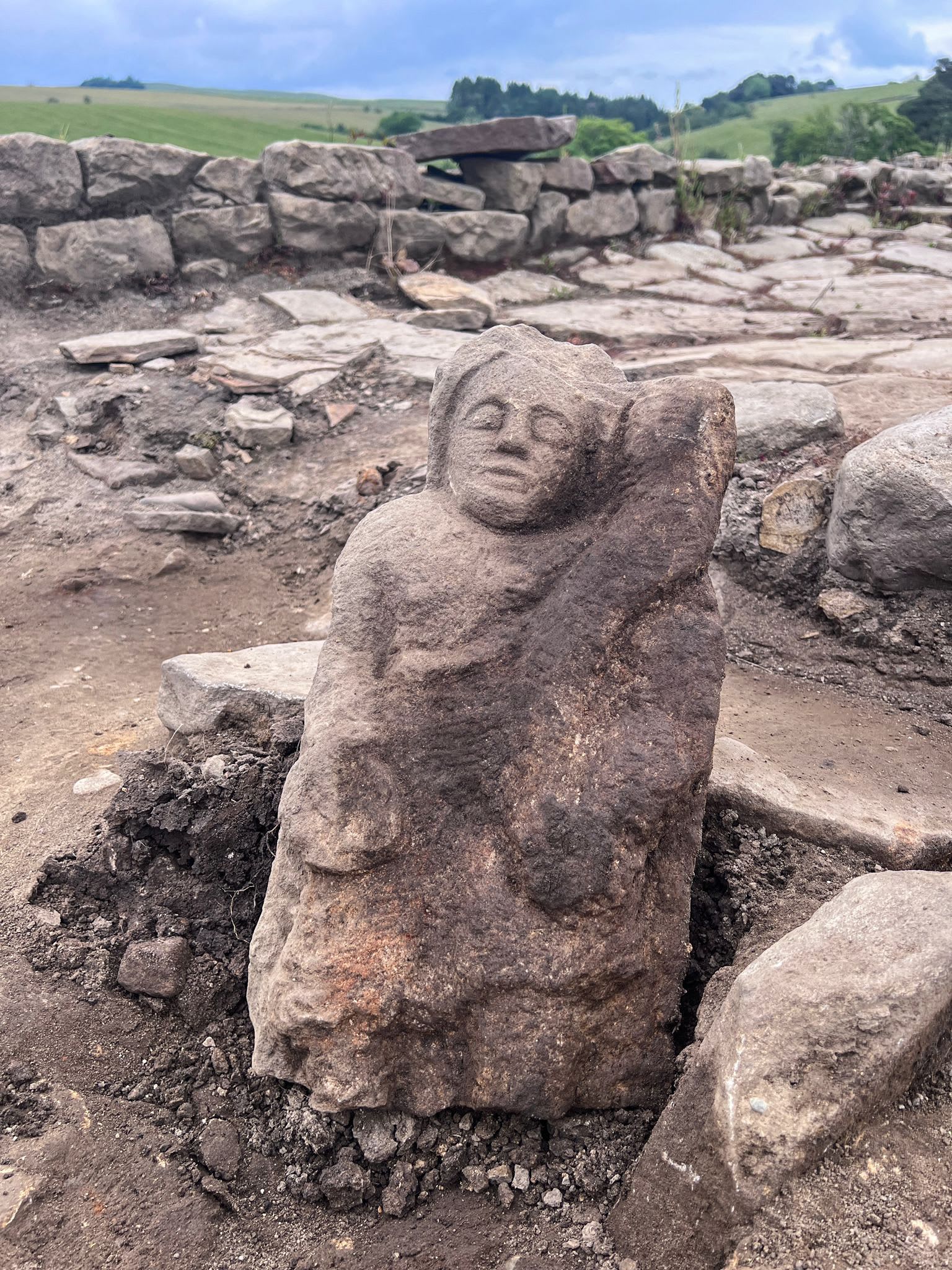
 A sculpture of a Roman Genius holding a cornucopia and a patera has been unearthed at the ancient fort of Vindolanda just south of Hadrian’s Wall in Northumberland. It was found face-down under the floor of a 4th century barracks building.
The carving is a relief on sandstone 17 inches high, nine inches wide and three inches deep. It depicts a Genius, or protective spirit, holding a cornucopia in one hand and a patera, a shallow dish used to pour out ritual offerings, in the other. It was likely carved by a local artists, either at the Vindolanda fort itself, or at one of the sculpture workshops in the area, such as the one at the Roman fort of Lanchester in County Durham.
In traditional roman religion, the Genius was a guardian spirit that brought prosperity, safety and good luck to a home or other place. Archaeologists believe the sculpture was originally part of a domestic shrine, and so predates the 4th century barracks. It was reused later as building material during construction, placed face-down with the gently curved back acting as a flagstone.
While inscriptions dedicated to a Genius are relatively common across Roman Britain, reflecting the widespread worship of these protective spirits, surviving carved stone reliefs are comparatively rare. The Vindolanda discovery therefore represents an important addition to the corpus of Romano-British sculpture, providing a rare opportunity to study both the iconography of a Genius and its archaeological context. […]
Buried beneath the floor of a fourth-century barrack block for more than sixteen centuries, the relief offers fresh insight into the religious beliefs of the soldiers and families who lived at Vindolanda during the closing centuries of Roman Britain. Its exceptional state of preservation and secure archaeological context make it one of the most significant religious stone carvings to be discovered at the site in recent years.
The Genius is now being cleaned and conserved. When conservation is complete, it will go on display at the fort museum.
Maybe, we should not take for granted that the proposed ‘cornucopia’ is a cornucopia after all. Instead –where using a patera for pouring libations– it usually takes some sort of vessel to source it from, which would make our cornucopia in fact a ‘drinking horn’!
To give another example for gods with drinking horns:
In Altenkirchen on the island of Rügen, the 13th century sacristy harbors a 10th century granite slab depicting a man with a moustache, wearing a cap and a long robe, particularly holding a large drinking horn, who represents the god Svantevit.
Waldemar I landed at Arkona in 1168, however, accompanied by his army commander Bishop Absalon. The temple was destroyed, the wooden Santevit was chopped up and burned, and afterwards the bishops of Lund oversaw the spread of Christianity.
If you look at the statue Genius at the London Museum, though the Vindolanda statue is much more crudely carved, tbere are marked similarities. The London Museum statue is described:
“He holds a horn full of grapes and vine leaves which is called a cornucopia, or horn of plenty, in his left hand. He is making a sacrifice, holding a dish over an altar.” The dish is in the right hand & is above a small altar.