
 A new 4,000-year-old clay tablet with markings whose symbolism has yet to be deciphered has been unearthed at the prehistoric pile dwelling site of Lucone di Polpenazze in Lombardy, northern Italy. This is the third so-called enigmatic tablet found in the Lucone D sector, the 21st tablet to be discovered at the overall Lucone site.
The tablets, usually made of clay but sometimes of stone, feature incised lines and impressions of geometric shapes including triangles, squares and circles. The oldest of the tablets are predominately characterized by impressed dots.
They have been interpreted as possible calendars, counting tools, or forms of proto-writing. A ritual function has not been ruled out either, extending to the hypothesis that they might have been used as a sort of sacred amulet. One of the most intriguing interpretations today, however, links them to the management of trade, suggesting a function comparable, in some respects, to modern shipping documents used to identify specific goods (perhaps metal).
In addition to northern Italy, enigmatic tablets have been found in Switzerland, Germany and the Danube-Carpathian Basin area in southeastern Central Europe. The largest single concentration of them has been discovered at the Lucone di Polpenazze site.
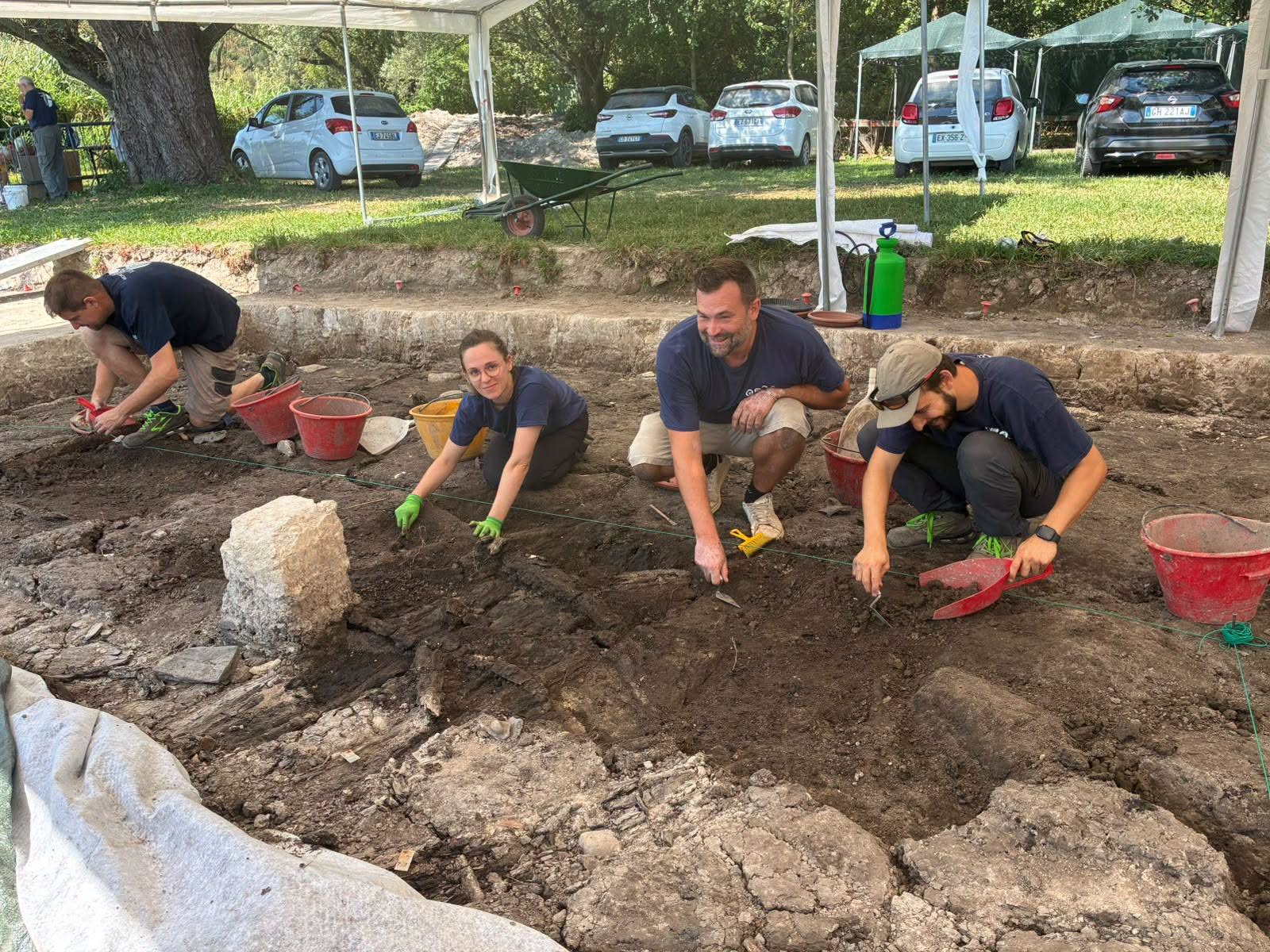 Located close to Lake Garda, the Lucone di Polpenazze site is now a shallow basin, but in prehistory was a small lake housing at least five distinct pile dwelling settlements occupied from the Neolithic period to the Bronze Age. The Lucone D sector is a small pile-dwelling village from the early Bronze Age. Radiocarbon dating of the oak logs used to build the houses on stilts dates the village to 2034 B.C. The distribution of the houses indicates they were built over the full lake, not when the water was low, attesting to the engineering prowess of the community. Archaeologists also discovered that household waste was ejected off the platforms the houses were perched on creating a layer cake of organic remains
What makes Lucone D exceptional among the other pile dwellings at the site is that the village was struck by a catastrophic fire which destroyed the homes but carbonized and preserved many materials that would normally have decomposed. Wooden sickles, loom weights, linen fragments, seeds and the remains of food in a ceramic bowl have survived in carbonized form. The conflagration even preserved some of the sun-dried clay of the dwellings, firing it as it were in a kiln.