Mystery of Early Bronze Age axeheads solved

The mystery of the pair of Early Bronze Age axeheads that were mailed anonymously to the National Museum of Ireland last month has been solved. The sender has come forward to tell his story. His name is Thomas Dunne, and he’s a farmer from County Westmeath. He found the axes on his land while looking for a lost piece of equipment.

Thomas Dunne said he had found the items by chance on his silage field at Banagher at the end of June. “I was cutting silage [grass fodder for beef cattle] one day and a bit of metal fell off a mower,” he told the Irish Times.

He said: “We started looking for it then because we thought it might go into the silage harvester and break it up. So, I got a man with a metal detector to look for it and that’s how it was found. It was in the side of a field underneath a row of beech trees; there would have been ancient forts on the land around here.”

At first Dunne thought they were horse plough fragments or some other kind of scrap metal and almost tossed them back in the ditch, but the person who was helping him out thought they might be archaeologically significant, so he decided to send them to the museum instead of throwing them in a ditch. He packed them up carefully in a oat bar box and send them anonymously because any archaeological finds made in Ireland are property of the state, and there are serious penalties for people who illicitly seek them out.

Dunne was not looking for archaeological objects, so he wasn’t actually breaking the law that requires written prior permission for metal detectorists or risk a large penalty of up to three months in prison or a $70,000 fine. He just figured discretion was the better part of valour and kept mum. He only found out their age and function when he read about his donation in the newspapers a week later.

National Museum archaeologists are now surveying the find site, logging everything they can find that might shed light on the Bronze Age people who created the handaxes 4,000 years ago.

Champagne galore found on Baltic shipwreck

The wreck of a 19th sailing ship still loaded with its cargo of champagne, wine, mineral water and porcelain has been discovered in the Baltic off the Swedish island of Öland. The Baltictech diving group, a Polish association of divers dedicating to exploring shipwrecks in Baltic waters,

The sonar images were unremarkable (the wreck looked like a fishing boat, at most), so much so that there was some doubt whether any of the divers would think it was worth exploring. Two divers agreed to give a quick once-over. They ended up being gone for two hours, so the crew realized it was definitely not a fishing boat.

Instead, the wreck proved to be a merchant vessel in excellent condition, much of its original cargo still in place. There were so many bottles it was difficult to estimate total numbers.

“The whole wreck is loaded to the brim with crates of champagne, mineral water and china,” Tomasz Stachura, the leader of the Baltictech diving group, told AFP.

He said: “I have been diving for 40 years and it often happens that there is one bottle or two … to discover a wreck with so much cargo, it’s a first for me.”

Divers counted more than 100 bottles of champagne and baskets full of the famous Selters mineral water in sealed stoneware bottles. The shape of the bottles and design of the stamp indicate the water was bottled between 1850 and 1867.

The Baltictech group has notified the Swedish authorities about the shipwreck. They will not attempt recovery of any of the champagne or mineral water until they get the go-ahead from Sweden.

“[The ship] had been lying there for 170 years so let it lie there for one more year, and we will have time to better prepare for the operation,” Stachura said.

Cuneiform tablet lists large furniture purchase

An excavation of the Bronze Age Aççana Mound in the Old City of Alalah in Turkey’s southeastern Hatay province has uncovered an Akkadian cuneiform tablet that records a large furniture purchase. The tablet is petite at just 1.65 inches by 1.38 inches with a thickness of 0.63 inches and weighing just shy of an ounce. It dates to the 15th century B.C. and is written in Akkadian, the language spoken of Mesopotamia at that time. The first lines note a large number of wooden tables, chairs and stools, who paid for them and who received them.

The mound is in the ancient city of Alalakh, the capital of the Bronze Age city-state of Mukis. First excavated in the 1930s by British archaeologist Leonard Woolley, the most recent excavation project began in 2021 with the aim of exploring the religion, commerce and daily life of the Late Bronze Age settlement and its diplomatic and trade connections to Eastern Mediterranean powers like the Hittite Empire in Anatolia and the Mitanni Empire in the Fertile Crescent.

Hittite and Mitanni artifacts have been found in different layers of the mound, imported over the active trade routes that crossed the Amik Valley. The empires wanted to establish commercial ties with Alalakh because it was so agriculturally rich. They had visions of the Amik valley becoming their breadbasket, feeding the growing empires. Skeletal remains found in the mound have had archaeological DNA extracted and analyzed, and researchers have found they were local people who lived in the town, not visitors or traders or foreign dignitaries.

This year, the excavation team was also working on restoring some of the architectural remains that were damaged in the devastating 2023 earthquake. The tablet was discovered during the restoration work.

The researchers continue to decipher the inscriptions on the tablet, paying special attention to details that reveal information about the parties involved in the furniture exchange, the precise quantities of the items, and the complexities of commercial transactions of the era. Preliminary findings suggest that the society of Alalah had a highly organized economic system, with records that could have been used for economic planning and administrative decision-making.

Roman urn of Attii family seized from farmhouse garden

A Roman cinerary urn with an important dedicatory inscription has been has come to light in Portogruaro, a town on the outskirts of Venice, northern Italy. The urn dates to between the 1st century B.C. and the middle of the 1st century A.D. Engraved in Latin capitals on the front of the box is an inscription commissioned by Attius Lucullus, a member of the Attii family who were prominent in the area and known from numerous inscriptions in nearby ancient Altinum.

The box is made of limestone and has a rhomboid shape with a pseudo-square base. There is a cut-out square cavity at the top which held the cinerary remains. Originally, the cavity was covered by a lid, but that is long gone, as are the ashes of the deceased. The inscription has suffered heavy wear and tear and is only partially legible with the naked eye. It reads:

L(ucio) Attio Sex(ti) f(ilio) patri,

C(aio) Attio Sex(ti) f(ilio) patruo,

[-] Attio L(uci) f(ilio) fratri,

[-] Attius L(uci) f(ilius) Lucullus.

It names four members of the Attius family: the dedicator, Attius Lucullus, his father Lucius, his uncle Caius and his brother.

The limestone box was discovered in the late 60s or early 70s in a field near a farmhouse, but the finder never reported it. It was left in the garden of the cottage even as different owners acquired it. When the current property owners, bought the farmhouse in 2023, they reported the urn to the Archaeological Superintendency who launched an investigation.

At the end of the investigation, in January 2024, the Pordenone Public Prosecutor’s Office seized the urn on the grounds that the current property owners had no legal title to it and assigned it to the Concordiese National Museum in Portogruaro. The Carabinieri Nucleus for the Protection of Cultural Heritage of Venice have now delivered the urn to the Concordiese National Museum. Researchers are now examining it further in the hope of being able to make out the faded parts of the inscription.

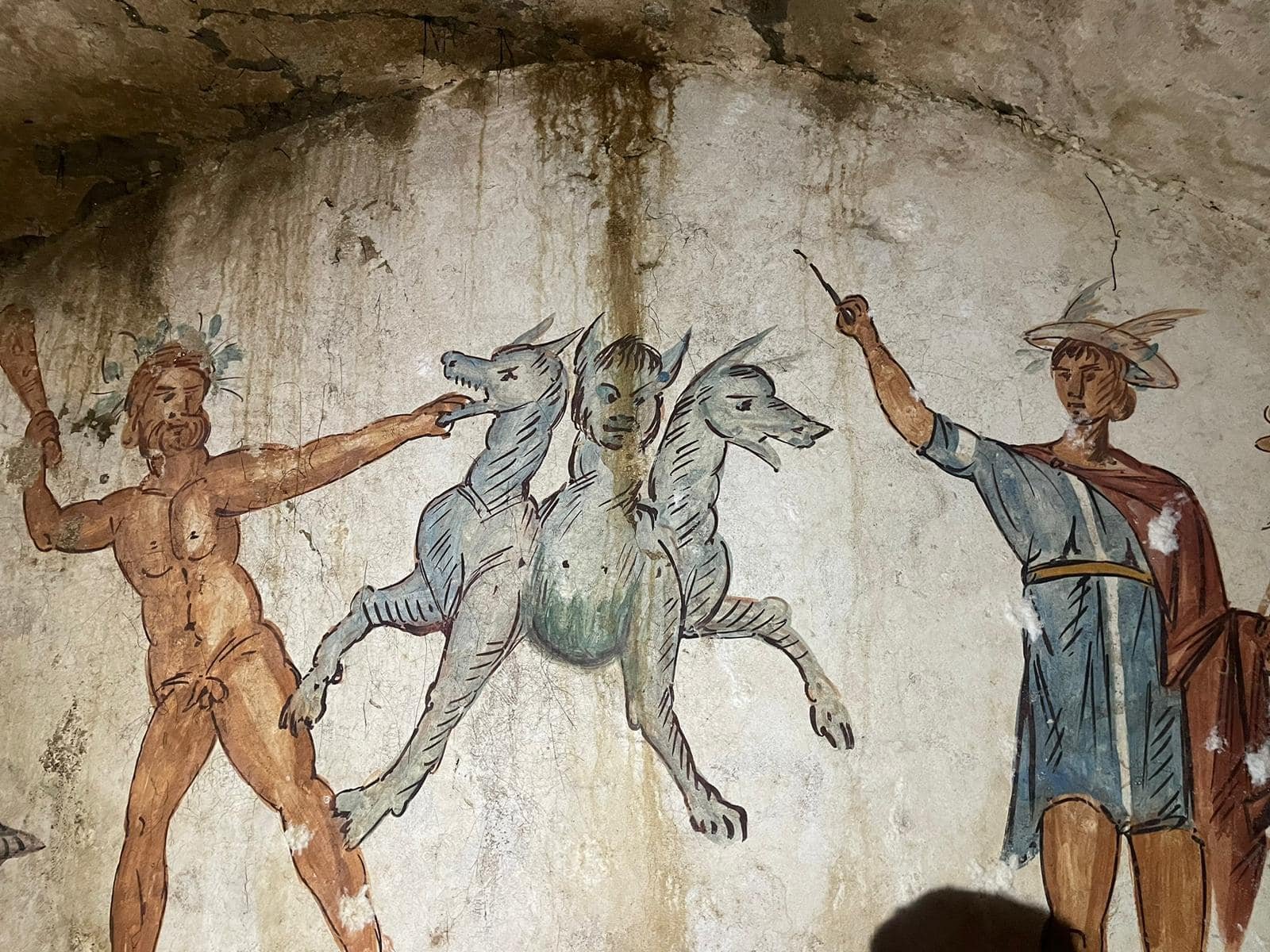
Contents of sarcophagus in Tomb of Cerberus revealed

For the first time in 2,000 years, human eyes have seen the contents of the sealed sarcophagus inside the Tomb of Cerberus, the vividly frescoed chamber tomb found in Giugliano, outside Naples, last year. Archaeologists threaded a microcamera into a gap in the sarcophagus to view and photograph the interior.

They found an inhumed body in supine position covered by a shroud. The textile was mineralized and preserved by the unique conditions of the sealed sarcophagus and the sealed chamber tomb. Grave goods buried around the deceased include pottery vessels, unguentaria and strigils. The care taken in the construction of the tomb, the burial in the sarcophagus and its grave goods suggests the deceased was an important figure locally, and the head of the family the tomb was built to inhume.

Samples have been taken from other inhumations on the funeral beds in the mausoleum and analyzed by a multi-disciplinary team of researchers. Pollen analysis and microscope observation revealed the presence of chenopodium, a genus of perennial herb colloquially known as goosefoot, and wormwood. These were likely applied to the bodies in creams to help prevent decomposition. Samples from the human remains are undergoing DNA analysis.

Continued archaeological research and laboratory sampling and analysis in the coming months will yield additional interesting data not only from the hypogeum, but also from the surrounding necropolis. These data will be useful in reconstructing the historical and social context of an ancient community that still has much to reveal.