“Joan of Arc” ring unveiled at French theme park

The ring purported to have belonged to Joan of Arc that was sold at auction last month for $412,845 is back in France. Its new home is the Puy du Fou theme park in the Vendée region of western France where the ring was unveiled with great pomp on Sunday by the park founder Philippe de Villiers before a crowd of 5,000.

The theme of Puy du Fou is French history through the centuries. Visitors can enjoy gladiatorial combat and real live quadriga races at the Gallo-Roman stadium, the traditional crafts in the medieval city, the adventures of the Knights of the Round Table complete with dragon slaying and enchanted lake, a Viking longship attack on a wooden keep, a working mill and musicians in the 18th century village, the bird of prey show in a ruined castle, a joust and tricks from horseback knights, the vicissitudes of a French naval officer fresh from the Revolutionary War in America to the French Revolution, a swashbuckling 17th century adventure of the dastardly Richelieu versus the King’s Musketeers, a Belle Epoque city ca. 1900, a fire fountain show on the lake at night and much more.

This party-time version of the past is a fitting setting for the ring because there are widespread doubts as to its authenticity. An Oxford University laboratory dated the ring to the 15th century based on its style, wear and engraving, but that’s as close as it gets to any actual facts linking this jewelry to the Maid of Orléans. They share a century. That’s all we know for sure. The long track record of ownership history included with the ring is entirely speculative. It’s based solely on the fact that Lady Ottoline Morrell’s ancestry can be traced back to Cardinal Henry Beaufort, Bishop of Winchester, who was present at the trial and execution of Joan of Arc. There are no references in archives or histories that mention the ring being owned by anyone in the family at any time between 1431 and when it first appears on the historical record in 1914.

On the advice of experts, neither the town of Orléans nor the Joan of Arc Historical Exhibition in Rouen bid for the ring. There are many fake Joan of Arc relics out there, and the association of this particular piece with Joan only dates to the early 20th century when there was a revival of Joanmania. Philippe de Villiers is no museum curator, however, and he insists despite the lack of evidence that the ring is unquestionably authentic. As a politician, leader of the conservative Movement for France party, he is keen to claim Joan and there’s a hefty portion of nationalism underpinning this acquisition. At Sunday’s unveiling he said “It’s a little bit of France that has returned. The ring has come back to France and will stay here,” then launched into a stirring rendition of La Marseillaise.

He was putting Britain on notice there. Appropriately enough, the export of the ring has sparked a war, of words this time, between the British and French. When the auctioneers gave the ring to park lawyers, they informed them that an export license would have to be secured before the ring could leave the country. Any antiquity worth more than £39,219 that has been in the UK for more than 50 years requires a special export license issued by the Culture Minister. The license is only issued after the Reviewing Committee on the Export of Works of Art and Objects of Cultural Interest (RCEWA) gives the Minister its recommendation, and in the case of this ring, it’s highly unlikely that they would have let it walk away without temporarily blocking export to give British institutions the chance to raise the purchase price and keep it in the country.

Philippe de Villiers has no intention of returning the ring, illegally exported or no, a position he made very clear at Sunday’s ceremony.

“The British government has sent our lawyer an unprecedented demand: the return of the ring to London,” Mr de Villers told the shocked throng. […] “Is the ring part of England’s national heritage?,” he asked the crowd, which booed loudly. Cheers erupted, however, when he asked whether it was part of France’s heritage.

Mr De Villiers claimed that he had checked the rules and found they only apply if the object is taken out of the European Union. In a mocking nod to Britain’s upcoming referendum over whether to remain or leave the EU, he told the crowd: “It is not at all our intention to have a Puy de Fou exit.”

In a final flourish, he laid down the gauntlet by stating: “Ladies and gentlemen from Britain, if you want to see the ring, then come to the Puy de Fou. For the rest it’s too late.” “The ring has returned to France and here it will stay…even if the European Commission orders it back.”

So much ado about a very questionable artifact. I have to admit, though, as theme parks go, even with its inherently inaccurate, sanitized, kid-friendly, way too clean version of history, it’s pretty cool. I am all over that quadriga race.
Update: St Eric’s wounds consistent with legend

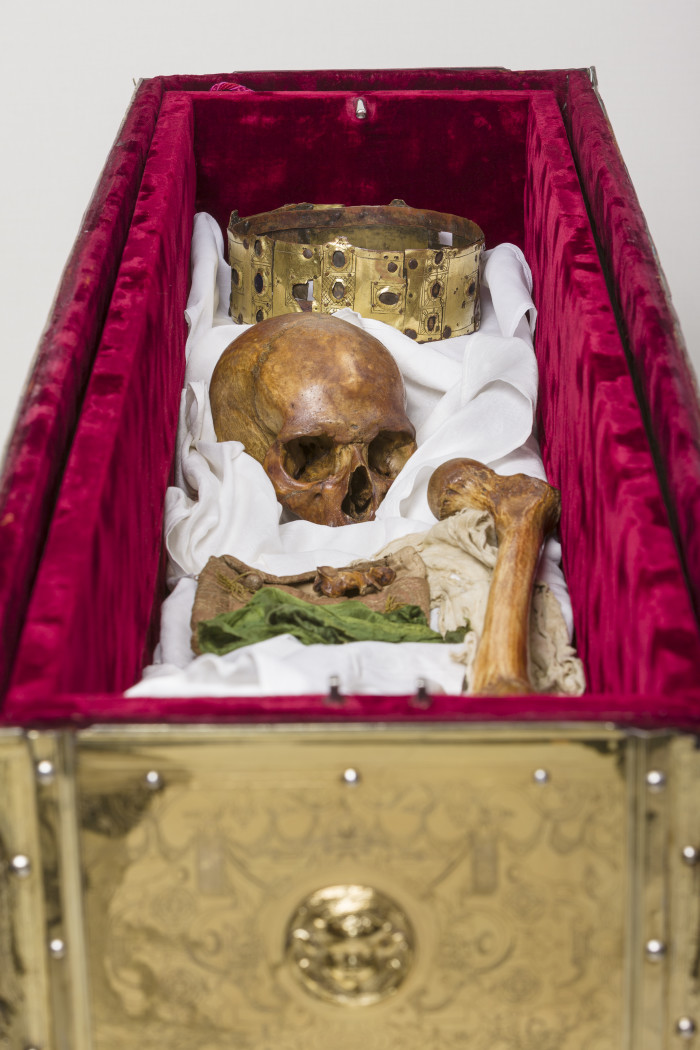
On April 23rd, 2014, researchers from Uppsala University opened a reliquary casket in Uppsala Cathedral to study the bones of King Eric IX of Sweden, the patron saint of Stockholm. The primary goal was to compare medieval remains to modern ones looking for changes in bone density for an interdisciplinary osteoporosis study, but while they were in the neighborhood, the research team examined the skeletal remains in the hopes of answering some questions about his national origins, health, diet and violent death.

The University has now released the first results of the study of Eric’s bones, and so far the osteological evidence is remarkably congruent with the stories told about him at least a century after his death. Since no contemporary writings about him have survived and the later histories are hagiographies that frame him as a saint in life, a martyr in death and a miracle-worker after death, it’s hard to know what’s fact and what’s legend. The study attempted DNA extraction and analysis, performed stable isotope analysis of his teeth, did a forensic examination of the bones looking for ante-mortem and perimortem wounds, radiocarbon dated the bones and enlisted orthopaedists and radiologists to determine his vital statistics and state of health.

There are 24 bones in the casket, 23 of them from the same person, plus one random shinbone. The group of 23 are the bones of a man about 35-40 years old who was 171 centimeters tall (5’7″). CT scans found no medical conditions evident on the bones. He did not have osteoporosis or suffer any kind of bone loss. On the contrary, his bone density was 25% greater than the average young man today. Eric was strong and very physically fit. Radiocarbon dating results are consistent with his having died in 1160.

Stable isotope analysis found one reason for his excellent health: he ate a great deal of freshwater fish. Kings had access to a great quantity and variety of animal protein, thanks to plentiful game and freshwater fish available on great estates. Eric ate both land animal protein and fish but emphasized the latter.This conforms to accounts of him in the hagiographies which describe him as fasting often out of religious devotion. Fasting in the Middle Ages didn’t require abstention from all food. It was usually meat that was excised from the diet, sometimes extended to animals products — butter, milk, cheese, eggs — during penitential seasons like Lent. The more extreme strictures were primarily observed by monks or individual ascetics. For lay Christians over most of the liturgical calendar, there were three fast days: Wednesday (the day Judas took 30 pieces of silver to betray Christ), Friday (the day Christ was crucified) and Saturday (the day dedicated to the Virgin Mary). Game birds like swan and peacock that only the aristocracy had access to were exempt from the no-meat rule.

Wounds on his bones also seem to fit the stories about Eric. His cranium had one or two healed wounds, possibly inflicted by sharp weapons. He fought a war, some call it a crusade, against pagan Finland, which would have afforded him plenty of opportunities for this kind of injury. The unhealed wounds inflicted at the time of his death match his story even better.

The saint’s legend says that in the king’s final battle, the enemy swarmed him, and when he fell to the ground they gave him wound after wound until he lay half dead. They then taunted him and finally cut off his head. The remaining bones have at least nine cuts inflicted in connection with death, seven of them on the legs. No wounds have been found on the ribs or the remaining arm bone, which probably means that the king wore a hauberk but had less protected legs. Both shin bones have cuts inflicted from the direction of the feet, indicating that the victim lay on his front.

A neck vertebra has been cut through, which could not have been done without removing the hauberk, i.e. not during battle. This confirms that there was an interlude, as described by the taunting in the legend, between battle and decapitation. At no point do the documented wounds gainsay the account of the fight given by the much later legend.

One thing that contradicts the hagiographies was an isotope analysis finding that suggests he spent the last decade of his life not in Uppsala, but in the southern province of Västergötland. This is only a preliminary finding, however, since stable isotopes have to be compared to previously recorded values in order to determine geographic locations and there’s still a lot of comparing to be done.

DNA analysis is still pending as well. Researchers were able to extract DNA samples successfully, which is a major hurdle to leap when dealing with 900-year-old bones. The DNA analysis is expected to take another year. They have DNA from King Magnus III of Sweden (reigned 1275-1290) who was descended from Eric IX through his mother Ingeborg. They will be compared to confirm the bones are indeed Eric’s.

Buckle from British Isles found in Danish Viking grave

A buckle of Scottish or Irish origin has been discovered in the grave of a Viking woman in Enghøj on central Denmark’s Jutland peninsula. The gilt bronze disc is a small piece of six centimeters (2.4 inches) with a Greek key-like geometric pattern that was made in the 9th century. The woman who took it with her to the grave died in the 10th century, so it was already decades, maybe even a century, old when it was buried in Denmark. She used it to keep her petticoat together.

Archaeologist Ernst Stidsing from the Museum East Jutland realized right away that it was a very unusual piece. He’d never seen anything like it before, so he sent pictures to Emerita Professor Else Roesdahl of Aarhus University. She had never seen anything like it either. Stidsing shared the pictures with English and German colleagues and they agreed that it was made in the British Isles. Having only the ornamentation to go on, the experts disagreed on whether it was of Irish manufacture or from southern Scotland.

They were certain that it didn’t start out as a buckle or brooch. It was a fitting from a shrine of some kind, stripped off a wooden box used to hold sacred objects. It’s therefore not a trade piece. Monasteries and churches weren’t in the practice of prying the decoration off their reliquaries and selling them to Vikings. This was acquired in a raid.

Viking loot from Britain and Ireland is very rare in Denmark, all the more so in a grave. It’s more common, albeit still a rarity, in Norway, where several examples have been discovered. A reliquary and fragment of an English 8th or 9th century crozier were found in the grave of a Viking woman in Romsdal, Norway, in 1961. A direct parallel, a Celtic disc, also originated in Scotland or Ireland as decoration on a shrine or reliquary. The Vikings converted into a brooch and it was buried the grave of a high-status woman in Lilleberge, Norway, in the 9th-10th century. It was unearthed in 1886 but kept in a soil block and only fully excavated and identified a few years ago.

Ernst Stidsing thinks there may have been a Norwegian connection for the Enghøj buckle.

“It could have been [brought by] a Norwegian woman who came to Denmark with her jewellery, and lived and died there,” says Stidsing.

He now hopes that strontium isotope analysis of the woman’s teeth could clear up where she came from.

“I’m pretty excited about the outcome of the analysis,” says Stidsing. “Especially as the Norwegian Vikings were often on expeditions to the north of England. It’s exciting that a woman may have come from Norway and have lived part of her life in Jutland [west Denmark].”

“It will confirm the picture that we were already [living] in a globalised world back then,” he says.

That picture was solidly confirmed most recently when Egtved Girl, the Bronze Age young woman whose exceptionally preserved burial complete with hollowed out tree trunk coffin, clothing, grave goods, textiles and accessories has become a Danish icon since its discovery in 1921, was actually from Southern Germany. Egtved Girl was a very important person even though she was only 16-18 years old when she died, a priestess or a dynastic bride, and it’s known that there were marriages between Danish kings and Slavic princesses starting in the 10th century. The woman who was buried with the buckle had status and wealth, but she wasn’t a princess. If isotope analysis finds that she was from Norway or somewhere else other than Denmark, it will give new insight into how mobile Vikings were at various social levels.

35,000-year-old Twitter logo found in France

In 2003, a salvage excavation in advance of highway construction in the Dordogne region of southwestern France discovered a dense group of prehistoric occupations, 10 sites in an area of less than two square miles. One of them, Cantalouette II, is an open-air site that was used as a flint workshop, as evidenced by the large quantity of flakes and knapping debris. There are seven layers, ranging in date from the Middle Pleistocene to the Holocene. In the Aurignacian layer (35,000 – 31,000 years old), archaeologists found a remarkably naturalistic bird (pdf) engraved on a flint flake. Other engraved flakes were found at the site, but none of them were figurative. In fact, this is the first example of figurative art discovered in an open-air Aurignacian site.

The bird is depicted with its head raised and its wings open, parallel lines representing the feathers. The beak is short, thin and pointed. A single eye is visible with a small line underneath that may represent an undereye feature. A projection on the left side of the bird may be the legs or the tail. It’s a capture of dynamic action, a bird in the moment of drinking, courting or about to take flight. Or express itself it in 140 characters.

Another unique feature of this piece, besides a silhouette so reminiscent of Internet-era iconography, is the style of engraving. Usually artwork from the Upper Paleolithic period is an incised outline. Some of the details may give the impression of relief and in very rare cases actual reliefs have been found, like the friezes of the Roc-de-Sers rock shelter (ca. 17,000 B.C.). The bird of Cantalouette II, however, is the opposite of the Roc-de-Sers animals in that it was made by the removal of the material inside the figure, not by the carving away of material outside of it leaving a high relief behind.

This sunken relief is unique among the Aurignacian artworks. The technique has never been seen before. To better understand the engraving process, researchers recreated it experimentally and found it was completed in six phases. First the outline was incised, then the interior was scraped with stone tool that left a wavy surface. The third step was adding detail to the head and beak with an L-shaped bevel. Another bevel was then engraved to add dimension to the upper left wing area. In phase five, the artist micro-pecked the inside of the head giving it a distinctive rough surface that conveys the different type of feathers birds have on their heads as opposed to their wings. Lastly, the eye and the subciliar line were added.

Also rare is the subject matter. Upper Paleolithic animal figures are more often land-based — horses, bovines, ibex, bison — and while birds have been found before, including the fragment of an outline bird figure at Roc-de-Sers, none of them are so naturalistic and detailed. Roc-de-Sers dates to the Magdalenian period of the Upper Paleolithic, thousands of years after the Cantalouette II bird was carved. Narrowing it down specifically to the Aurignacian period, there are only two other known birds: an ivory water bird from Hohle Fels (ca. 39,000-34,000 years old) and an owl in the Chauvet cave. Neither of them have the same attention to detail as the Cantalouette II bird. Because of those details, experts were able to compare its features to birds found in the fossil record of Upper Paleolithic southwestern France. The likeliest candidates are the passerine, the wryneck or partridge/quail.

After all this trouble, the piece was simply discarded onto the pile of lithic fragments, the detritus of the prehistoric tool-making workshop. It wasn’t meant to be permanent like rock art on walls. It wasn’t even meant to be portable, like something pretty to wear or display. It seems to have been the artistic impulse of a flint knapper who, having completed his oeuvre, threw it away.

This engraving is distinct in the rarity of the animal depicted and the use of innovative techniques. They suggest an absence of rigid artistic traditions and techniques during the Aurignacian. This absence of canons is in fact characteristic of Aurignacian art, despite certain convergences, such as the depiction of dangerous animals in the Swabian Jura, Dordogne, Adèche and northern Italy. At the doline site of Cantalouette II, the artist was thus free to “test” other manners of representing volumes and outlines. The artistic liberty of this artist can be correlated with that of the Aurignacian flint knappers in the Bergeracois region, who surpassed their technical skills by producing unusually large blades. The object itself, discarded in a flint knapping workshop, suggests the existence of an ephemeral form of artistic expression, a behavior previously unknown in the Aurignacian, and which raises questions about the function of the earliest figurative art in Europe.

Torlonia collection to see the light after 40 years in the basement

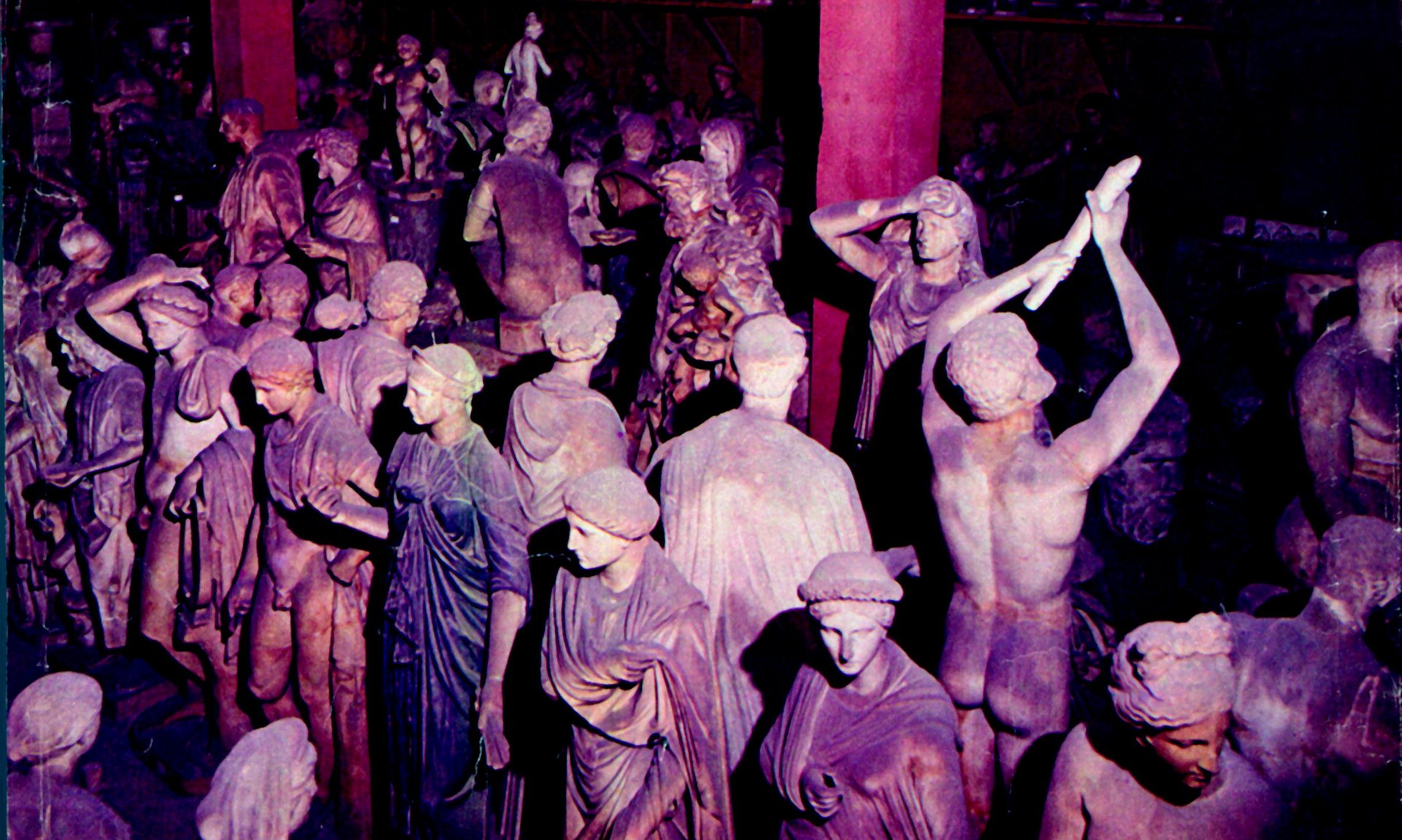
One of the most important private collections of ancient sculpture in the world hasn’t been on display in four decades. In fact, it really hasn’t been on public display since the 19th century. The Torlonia family’s collection of antiquities, 620 world-class Greek, Roman and Etruscan statues and sarcophagi, has been favorably compared without hyperbole to the ancient sculpture collections of the Capitoline and Vatican Museums, and the Italian government has tried for years to craft an agreement with the family that would allow these unique treasures to be seen by the public. On Tuesday, March 15th, Culture Minister Dario Franceschini announced that the long-sought agreement has been reached and about 60-90 of the most important pieces in the Torlonia collection will go on display in 2017. The details haven’t been worked out yet, but the likely venue will be the Palazzo Caffarelli Clementino on the Capitoline Hill.

The Torlonia family are new, by Roman standards. The founder was Marino Torlonia, born Marin Tourlonias in Auvergne, France, in 1725. He moved to Rome and became the manservant of powerful Neopolitan cardinal Troiano Acquaviva d’Aragona, best remembered today for having employed Giacomo Casanova in 1744 only to dismiss him when he was discovered hiding a teenaged runaway in the cardinal’s residence on the Piazza di Spagna. Acquaviva died in 1747, leaving Marino Torlonia an inheritance which he used to set himself up as a textile merchant.

The business was successful and Marino parlayed some of his income into a small lending concern. When he helped Pope Pius VI with some pesky financial matters, he was granted the title of duke. It was his son Giovanni Raimondo Torlonia who took both businesses and ran with them. He made savvy deals with the French occupiers under Napoleon and when the French troops left after the Treaty of Paris in 1814, Giovanni was flush with cash, cash the old noble families distinctly lacked. The Banco Marino Torlonia was delighted to loan them money with their estates and furnishings as collateral.

Pope Pius VII granted Giovanni Raimondo Torlonia a princely title in 1814, the first of many. Just two generations removed from Marin Tourlonias, the Torlonia family was one of the richest in Rome, as ennobled as it could be and, thanks to advantageous marriages, related to some of the greatest noble houses of the city — the Colonna, Orsini and Borghese. When those loans went into default, the Torlonia family accumulated lands and artworks by the cartload, including pieces from the Orisini, Cesarini and Caetani-Ruspoli families and a prized 17th century collection of ancient sculptures from the Giustiniani family.

Not that they needed the loan collateral to make out like bandits. After the upheaval of the Napoleonic period, many noble families were compelled to sell their properties and private collections. The great collection of dedicated antiquarian Cardinal Alessandro Albani was sold along with his Roman palace, Villa Albani, to the Chigi family who in turn sold it to the Torlonia. Giovanni also bought more than a thousands pieces from the estate of sculptor and restorer Bartolomeo Cavaceppi, among which were important sculptures Cavaceppi had acquired from the collections of the Savelli, Cesi and Pio da Carpi families.

Their extensive property holdings proved invaluable sources of ancient statuary as well. Draining swamps and developing lands, the Torlonia unearthed antiquities hand over fist, particularly from the man-made Roman harbour of Portus, the town of Fiumicino where Leonardo da Vinci Airport now stands, and the ancient Etruscan cities of Vulci and Cerveteri

In 1859, Giovanni’s son Alessandro founded a private museum in one of their palaces on the Via della Lungara. The sculptures, including about a hundred Roman portrait busts from the late Republican and Imperial period so prized many scholars consider them superior to the busts in the Capitoline and Vatican Museums, were installed in the 77 rooms of the palace. Already by the 1870s the public was not allowed inside the museum. I can’t confirm whether they ever were, for that matter. Alessandro Torlonia granted access only to his aristocratic friends and occasionally to experts. The collection was catalogued repeatedly in the 1870s and 1880s. Some of the catalogues were illustrated with photographs, among the first in Italy to be printed with pictures instead of drawings. (here’s a text-only example from 1881)

In the 1960s and 1970s, the collection was gradually packed up and stored, perhaps in other Torlonia properties, perhaps in the basement of the old museum. Another Alessandro Torlonia, great-grandson of the museum’s founder, got permission from the government to repair the roof, but those repairs proved to be a smokescreen for an illegal subdivision of the palace into 90 tiny apartments. A 1979 judgement from Italy’s supreme court of appeals found that the sculptures had been stored in “narrow, insufficient, dangerous spaces […] removed from the museum […] crammed together in unbelievable fashion, leaned against each other without care for consistency or history.” The court ruled that the private owner should pay a fine to the state equal to the value lost or diminished by this dire, careless treatment of cultural patrimony. That ruling was never enforced.

With tension between the state and the family, the past 40 years have seen many long negotiations go nowhere. Finally the parties have managed to come together, although the vast majority of the Torlonia sculptures will not be on display, at least not right away. I hope this is just a first step. None of these works should be gathering dust in basements.

The history of this collection, how it was amassed from acquisitions, debt collections and excavations on Torlonia properties, may be a central theme of the first exhibition. It’s particularly relevant to the Torlonia collection as opposed to some of the older ones built gradually by noble families over the course of centuries. The way entire collections were absorbed by the Torlonia makes for a unique perspective into the history of antiquities collection in Rome, with built-in organizational divisions, like, for instance, the pieces from the Cavaceppi collection in one section, the pieces from the Giustiniani collection in another. The sculptures unearthed on Torlonia estates could be in another section.

Again, it’s still in the early stages, but the Ministry is hoping to make this a traveling exhibition. After the Roman show, the treasures of the Torlonia collection will go to top museums in Europe and the United States. Eventually a permanent place will be found for it back home in Rome.