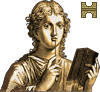
Terracotta head found at Magna Roman Fort

A rare terracotta head of a female figure that looks like a rough-hewn version of one discovered 40 years ago has been discovered at Magna Roman Fort on Hadrian’s Wall in Northumberland, northern England. The terracotta head was discovered last June by volunteers Rinske de Kok and Hilda Gribbin while excavating a ditch fill from the 3rd century.

The head depicts a female figure with a striking four-strand plaited hairstyle on both sides of a center part. It is broken below the nose, a remnant 3 inches high by 2.6 inches wide.

Roman artefact specialist Lindsay Allason-Jones commented:

“It appears to me that this has been a practice piece by an inexpert hand… the eyes do not match at all, and the ears are very weird. That leads me to presume it was made on site as no-one would have bothered to transport this very far or paid good money for it!”

A more sophisticated and complete terracotta figure with the same hairstyle was discovered at a farm at Carvoran (the modern town where the Magna site is located) in the 19th century. Now held in the stores of the Great North Museum: Hancock, the head is intact with a bust that shows the draping of a garment and a pattern of dots around the neck that implies a beaded necklace. The hairstyle, large ovoid eyes, straight, slim nose and placement of the ears are very similar on both figures.

Rachel Frame, Senior Archaeologist at Magna, said:

“There are clear similarities between the two heads from Magna, they are clearly meant to depict the same figure.” She added, “My current hypothesis is that the 2025 find is a locally made copy of the earlier example, which may itself have been imported. The woman depicted was clearly important to the people living at Magna.”

The terracotta head fragment is now on display at the Roman Army Museum along with other discoveries from the last dig season at Magna Roman Fort.

Bronze Neptune from Lyon arrives in Rome

The Neptune of Lyon, one of the largest and most important bronze statues from Roman Gaul, has arrived in Rome for a one-time guest starring appearance at the Giovanni Barracco Museum of Ancient Sculpture. The statue is in the permanent collection of the Lugdunum Musée et Théâtres Romains in Lyon, and is being loaned to the sculpture museum as part of an extraordinary exchange of ancient works between the two cities.

The statue is 4’8″ in height and stands on a round base. It was made of hollow cast bronze in a local workshop in the 3rd century A.D. It is the largest bronze statue of Neptune ever discovered in France, and one of the largest surviving bronzes from Roman Gaul.

His “wet curls” hairstyle (a cap of curls clinging close to the head as if he’d just emerged from the water) identifies him as Neptune rather than another wavy-haired bearded deity like Zeus. While the objects he was holding in his hands were lost, the position of his hands compared to other statues suggest he originally held a trident in his left hand and a dolphin in his right.

The bronze was discovered in the Rhône river, between the Hôtel-Dieu bridge and the Guillotière bridge in 1859. The large size of the statue indicate it was publicly placed in a temple by the river, perhaps erected by the “renunclarii,” the guild of boatmen who dedicated a marble statue of Neptune just down the Rhône at Arles. Shortly after its discovery, the statue was given to the Museum of Fine Arts of Lyon, at that time home to city’s archaeology collection. It was transferred to the Lugdunum Musée et Théâtres Romains, the museum dedicated to the Roman history of Lyon, after it opened in 1975.

In honor of its 50th anniversary, the museum is running a major exhibition C’est canon. L’art chez les Romains, which explores Roman attitudes towards art and artists. It brings together an unprecedented assemblage of statues, reliefs, jewelry and artifacts from other museums in France and Italy. Many of the pieces on loan from French museums have never been seen before in Lyon, and a number of masterpieces from museums in Italy have never been seen before in France.

The Giovanni Barracco Museum, part of the Rome Capital Museum System, is one of Rome’s most sparkling and least known gems. Giovanni Barracco was a Calabrian nobleman, intellectual and politician who served as member of parliament and senator for years. He was an avid collector of ancient sculpture, putting together great works of Egyptian, Assyrian, Cypriot, Etruscan, Greek and Roman art.

He was highly selective and had impeccable taste, so when he generously decided to donate his sculpture collection to the City of Rome, it consisted of 200 exceptional pieces. The city gave him a plot of land on the Corso Vittorio Emmanuele and he worked closely with the architect to design a charming Neo-Classical building with a façade designed to look like an Ionic temple to house his small but spectacular collection.

The museum opened in 1905, so it celebrated its 120th anniversary as the Lugdunum Musée et Théâtres Romains celebrated its 50th. It is now undergoing renovations, and while some spaces are unavailable, the Lyon Neptune will be the centerpiece of the ground floor gallery. The exhibition opened yesterday and will run through June 7th.

Victorian school slates, marbles found in London

An excavation in central London has uncovered the remains of a boys school complete with artifacts from the students’ schoolwork and their playtime. The objects include a slate tablet used as an erasable notebook to practice handwriting, a slate pencil and several ceramic alleys — marbles made of decorated white ceramic — from the Victorian era. Artifacts related to children’s lives are less frequently found than ones relating to adults, so these objects give us a special glimpse into the lives of schoolboys.

A team from the Museum of London Archaeology (MoLA) excavated the site in the dockland district of Wapping ahead of development, uncovering the remains of a chapel, alms houses, terraced housing and associated cesspits as well as the school. The structures date to between 1500 and 1800, and the schools and alms houses were still active there in the 1870s.

The school was founded in 1536 by Sheriff of London Nicholas Gibson and his wife Avice. It was dedicated to the education of 60 poor boys. The couple also founded the alms houses for widowed women of limited means in the same location. After Nicholas Gibson’s death, Avice handed over management of the institutions to the Worshipful Company of Coopers, the barrel-makers guild which was well-funded and charitably inclined. The school still exists today, although it moved from Wapping in the late 19th century and is now a co-ed secondary school of excellent academic reputation known as the Coopers’ Company and Coborn School in Upminster.

The marbles date to the last stage of the school’s presence at the site. They were discovered in a Victorian-era brick lined drain. It’s possible they were lost in a rousing game of marbles during recess at the school. The name “alleys” is short for alabaster, and they were decorated with green, red, purple and blue stripes and swirls to make them look like veined alabaster. (I think they look more like planets or plaids.)

The corner of a slate writing tablet was found next to the drain. It is covered with what look like grid lines, scribbles and a looped handwriting. Paper was not readily available to schools in the 19th century. Slate tablets were used for math and handwriting exercises, done with a sharped slate cylinder that made a lighter grey mark on the dark tablet. The pencil marks could be wiped clean with a cloth or sponge. Tablets were usually set in a wooden frame and could be pierced with a hole at the top to tie the pencil to the tablet. This tablet fragment has none of the wood frame remaining, but it does have a hole at the top.

Trepanned skull of giant found in Viking-era mass grave

A mass grave from the 9th century containing mixed skeletal remains including the trepanned skull of an extremely tall man has been discovered on the outskirts of Cambridge, UK. A team of University of Cambridge students and professional archaeologists  The find site was a frontier area between the Saxon kingdom of Mercia and East Anglia, conquered by the Vikings in 870 A.D. so the mass grave may be related to constant armed conflict in this border region in the decades after the Viking invasion.

The burial pit contained a mixture of complete articulated skeletons and bones from dismembered body parts, including scattered limbs, a stack of legs and a pile of skulls. There are at least four complete skeletons and their positions suggest they were bound before being buried. The severed heads and limbs were thrown in the pit on top of them. Based on the number of skulls, archaeologists estimate the grave contains the remains of up to 10 different individuals, all of them younger men.

One of the men thrown into the pit was exceptionally tall, about 6’5″, which more than a half foot above the average height for men in the UK today, never mind in the 9th century when the average height for an adult man was around 5’6″. He was between 17 and 24 years when he died. It was his skull that had the trepanation hole in the side. The elliptical hole is 3cm across and was evenly cut, drill or scraped with a sharp tool. The bone edges were healed, so we know he survived the operation, but the new growth conceals the evidence of what tool was used.

“The individual may have had a tumour that affected their pituitary gland and caused an excess of growth hormones,” said Dr Trish Biers, curator of the Duckworth Collections at the University of Cambridge, where these remains have been taken for further analysis.

“We can see this in the unique characteristics in the long shafts of their limb bones and elsewhere on the skeleton. Such a condition in the brain would have led to increased pressure in the skull, causing headaches that the trepanning may have been an attempt to alleviate. Not uncommon with head trauma today,” Biers said.

The mass grave was discovered just south of the ringwork of an Iron Age hillfort in Wandlebury Country Park. This is actually the second mass burial from the 8th-9th century period found at Wandlebury. The first was discovered close to the current dig site in 1976 when a tree was uprooted during a storm. It contained five skeletons, all of them complete.

The combination of complete skeletons and disarticulated remains in the recently excavated burial pit is very unusual. Only one of the heads displays chop marks on the jaw consistent with decapitation and a few other bones show signs of combat injuries, but this is too meager evidence to indicate the deceased were killed in battle.

However, to have severed heads, limbs and other remains – from ribs to pelvises – tossed in a pit, with body parts of the same type stacked together in some cases, piled on top of four dead men, at least one apparently bound, suggests terrible violence and perhaps an execution, according to CAU’s Dr Oscar Aldred.

“Those buried could have been recipients of corporal punishment, and that may be connected to Wandlebury as a sacred or well-known meeting place. It may be that some of the disarticulated body parts had previously been displayed as trophies, and were then gathered up and interred with the executed or otherwise slaughtered individuals,” Aldred said.

“We don’t see much evidence for the deliberate chopping up of some of these body parts, so they may have been in a state of decomposition and literally falling apart when they went into the pit.”

The team will now subject the bones to DNA and stable isotope analysis to find out more about the health, origins and kinship links of the deceased. They will also attempt to puzzle together the disarticulated remains to see if they can reconstruct skeletons and determine how many people’s remains are in the pit.

$40 estate sale find by early African-American silversmith sells for $24,000

A unique silver pap boat made by pioneering American silversmith of African descent Peter Bentzon has been sold to an as-yet unnamed “prominent American institution” for $24,000 after being discovered at an estate sale in Minnesota in a $40 box labelled “silverplate.” The young buyer spotted Bentzon’s hallmark and realized he’d hit the estate sale jackpot.

A pap boat is a shallow elongated bowl with a pouring rim on one side that was used to feed babies or sick people with a thin porridge (aka pap). The pap was highly digestible nourishment that could be given to someone who was too young or too ill to chew. The boat-like shape and pouring lip made holding the bowl and feeding easier. This one is less than five inches long and three inches wide. It weighs 69 grams. The flat bottom of the boat is stamped P. BENTZON in capital letters embedded in a rectangle. It dates to between 1810 and 1820.

Peter Bentzon was the only silversmith of African descent working in early America whose silver pieces can be identified by his personal hallmark. He was born on the island of Saint Thomas to a mother of mixed Afro-Caribbean heritage and a white European father believed to have been Norwegian Jacob Bentzon, a lawyer and royal judge advocate on the island. Peter was just eight years old when he was sent to Philadelphia to become an apprentice to a silversmith. He worked there from 1799 to 1806, then moved back to the Caribbean where he opened his own shop in Christiansted, St. Croix. He worked there for 10 years, marrying Rachel de la Motta, a free woman of color from a prominent family and ultimately having seven children.

Bentzon and his family moved back and forth between St. Croix and Philadelphia. He had an active trading business as well as the silversmith shop. He must have passed for white in Philadelphia as the 1820 census listed both him and his mixed wife as white. They last appear on the census in 1850, and there are no records of his death.

Fewer than 30 pieces of Bentzon silver are known to survive today. Most of them are small flatware (teaspoons) or implements like a nutmeg grater that sold for $40,000 at Sotheby’s in 2021. His two largest and most famous pieces are a pair of identical teapots made for Rebecca Dawson, member of a prominent Philadelphia Quaker abolitionist family, in 1817. One of them is now in the Saint Louis Art Museum; the other in the National Museum of African American History and Culture in Washington, D.C. Even his teaspoons are in museums. The Philadelphia Art Museum has one, and another well-known piece: a footed cup he made in 1841 for Reverend Benjamin Lucock, a presentation gift from the superintendent and teachers of St. John’s Episcopal Church Sunday School in St. Croix.