17th c. panel returned to church 30 years after it was stolen

A 17th century memorial painted wood panel stolen from a church in Hertfordshire in 1996 has been returned 30 years later, thanks to a keen-eyed Australian heraldry enthusiast.

The panel is 2’8″ x 2’2″ and contains a vividly painted coat of arms over a neatly lettered dedication. The inscription reads:

“At the upper ende of this midle ile lyeth intered the
Body of George Cordell Esquire, who served Queene
Elisabeth and was Sergeant of the Ewry to
King Iames & the late King Charles, in all Sixty yeeres:
Who maried Dorothy the only daughter & heyre of
Francis Prior of this parish, with whom he lives 57
Yeares & deceased the 25th of May 1653 he being
Aged 84 yeeres.”

Cordell’s and his wife’s families had deep ties to Flamstead and after serving as courtier to three monarchs (the Sergeant of the Ewry was in charge of all the linens and silverware for the royal table), he was buried at St Leonard’s Church. This marker was mounted on the north aisle wall.

The panel disappeared from St Leonard’s Church in Flamstead in April 1996. Authorities were notified at the time, and the theft was recorded in the database of the Art Loss Register in May. For decades there was no sign of it, and eventually the new staff and parishioners forgot about the purloined panel.

Then, all of a sudden on New Year’s Eve the vicar of St Leonard’s, Reverend Jo Burke, received an email from one Richard d’Apice, member of the Australian Heraldry Society in Sydney. He had perused the online catalogue of an auction at Dreweatts and spotted a panel painted with an elaborate coat of arms and a funerary inscription. This roused his nerdly suspicions, and a little detective work online led him to a description of the panel in the March, 1812, issue of The Gentleman’s Magazine which recorded it in St Leonard’s Church in Flamstead. The article quoted the full dedication, so there was no mistaking it for another piece.

After getting over her initial suspicions that this was a very weirdly specific new email scam, Reverend Burke had the church archivist search the church’s old files. They found a photograph of the panel and the ALR database information. On January 9th, Burke notified Dreweatts that the lot was stolen property. The company immediately withdrew it five days before the scheduled auction.

The seller had no idea it had been stolen and while Dreweatts had done their standard due diligence search in the ALR database, the panel had slipped through the search thresholds. ALR sent the seller a letter confirming the panel had been stolen in 1996 and registered with them since May of that year. The seller made arrangements for the church to pick up the panel, and two weeks later it was back home at long last.

The church is very happy as the panel is a “fascinating piece of local history”. The panel is now back with St Leonard’s and in a safe location until an appropriate display method can be purchased.

Burke added: “Our archivist and member of our Parochial Church Council is a retired curator of the British Museum and continues to have museum contacts. We are taking advice on how to display it securely.”

Rare Mithraic altars found in Scotland go on display for the first time

Two exceptionally rare and beautifully carved Mithraic altars found in Inveresk, East Lothian, Scotland, are going on display for the first time. They are not just the only Roman altars ever found in Scotland, but are among the finest examples of Roman sculpture in Roman Britain. They are also uniquely early in date, having been made in 140s A.D. during Antoninus Pius’ reoccupation of southern Scotland, whereas most other archaeological materials related to the worship of Mithras in Britannia date to the 3rd century.

The altars were unearthed in 2010. Inveresk was the site of a fort on the Antonine Wall and a bustling town grew around the military base. It was also home to the northernmost temple to Mithras in the Roman Empire, and the two altars were the focal points of the temple, which would have been an underground space, dark and windowless, resembling or even built into a natural cave. The altars were found broken in large fragments, and required extensive conservation work so they have never before been placed on public view.

One of the altars is dedicated to Mithras himself and bears the inscription “DAEO / INVICT· MY / C · CAS ·/ FLA” meaning “to the invincible god Mithras” followed by the abbreviated name of the man who erected the altar, probably Gaius Cassius Flavianus, likely the legionary centurion commander of the fort. The capital is finely carved with leaves and flowers over a turned rope border, and topped with two scrolls on each end. The center top features a raven, which may have been one of a pair but the spot where the other would have been is damaged. Ravens played an important role in Mithraic mythology as the messengers from the sun god Sol Invictus to Mithras. The sides of the altar are decorated with relief carvings of other Mithraic iconography, including a griffin and a patera on one side, and a lyre, plectrum, a lyre and a jug.

The second altar is dedicated by the same centurion to the god Sol himself. The face of the god was carved on the front of the solid stone altar in high relief, but then the center of the stone block was hollowed out from behind and the rays around the sun god’s head, his eyes and mouth were punched through to make them cutouts. His chin was also punched through, although that was by mistake. It was later rebuilt in plaster, but that plaster is now missing exposing the cleft. The altar would have been illuminated from behind, and in the dark, cave-like interior of the Mithraeum, the eyes, mouth and rays of the solar crown would have glowed brightly. On the capital of the altar, female personifications of the four seasons are depicted in relief, representing the passage of time.

There were rare surviving traces of the original polychrome paint visible on the altars when they were first unearthed. Conservators found more evidence of the color accents when examining the surface with ultraviolet light. They didn’t find enough to make a complete map of how the altar were painted, but they were able to clarify areas with red and blue outlines.

The new exhibition, Roman Scotland: Life on the Edge of Empire, runs from November 14th 2026 through April 28th, 2027, and the National Museum of Scotland in Edinburgh. It focuses on Rome’s attempts to conquer Scotland, how it was supplied and supported from the core of the Empire, the impact on the local population and the long-term effects of the occupation.

Dr Fraser Hunter, Principal Curator of Prehistory and Roman Archaeology at National Museums Scotland said:

“These stunning altars really bring the beliefs of the Roman frontier to life. The quality of the carving, traces of paint and dramatic lighting effects show they were impressive and expensive monuments. The cult of Mithras represented the triumph of good over evil and gave soldiers a sense that there was a purpose to their world and a life after death.[…]”

Great hall from 4th c. bishop’s palace complex found in Ostia

The remains of a monumental hall belonging to a 4th-century episcopal palace have been discovered at Ostia Antica, Rome’s ancient port town. The base of the structure is eight by 20 meters (ca. 26 by 65 feet) and the walls were an estimated eight meters high. This is an extraordinarily large space, and it was richly decorated with mosaic floors and marble panels. It is one of the oldest Christian complexes ever discovered the environs of Rome, and its rich decoration and expansive facilities are on a scale previously unknown in the Constantinian period.

The archaeological remains of the 1,700-year-old structure lay hidden just inches below the topsoil, scraped and dislodged but not severely damaged by centuries of agricultural activity just above it. In fact, farming helped preserve the remains.

Ultimately, it was fortunate that the farmers continued to use the land until the Ostia Antica Archaeological Park near Rome was established. “Here, no buildings interfere with our excavations – we hardly have to take graves or anything like that into consideration,” says Prof. Dr. Sabine Feist of the Department of Christian Archaeology at the University of Bonn. A favorable situation for research – and not only for that reason: “We know of other churches from this early period, but these were completely altered in the Middle Ages.” That didn’t happen here either.

The newly-discovered structure is adjacent to a monumental church complex discovered by geophysical surveys in 1996 and excavated in 2023-4. The church was built around 330 A.D., late in the reign of Constantine (306-337 A.D.) on the remains of a Roman insula (apartment building). Measuring about 50 by 80 meters, the church complex covered 4,000 square feet and included am adjacent bishop’s residence.

For such an elaborate complex to have been built when Christians had only recently been granted legal rights (Edict of Milan, 313 A.D.) and freedom of worship is evidence of a well-organized Church apparatus, capable of emerging from the penumbra of private and literal underground spaces straight into sophisticated, large-scale architectural developments.

The Bishop of Ostia was an important church leader in the Early Church. He held the position of Cardinal Dean, charged with convening the conclave of cardinals to elect a new pontiff after the death of a Pope. The exact location of his titular church and residence were unknown until the 2023-4 excavation confirmed the identity of the building complex.

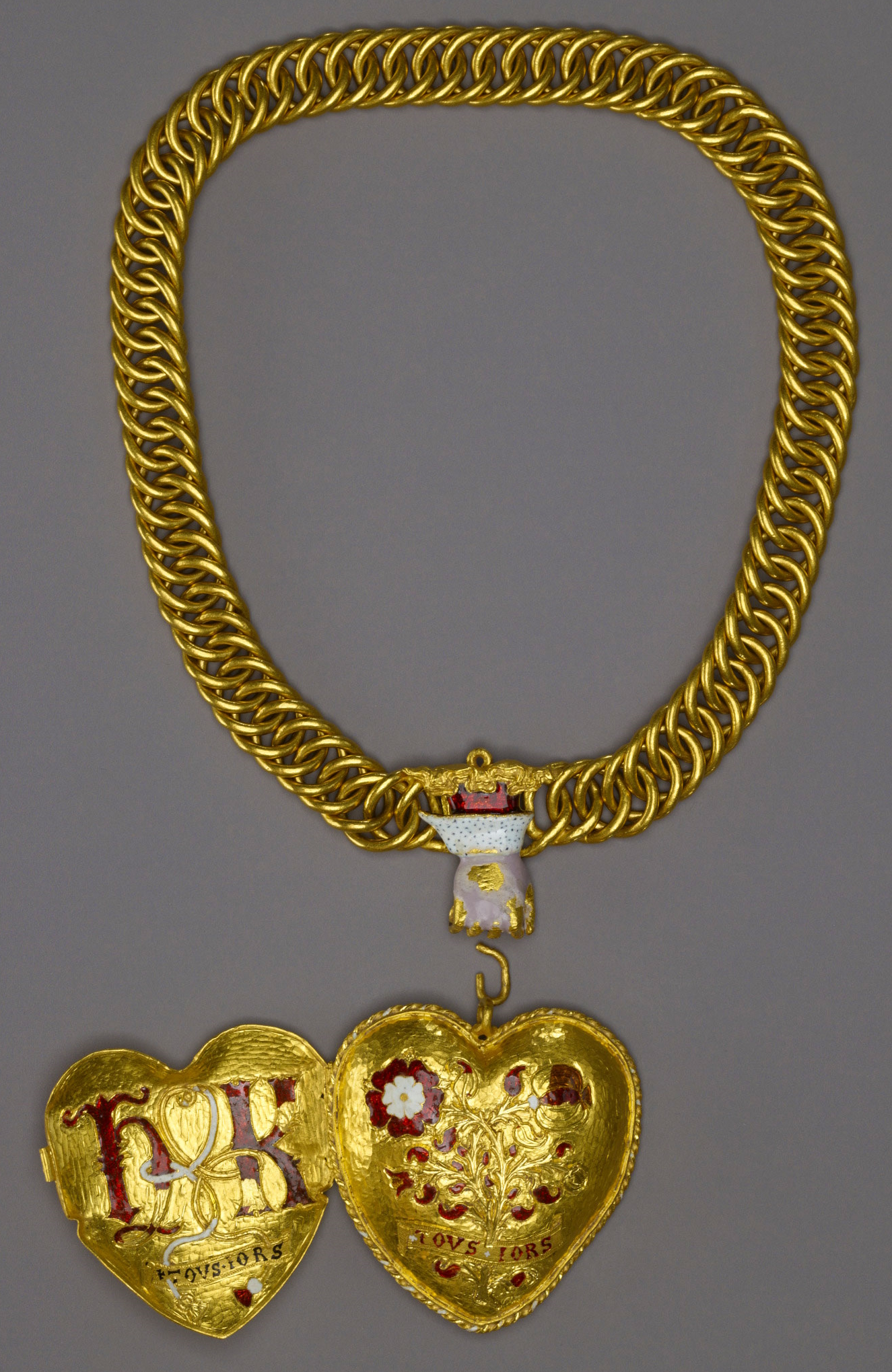
British Museum acquires Tudor Heart

The British Museum’s campaign to raise £3.5m ($4.7m) to acquire the unique Tudor Heart gold and enamel pendant commemorating the marriage of Henry VIII to Katherine of Aragon has reached its goal.

The gold pendant is engraved with a Tudor rose representing Henry VIII entwined with a pomegranate representing Katherine of Aragon decorated in red and white enamel. It features an H and a K on the reverse side, also enameled in red and white. A banner with the lettering + TOVS + IORS (the French “toujours” meaning “always”) is on both sides of the pendant. It was found with a thick gold link chain with a gold enamel gloved hand at one end functioning as a clasp. The total weight of the set is 317 grams of 24K gold.

British Museum researchers believe it was commissioned to celebrate the betrothal of Henry and Katherine’s daughter Princess Mary, then two years old, to Francis, Dauphin of France, then eight months old, in 1518. This is why it emphasizes love and marriage, and specifically the marriage of Henry and Katharine. The betrothal was called off in 1521, and Henry rousted Katharine from his court in 1531, ultimately divorcing her in 1533 to marry Anne Boleyn.

The Tudar Heart was discovered by a metal detectorist in Warwickshire on December 13th, 2019, a very fortunate Friday the 13th. It was reported to the Portable Antiquities Scheme and declared Treasure. A valuation committee assessed its market value at £3.5m. Any museum that wished to acquire this unique jewel had to pay that sum to be divided between the metal detectorist who made the discovery and the owner of the land where it was unearthed.

The fundraising campaign was launched last October with a deadline of April 2026, but they hoped to meet the goal by Valentine’s Day, to go with the motif of the heart-shaped pendant. Because of the high cost of the piece, both in gold alone and its priceless historical value, the museum appealed to the public for donations and to trusts and art organizations for grants. The campaign got a huge response. Celebrities like Damian Lewis, who portrayed Henry VIII in the BBC’s Wolf Hall series, promoted the appeal. Ultimately, small donations from more than 45,000 members raised £360,000, The National Heritage Memorial Fund contributed £1.75m, The Julia Rausing Trust £500,000, the Art Fund £400,000, and The American Friends of the British Museum £300,000.

“I want to say a heartfelt thank you to everyone who supported our campaign,” [Museum director Nicholas] Cullinan said.

“This beautiful survivor tells us about a piece of English history few of us knew, but in which we can all now share.”

Simon Thurley, chairman of the National Heritage Memorial Fund, said: “The Tudor Heart is an extraordinary insight into the culture of Henry VIII’s court, and I am delighted that Memorial Fund support will enable it to go on public display.”

The museum hopes to formally include the pendant in the collection later this year, and has plans for it to tour the UK in the future.

Phoenician scarab found at Nuragic site in Sardinia

An excavation at the Nuragic site of Ruinas in Sardinia has unearthed a Phoenician scarab seal, produced 2,700 years ago in what is now Lebanon. The scarab is made of steatite stone and has a flat side engraved with hieroglyphic-like symbols.

The scarab, currently undergoing a delicate conservation process and a battery of non-invasive diagnostic analyses in the laboratories of the Archaeological Superintendency, presents a morphology well known in the glyptic tradition of the ancient Near East. Its surface, precisely worked in soft but durable steatite, shows incisions of hieroglyphic characters that will be the subject of detailed decipherment once the stabilization work has been completed.

According to the conventions of the time, these objects fulfilled a dual practical and symbolic function: they served as protective amulets, frequently worn around the neck, and acted as seals of authority or property, whose impression in clay or wax was unique and unrepeatable given the exclusive design of each piece, which explains the variability that exists among the thousands of known scarabs.

Phoenicians established several coastal settlements on Sardinia, part of their extensive trade network of colonies and trading posts that spanned the whole Mediterranean between the 9th and 6th centuries B.C. The scarab, however, was found in the deep rugged interior of the island occupied by the Ilienses, a Nuragic people credited by ancient sources as the oldest population on Sardinia, inhabiting the interior since the Bronze Age.

A number of artifacts that had to have been imported from long distances have been discovered in Ilienses territory, including pottery from Mycenaean Greece and oxhide-shaped copper ingots believed to have produced in Cyprus. In return, characteristic Iliense grey pottery dating to between the 14th and 13th centuries B.C. has been found in the Minoan palace of Knossos in Crete.

For some scholars, such as the archaeologist Giovanni Ugas, the Ilienses represented the most important population of nuragic Sardinia and could be directly or indirectly related to the Shardana, one of the so-called Sea Peoples who appear in Egyptian records as mercenaries and adversaries of the pharaohs.

The scarab of Ruinas thus fits into a pattern of contacts that can no longer be described as sporadic or merely incidental. Its Phoenician provenance adds a new layer of complexity to the map of interactions, showing that the nuragic communities of Barbagia maintained links with multiple cultural centers of the eastern Mediterranean, not only with the Aegean-Mycenaean world.

The piece is a personal object, a movable good of value that traveled more than two thousand kilometers by sea and land, crossing cultural borders, until ending its useful life in a mountain village of inland Sardinia. Its presence materializes the commercial networks, prestige flows, and perhaps the movements of specialized individuals (artisans, merchants, smiths) who connected the Levant with the insular West.