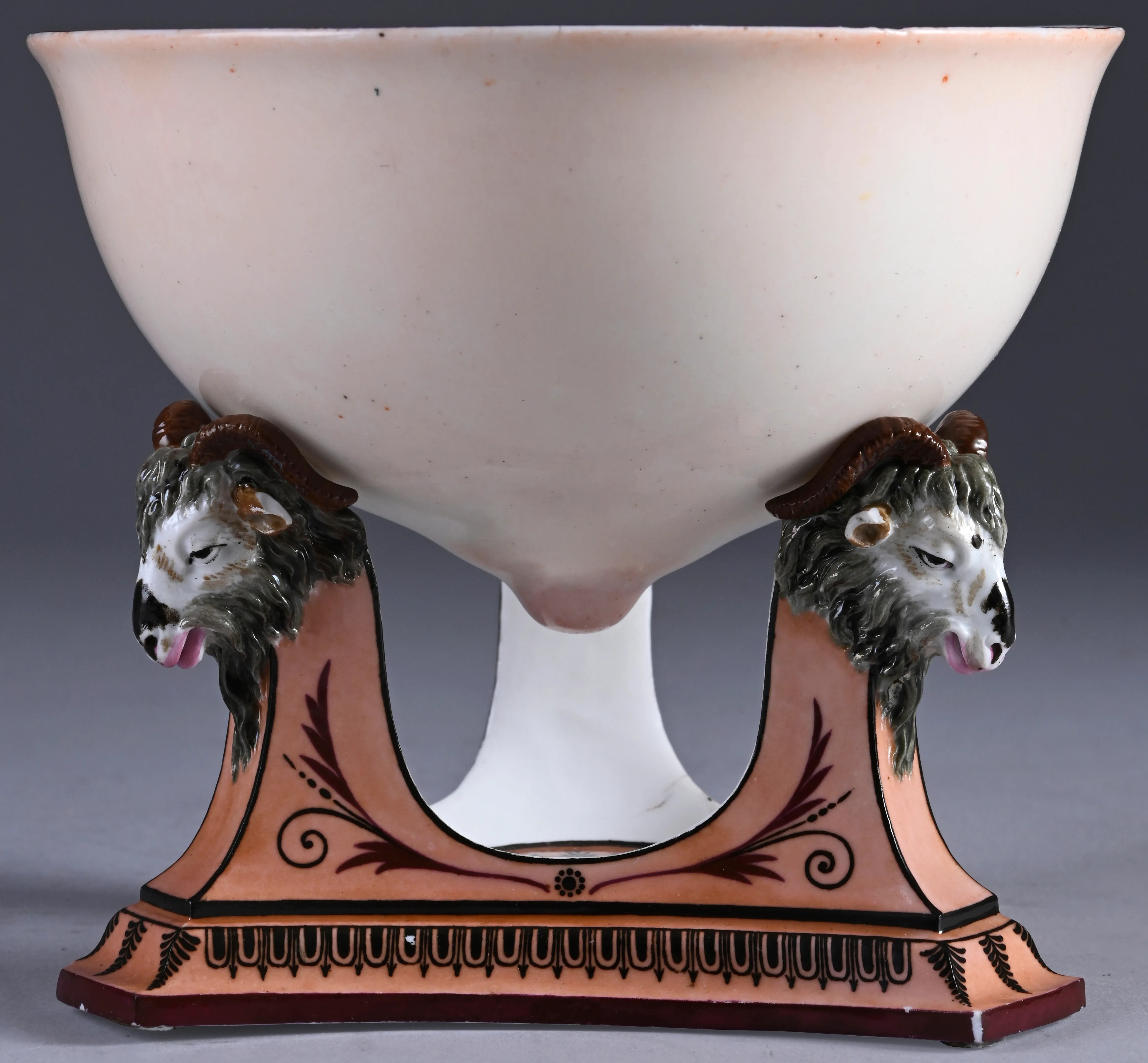
 The last of the four jatte téton, the breast-shaped bowls made by Sèvres for Queen Marie Antoinette’s pleasure dairy at the Château de Rambouillet, has been rediscovered more than 200 years after its last known appearance. It was found during an inventory of the estate of the Galerie Meyer, a Paris art dealer in business for three generations, and is the only remaining one of the four in private hands.
King Louis XVI commissioned the Sèvres Porcelain Manufactory to make an 108-piece service for the Queen to serve the fresh products of her dairy in royal finery while ensconced in her fake bucolic fantasy. Only 65 pieces were ever produced, delivered to Rambouillet in 1787 and 1788. The four breast-shaped bowls consist of a creamy pink-white bowl shaped like a breast, completely with a realistic colored nipple, on a tripod of goat heads. Goats were a symbol of fertility and apparently Marie Antoinette’s favorite animal among the stock at her dairy. The base of the tripod is decorated with black and purple with foliate scrolls and egg-and-dart friezes against an ochre-orange background.
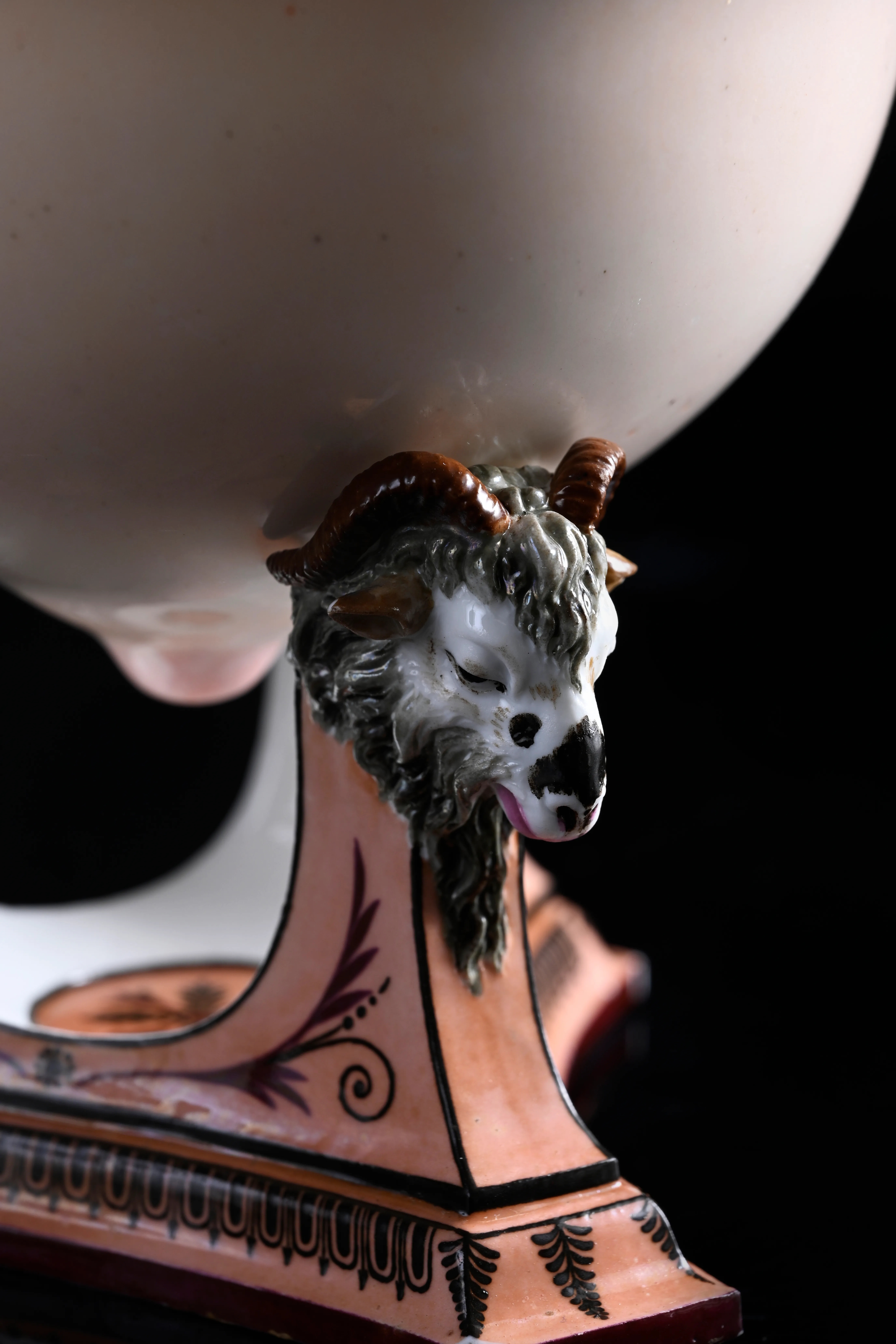 Produced just one year before the French Revolution put an end to Marie Antoinette’s pastoral fantasy life and soon thereafter her real life, a legend sprang up that the jatte téton had been made from moulds of her own breasts. They were not made from moulds of anyone’s breasts, let alone the Queen’s. The design was inspired by the mastos, a breast-shaped drinking cup used in Greek symposia.
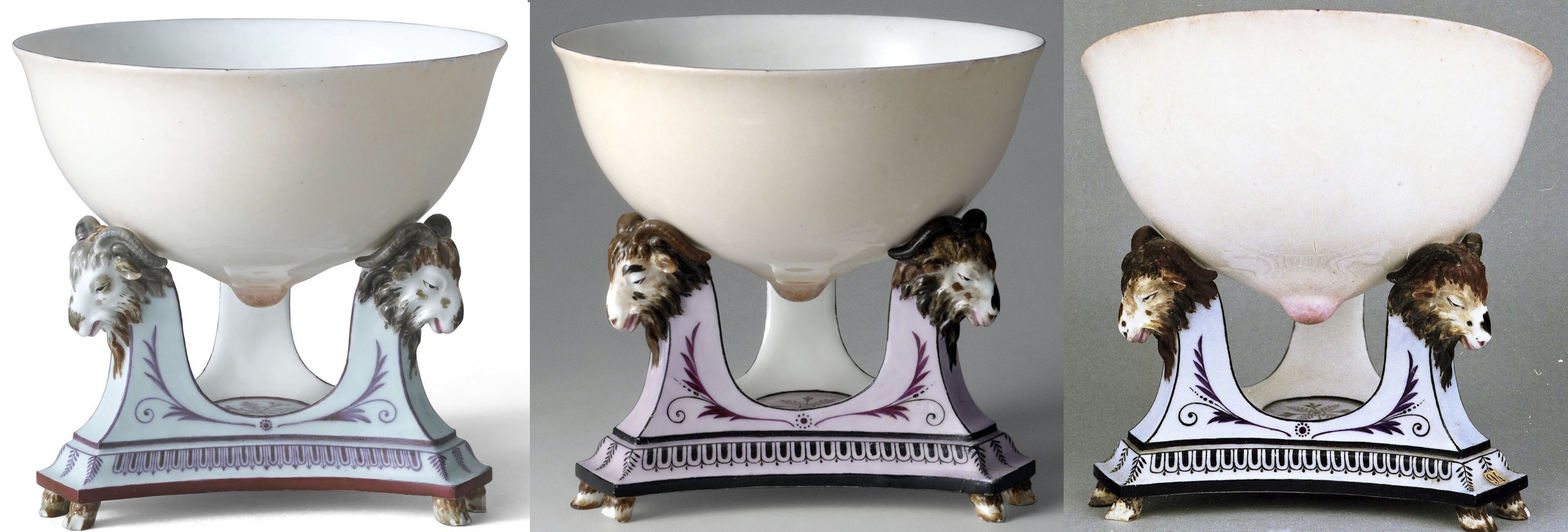
Three of the bowls are now in public collections. Two are held at the National Museum of Ceramics in Sèvres, one with a pale aqua background with purple decoration on the tripod and one with a lavender background with purple and black decoration. Another with a light blue background and black decoration, is in the collection of the Duca di Martina Museum in Naples. The orange background of the recently found bowl is markedly different from the pastels of its three siblings.
According to a handwritten document found with the breast bowl, it went from the Rambouillet dairy to Marie Josephe Rose, Marquise de Chanaleilles, (1784-1867), who was the sister of Marie Louise Zélie, Comtesse de Bouillé, one of the ladies-in-waiting to the Duchesse of Berry. The Marquise de Chanaleilles gave it to her grandson, General Ferdinand de Salles (1831-1925). He sold it to the Galerie Meyer in Paris.
Marie Antoinette’s rediscovered breast bowl will go up for auction at Hôtel Drouot on November 26th. The pre-sale estimate is €1,000,000–€2,000,000. Any foreign buyer will almost certainly be subject to an export bar, so I imagine there will be an effort to secure it for a French institution.