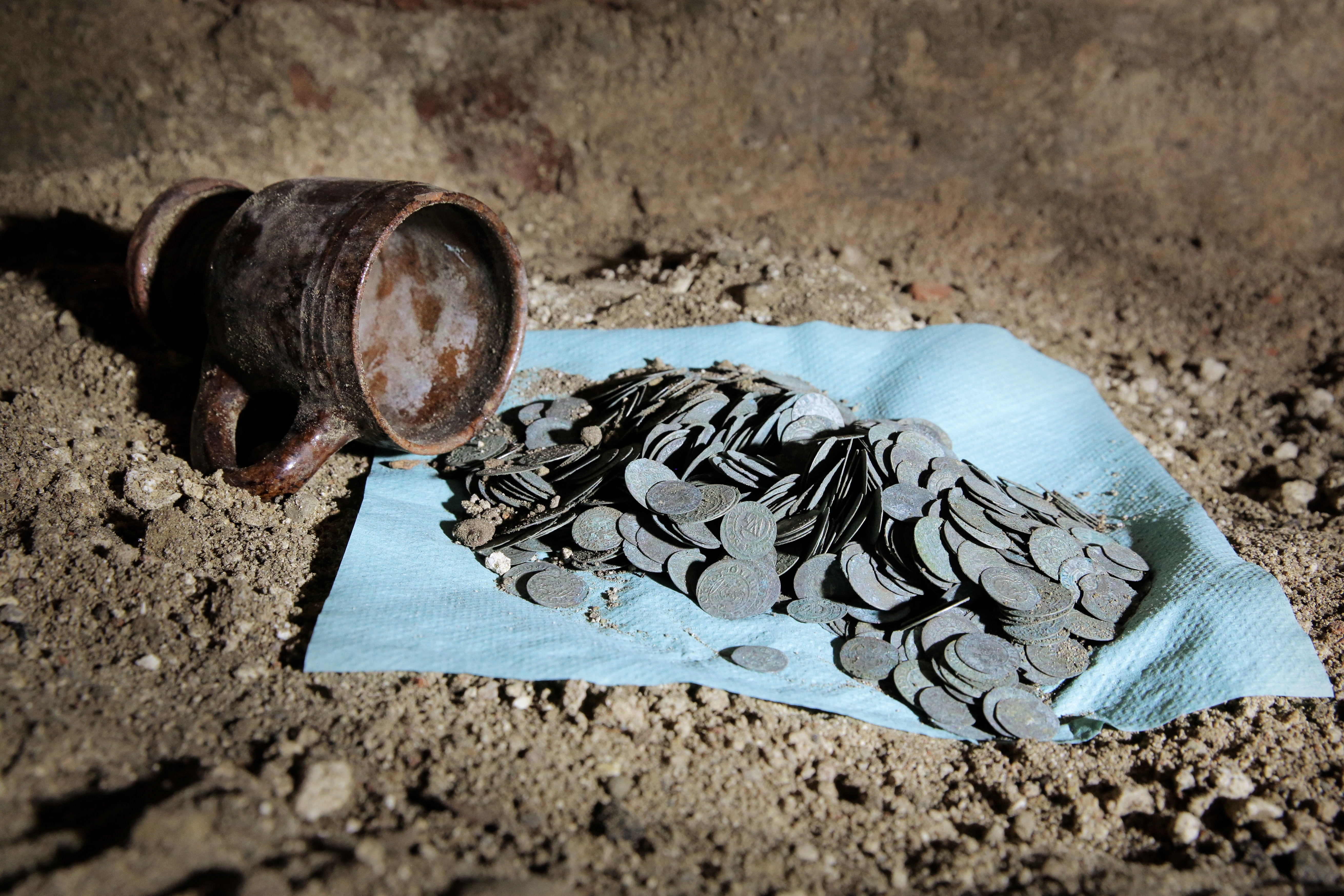
A Spanish silver coin marking the spot of a doomed colony on the north side of the Strait of Magellan has been discovered on what is now the southern tip of Chile. The coin confirms the account of a ceremony performed at the founding of the colony written in 1584, and also confirms the accuracy of a map from the period.
 The “real de a ocho” coin was discovered last month in an excavation at the site of the Ciudad del Rey Don Felipe. It was placed on a flat stone in the foundations of the colony’s first church. Leaving a coin on a stone was a common ceremonial practice for Spanish colonies founded in the New World. In this case, the coin ceremony and location were documented by Pedro Sarmiento de Gamboa, the navigator, explorer and historian tasked with colonizing the Strait of Magellan.
From his account of the founding of the colony:
The Governor, with a spade in his hands, cut the first sods for the foundation of the high altar, in the name of the most Holy Trinity, behind him being the Friars in their vestments. Then the captains and officers dug up earth, in the name of their saints and advocates. Pedro Sarmiento placed the first stone in the hole, and in the name of our Lord Jesus Christ and of your Majesty he put a large silver coin, with the arms and name of your Majesty, with the day and year, in a testimony or instrument written on parchment, with the testimony of possession, into a jar, tarred and sealed with charcoal, so as to make it imperishable.
 The stone and coin were found in a metal detectors and geolocation survey of the site. The discovery pinpoints the location of the church, and gives researchers an accurate anchor point to understand the layout of the settlement. It verifies the map made by Sarmiento de Gamboa, but the other key structures of the settlement — palisades, dwellings, other churches — have yet to be archaeologically confirmed.
Sarmiento de Gamboa was appointed governor of the Strait of Magellan by King Philip II of Spain in 1581. His instructions were to establish forts on the strategic lands on both sides of the strait to anchor Spain’s control of what was then the only passage between the Atlantic and Pacific. That control was tenuous at best, thanks to Francis Drake’s activities. By command of Queen Elizabeth I, in 1578 Drake targeted Spanish interests on the Pacific coast of South America, attacking Spanish shipping and port cities on the coasts of Chile and Peru. Drake was so successful at disrupting Spanish operations that Francisco Álvarez de Toledo, Viceroy of Peru, ordered Sarmiento de Gamboa to chase him down and capture him.
Drake was already well out of reach when Sarmiento de Gamboa began looking for him, so he returned to Peru empty handed. The viceroy then dispatched Sarmiento de Gamboa’s two ships to explore the coast of the Strait of Magellan for suitable locations where Spain could found fortified colonies with artillery that could be trained on Drake’s or any other enemy’s ships. His orders were to map the area, make sure the English hadn’t founded any forts or settlements of their own and capture Drake dead or alive if they encountered him.
 King Philip approved the Viceroy’s plan, granting Sarmiento de Gamboa the governorship of the Strait. After many losses from storms, desertions and illness, the expedition finally entered the Strait of Magellan on February 1, 1584, two years after they had set out from Spain. Sarmiento de Gamboa founded the first colony, Ciudad del Nombre de Jesús, where he made landfall in what is now Argentina. He founded the second colony, Ciudad del Rey Don Felipe, on the Punta Santa Ana near what is now the Punta Arenas in Chile, a location he had first explored in 1580.
 Both colonies were ill-fated, the settlers assailed by disease, extreme cold and their inability to be self-supporting. They were dependent on the supplies from Spain but Sarmiento’s ships kept getting slammed by storms, forcing him to dump the cargo to save the vessels and lives of the crew. Eventually his crew refused to go back out, and the colonies were left to their own devices.
In June, 1586, Sarmiento headed back to Spain. That didn’t go smoothly either. His ships were attacked by Walter Raleigh’s fleet and he was taken prisoner, brought before Queen Elizabeth I herself who questioned him for two and half hours in Latin before sending him back to Spain via France. He was captured yet again by Huguenots in December 1586 and kept captive until Philip II finally agreed to pay ransom in 1589.
Meanwhile, back in the Strait, Ciudad del Rey Don Felipe was doing even worse than its founder. When English navigator Thomas Cavendish passed through the town in January of 1587, only 18 people survived of the 300 original settlers who had come with Sarmiento de Gamboa. Cavendish noted that the colony was very well situated, with easy access to firewood and water, and its four forts were still well armed. With almost everyone dead (and unfortunately unburied due to hardship), Cavendish helped himself to some of the artillery and gave one of the surviving colonists passage. The last colonist was rescued in January, 1590, by yet another English privateer, Andrew Merrick. Thus Spain’s attempt to control the Strait of Magellan against English incursions ended with English ships saving the few survivors of the colonization expedition.