
Update: pre-Hispanic mosaic skull repatriated to Mexico

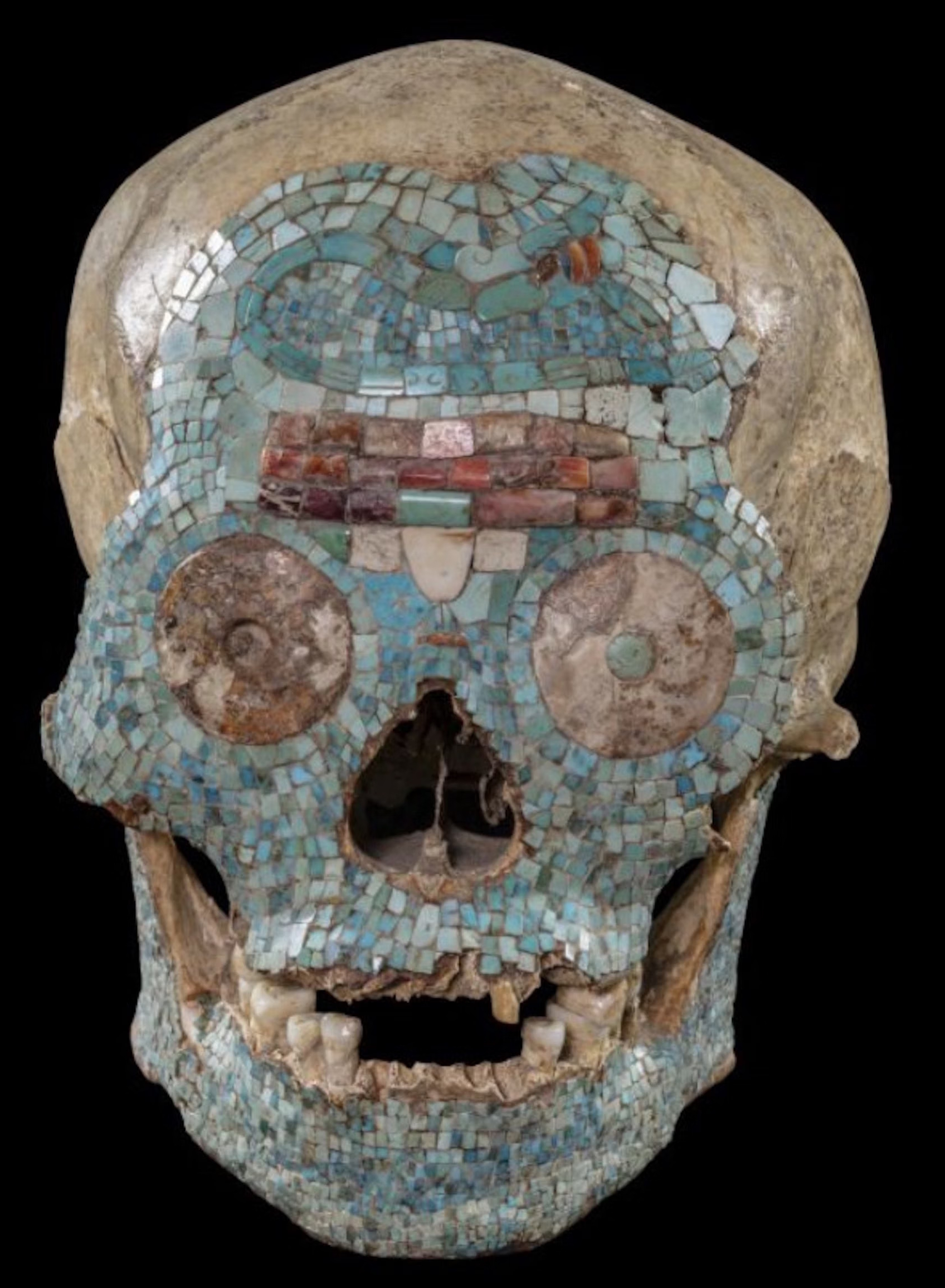
The Mixtec human skull with turquoise, shell, jadeite and quartz mosaic ornamentation has been repatriated to Mexico after more than 60 years spent on display at the National Museum of Ethnology (Wereldmuseum) in Leiden, the Netherlands. It will first go on display at the Museo de las Culturas de Oaxaca, but its permanent home will be the Yucu Saa Community Museum in Villa de Tututepec, Oaxaca, a local museum in the heart of the indigenous Ñuu Savi community, descendants of the Mixtec.

The Wereldmuseum acquired the skull from an American antiquities dealer in 1963 for the equivalent of about $20,000. There was no provenance, very common in an era when unrestrained looting of archaeological sites was rampant and neither the market nor collectors nor museums cared about legitimate ownership histories. The elaborate adornment of the skull ranked it as one of the greatest examples of Mixtec craftsmanship from the Late Postclassic Period (1200-1521 A.D.).

Doubts begin to rise about its authenticity in 2010 after a similar skull was discovered to be a forgery. Studies in 2011 and 2012 found that the skull itself and the mosaic materials did date to that period, but 99% of the adhesive used to affix the mosaic to the skull was from the 20th century. Researchers believe it was created in Oaxaca’s border region using turquoise and human remains found in a dry cave to create a plausible fake for the international art market.

The campaign for repatriation came a decade later when artist Daniel Aguilar Ruvalcaba found about the skull and its complex history while he was in Amsterdam doing a residency at the Rijksakademie. He teamed up with the Nchivi Ñuu Savi collective, an organization dedicated to the promotion of Ñuu Savi culture and rights, to petition the Netherlands’ government for restitution. In 2023, Mexico’s government filed a request for repatriation which was approved at the end of 2024.
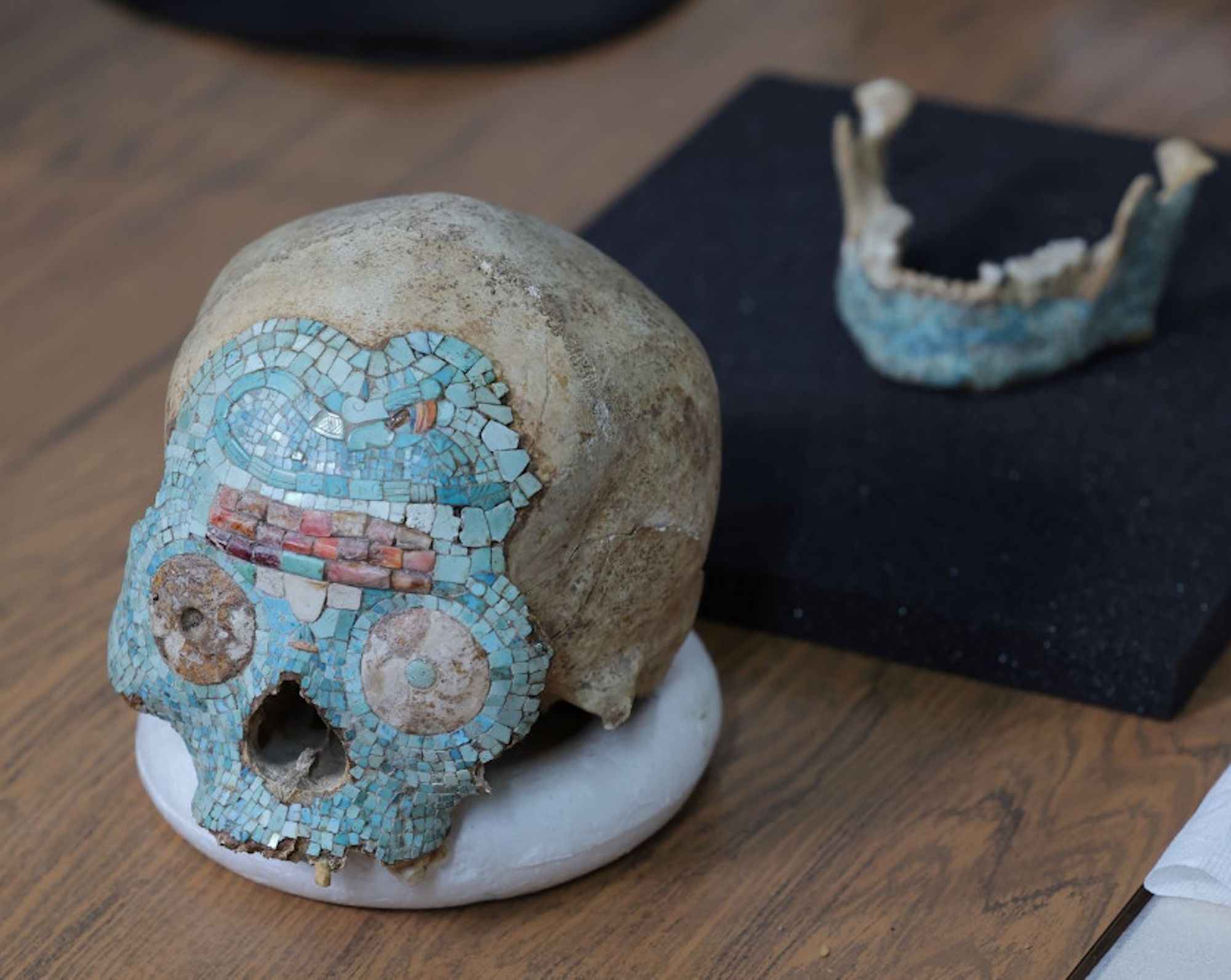
The skull was officially returned to Mexico in May 2025 where it was transferred to the Directorate of Public Registry of Monuments and Archaeological and Historical Zones (DRPMZAH) of the National Institute of Anthropology and History (INAH).

Physical anthropologist Olaf Bello Cardoso, from the DRPMZAH, emphasizes that the skull offers biological and social information, which can be further studied in complementary studies, such as radiocarbon dating. He considers it feasible to obtain samples from some teeth or from the temporal bone, the hardest part of the skull, which exceptionally preserves ancient DNA.

“From an anthropological perspective, in addition to conducting physical analyses of the skull, it is important to decipher who the person behind the turquoise mosaic is. For example, it is known that the skull from Tomb 7 of Monte Albán was part of an offering dedicated to a principal figure; in the case of the now repatriated skull, it is possible that the intention was to exalt the individual with the ornamentation of his skull,” he notes.

Meanwhile, the Nchivi Ñuu Savi collective submitted a petition signed by 1,020 residents of Tututepec to INAH asking that their ancestor’s skull be displayed at the community’s own museum, not in the capital. INAH representatives visited the Yucu Saa Museum in June and worked on a plan for the Mixtec’s skull’s safe display. The museum is working to improve its security and exhibition space to make it appropriate for such a significant piece. The plan is for the skull to go on display there in April 2027 after the changes have been completed.

9th c. B.C. burial found in El Salvador

Ancient pre-Hispanic human remains have been discovered at the Antiguo Cuscatlan suburb of San Salvador. The skeletal remains were found face-down and preliminary estimates date them to around 850 B.C.

Archaeologists discovered the grave in a trench at the Pasaje 4 archaeological site under layers of volcanic ash deposits from various periods.

Among the findings, a human skeleton stands out, as well as a small Usulután ceramic vessel shaped like a sea turtle; two yucca cultivation furrows found under segments of ash from volcanic eruptions (from different periods), one from the Plan de la Laguna (850 BC) and another furrow under the eruption of the Ilopango Caldera Circa 431-539 CE.

The remains found were in a ventral position (face down) at 17 degrees east of north, and according to initial estimates, it may be a skeleton from 850 BC. In addition, it is believed that a similar number of remains to those found in Structure 3-7, in Chalchuapa, could be found in the area.

The burial was removed in a soil block so that the remains can be fully excavated in laboratory condition, preserving organic materials, even small traces, as much as possible. Archaeologists will radiocarbon date the remains in the hopes of narrow downing the burial date. They will also attempt to extract archaeological DNA for testing. If the estimates are confirmed, the discovery will be one of the oldest pre-Hispanic burials in Mesoamerica.

3,800-year-old ritual deposit of figurines found in Peru

A group of 43 figurines deposited as a ritual offering 3,800 years ago have been discovered in Peñico in the Caral Archaeological Zone on the Pacific coast of Peru. The discovery sheds new light on the ceremonial practices and cultural continuity of the people who inhabited the cities of the first urban civilization of the Americas after the demise of the Caral Civilization.

The 43 pieces were carved from wood and bone and include representations of mythological figures, anthropomorphic figures, among them one female and what may be deities, geometric and abstract shapes, zoomorphic figures like birds, snakes, and tadpoles. Some of the figures show evidence of exposure to fire, which archaeologists believe may have been part of the ritual. Beads of Chrysocolla (a blue stone) and different types of shells were found in the grouping. They were likely intended to be inlaid on the carved figures.

Archaeologists found the objects in an excavation of the Major Public Building of Peñico. They had been placed together in a small area bordered with a semicircle of pebbles. It was filled with soil and covered with a capstone. This deposit was associated the construction of a new platform of the building.

The urban center of Peñico was founded around 1800 BCE, with an archaeological occupation area of ​​19.44 hectares, in a period following the decline of the earliest and most prestigious urban centers of the Caral Civilization, including the Sacred City of Caral-Supe, located 12.93 km away. Far from representing a cultural break, research indicates that this city, where 15 public buildings were found, was conceived as a space for integration between the coast and the highlands. It even received goods from the rainforest and preserved and transformed knowledge, ritual practices, and forms of organization inherited from the Caral tradition, which had flourished centuries earlier in the same valley.

The recent discovery provides evidence of this historical continuity. Specialists have identified similarities in the materials used, the incision techniques, and the iconographic patterns present in the recovered pieces. Furthermore, archaeological analyses indicate that the offering was deposited during the initial stages of construction of the Main Public Building, as part of ceremonies related to the consecration of architecturally significant spaces.

The offerings were discovered in December 2025 and have been undergoing cleaning and conservation ever since. Conservation has been completed on 32 of the objects which have now gone on display at the office of the Culture Ministry in Lima.

Toltec human sacrifice altar found in Mexico

Archaeologists with Mexico’s National Institute of Anthropology and History (INAH) have discovered an ancient Toltec altar and human remains near the Tula archaeological zone north of Mexico City. It dates to the Tollan period (900–1150 A.D.) when Tula was the capital city of the Toltec Empire.

The momoztli (altar) measures about one meter (3.3 feet) square and was built out of different stones, including volcanic blocks and river stone. It consists of three sections: a base of andesite quarry stone with small blocks no more than four inches thick on the outer face, a second section of larger slabs of andesite and a top section composed of river stones and basalt.

Four skulls, one of them still connected to a vertebral column, and several long bones, probably femurs, were found placed on three of the four sides. Their placement suggests a ritual purpose, and archaeologists believe they may be the result of ceremonial decapitations. Ceramic vessels, including a black bowl containing another bowl, obsidian fragments, obsidian blades and bone tools, known to have been used in sacrificial rituals, were also found. Archaeologists also uncovered shell remains, spindle whorls and awls, objects that played roles in both ritual practices and daily life. The fourth side has not yet been fully excavated; there are likely to be remains there too.

At the base of the altar were two skulls, one facing upwards and the other southwest. As the levels descended, a compacted layer with stucco, possibly lime and sand, was detected, and beneath this were found the other two incomplete skeletons, as well as some vessels.

Heredia Guillén said there is little chance of finding complete skeletons, because perhaps only those parts of the individuals were offered as sacrifices. Once registered, they will be sent to the project’s physical anthropology laboratory in the State of Mexico to determine age, sex, bone pathologies, and even whether they were decapitated, since one of the skulls still appears to be attached to the spine.

“In this case, although metals were already being worked in the Postclassic period, we know that here decapitations were still done with obsidian or flint knives, and they left cut marks on the bones,” he explained.

The altar was found near the Tula Chico area, about 300 meters (984 feet) from the perimeter wall of the Toltec capital. Remains of walls and foundations indicate the altar was in the center of a courtyard. INAH archaeologists believe the walls are the remains of elite buildings as people of high social rank in Tula lived outside the walls of the city.

All of the artifacts and remains recovered from the excavation will be cleaned, conserved and studied in laboratory conditions. The bones will be analyzed to narrow down the date of deposition and to determine the individual’s age, sex, geographical origins, health and possible causes of death.

Colossal offering uncovered at Templo Mayor

Archaeologists with the Templo Mayor Project (PTM) in Mexico City have unearthed a massive ceremonial offering including dozens of greenstone figurines, thousands of marine elements, copal, tar, and monumental sculptures deposited in a single event in the middle of the 15th century.

The greenstone figurines are carved in the Mezcala style from the present-day Guerrero area. The Mezcala figurines were already antiques when they were deposited, some of them as much as 1,000 years old. Archaeologists believe they were cult effigies that were plundered by the Mexica when they conquered the Guerrero region. They were brought to the capital as war booty and red and white pigments were applied to reconfigure the figurines with the attributes of the god Tlaloc.

The newly-discovered offerings, numbered 186, 187 and 189, were found in three stone chests, known as tepetlacalli. Offering 186 was was unearthed in 2023, and the next two in the most recent dig season. The chests, their contents and their date of deposition matches three other offerings found in previous excavations. Offerings 18 and 19, discovered in the late 1970s, were found on the west side of the great temple pyramid, and Offering 97 was found in 1991 on the north side. They too contained marine elements and 40 greenstone figures in the Mezcala style, for a total of 83 greenstone figurines between the six deposits.

The offerings date to Stage IV of the Templo Mayor, between 1440 and 1469, the regnal years of Moctezuma Ilhuicamina (meaning the Archer of the Sky), the fifth king of Tenochtitlan and second emperor of the Aztec Empire. When the previous three offerings were found, archaeologists hypothesized that there might be another three on offerings on the east and south of the pyramid. That has now been proven true.

In addition to the moveable objects in the depositions, there are monumental sculptures weighing as much as a ton, which would have required complex logistics (ropes, levels, rollers) to move to and arrange at the temple. The scale of the offerings is so colossal that the ceremony must have been one of the largest ever seen in pre-Hispanic Mexico.

Such a large number of Mezcala figurines do not appear before or after in the archaeological record of the Templo Mayor. Moctezuma Ilhuicamina was the first king of Tenochtitlan to conquer territories outside the Valley of Mexico. He conquered Tlaxco and Tlaxmalac in Guerrero between 1447 and 1450, which is likely when he returned absolutely heaving with war booty that were then deposited in a massive ceremony with dozens of priests and the whole population of the city in front of the Templo Mayor.