Bath’s famous waters may contain real healing power

The natural hot springs in Bath that give the city its name and 2,000-year-old reputation for healing contain a small army of pathogen-combating bacteria. Biomedical researchers at the University of Plymouth sampled the water, sediment and bacterial biofilm from the King’s Spring and the Great Bath, and found 300 different types of bacteria, 15 of them showed broad spectrum activity against pathogens including E. coli, Staphylococcus aureus and Shigella flexneri.

Antimicrobial resistance is one of the most urgent threats to global health today. Antibiotic-resistant pathogenic infections were responsible for killing 1.27 million people around the world in 2019. That figure is expected to skyrocket to 10 million a year by 2050. There are no new antibiotics coming down the research pipeline, so the search for novel antimicrobial natural products is of towering importance in combating this threat. Extreme ecological environments are getting new attention as their unique ecosystems are rich in microbial diversity and may contain antimicrobial NP.

Bath’s hot springs are the only ones in the UK, and with the geothermal energy that heats the waters as high as 96 °C (205°F), it offers a unique opportunity for the discovery of microbial powerhouses. Thermal springs in Italy, India and Jordan have all been found to contain microbes that combat human pathogens, but this is the first study to look at Bath’s hot springs.

The mineral-rich hot springs of Bath have been famed for their medicinal properties since the pre-Roman Iron Age. The Britons built a shrine to the goddess Sulis at the site of the hot springs and when the Romans came, they built it up into a huge bath complex and temple dedicated to the goddess Minerva who they identified with the local deity Sulis. Even after the Romans left and the baths fell into ruin, new facilities were built several times from the Middle Ages into the 19th century.

The Roman Baths has been welcoming visitors for almost two millennia, and in 2023 more than one million people toured its hot springs and other collections.

Zofia Matyjaszkiewicz, Collections Manager at the Roman Baths and a co-author of the new study, added: “People have visited the springs in Bath for thousands of years, worshipping at, bathing in and drinking the waters over the centuries. Even in the Victorian period the Spa Treatment Centre in Bath used the natural spring waters for their perceived curative properties in all sorts of showers, baths and treatments. It’s really exciting to see cutting edge scientific research like this taking place here, on a site with so many stories to tell.”

The research into Bath’s potential contribution to the fight against antimicrobial resistance will continue. The University of Plymouth will launch an expanded study with a PhD studentship beginning October 2024 that will take an in-depth look at the Bath hot spring’s microorganisms, screening them to identify any with antimicrobial activity that may have clinical use.

Grave slabs raised from England’s oldest medieval shipwreck

Two 800-year-old gravestone slabs that went down with the ship transporting them in the 13th century have been recovered. One slab is intact and in excellent condition; the other is much larger but broken into two pieces. The slabs were brought to the surface in a complex operation requiring a barge anchored to the seabed, a crane and huge metal crates to raise the heavy Purbeck stone slabs.

The Mortar Wreck sank in Studland Bay off the coast of Dorset in the second half of the 13th century. Dendrochronological analysis of the hull planking found the clinker-built ship was made from oak trees cut down in Ireland between 1242-1265, when Henry III ruled England. It is the only known wreck of a seagoing vessel from the 11th to the 14th centuries in English waters, and the oldest known shipwreck in the seas surrounding the British Isles. (There are a few Roman wrecks but they were found inland.)

This was a period of prosperity when the population was booming and huge building projects like the construction of Westminster Abbey and Salisbury Cathedral were underway. The Purbeck quarrying and transport industry was at its peak during this time, and the gravestone slabs were very popular among the clerical elite. The ship was carrying a heavy load of unworked quarried Purbeck stone, the gravestone slabs, carved with cross decorations but not polished yet and not personalized, and a number of daily use objects including Purbeck stone mortars used for grinding flour, which is what the wreck was named after.

The wreck was discovered in 2019 by Bournemouth University divers. It was granted official protection in 2022, and maritime archaeologists have been monitoring it for condition and exposure as sediment erodes. The monitoring of the Mortar Wreck will continue. This includes a plan to document the timber frames of the ships hull. It will also be a learning site for students at the university to be trained in maritime archaeology.

The recovered slabs will be desalinated and conserved by Bournemouth University experts. They will go on public display at the Poole Museum in its new Shipwreck Gallery when it reopens next year.

17th c. mayor’s hoard found in Saxony-Anhalt

Excavations at the historic Altstadt Wettin Farmhouse in the center of Wettin, southeastern Germany, have unearthed a hoard of silver coins buried 350 years ago. Construction workers found the first coins when digging a trench for a new sewer line in July 2023, and archaeologists from Saxony-Anhalt’s State Office for Monument Preservation and Archaeology followed up with an excavation of the find site in the farmhouse’s courtyard. About 20 inches beneath the surface, 285 silver coins, greened by corrosion, were found compacted together. They were likely in an organic container that has rotted away. The hoard was removed in a soil block for micro-excavation under laboratory conditions.

The coins were exposed in layers, documented, cleaned and conserved. They were found to range in date from 1499 to 1652, and are an unusually international grouping. The majority are regional Saxon froschen coins, used for local markets, but the second largest number are thalers from the Spanish Netherlands, coins used for long-distance trade. There are also coins from Austria, the Netherlands, Switzerland, Italy and many German cities. Some of these are very rarely found in Wettin, for example a 1630 scudo minted by Odoardo Farnese, Duke of Parma and Piacenza, and a tallero minted in 1620 by Cosimo II de’ Medici when he was Grand Duke of Tuscany.

Archaeologists believe this was a collection amassed by a wealthy family active in international trade over 150 years and buried in the late 1650s. The two-story rectangular farmhouse was built in the second half of the 16th or the early 17th century by wealthy Wettin citizens. Records of ownership go back to the end of the Thirty Year’s War (1648). At the time when the coins were buried, the farmhouse belonged to Johann Dondorf, one of Wettin’s wealthiest people who would go on to become the town’s mayor in the late 1660s.

He earned his income primarily from agriculture, some wine-growing and brewing rights. Wettin was an extremely wealthy brewing town during and after the Thirty Years’ War. Dondorf’s wealth became clear after his death in 1675. When his estate was recorded by the court, more than 2,500 thalers were found in his house in 13 separate items, of which 1,000 thalers alone were “[…] 500 ducats in a long leather bag.”

Maybe this hoard was one of his leather bags full of cash he stashed all over his property.

Ancient necropolis of stillborn babies, toddlers found in Auxerre

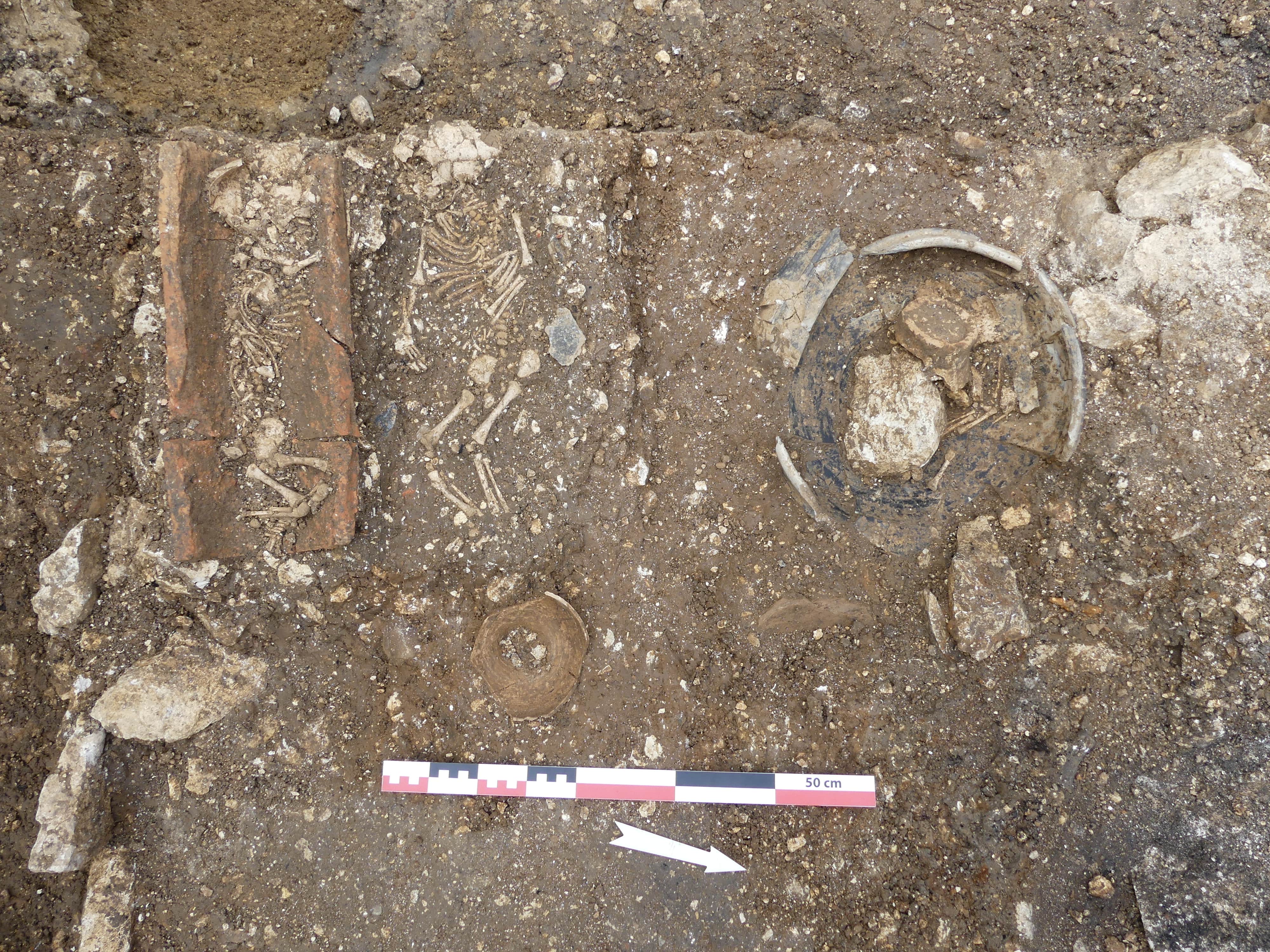
An excavation in the historic center of Auxerre, France, has unearthed a necropolis dedicated to stillborn and very young children. It was on the periphery of a larger necropolis for the general population, common for a burial ground for dedicated subgroups, and was in use from the 1st to the 3rd century.

The fortified town of Autessiodurum was founded by the Gallic Senones people in 30 B.C. on the banks of the Yonne river. Under Roman rule, it was at the intersection of several important roads, but it didn’t rise to notable political importance until it was made a provincial capital of the Roman Empire in the 3rd century. New fortifications enclosed the town in the 4th century. It was under those ramparts that the necropolis was found.

The necropolis contains a wide variety of funerary practices. Babies and very young children (toddler age) were buried in ceramic containers, wood coffins, tree bark, stone formwork, texties and long curved roof tiles (imbrex). Sometimes they were covered with amphora fragments or another set of tiles. One grave is marked with a reused stone engraved with a rosette shape. There is evidence of complex muti-stage funerary rituals performed in the burials.

Ceramic crockery is broken near the burials on circulation levels, their contents being intended for the dead and the gods. In order to protect these young deceased people, objects intended for protection in the afterlife (called “apotropaic” or “prophylactic”) accompany them, such as a pearl, a coin, a spindle. A miniature ceramic cup was also placed at the head of a young child. […]

The very high density of burials and their superposition make it possible to study a very large number of burials and other funerary practices associated with toddlers during the 1st – 3rd centuries . Up to five levels of tombs have been observed, which, in the current state of research, is unique in the Gallo-Roman world where the integrity of the tomb must be preserved. In Auxerre, however, some graves destroy others, which may be linked to a problem of available space but also be linked to the very status of these very young children, not always perceived as individuals in their own right. The excavation of Auxerre, like that of Narbonne and others recently, brings a lot of new knowledge and questions about the funerary practices associated with very young children and stillborns in Antiquity.

Donatello’s Judith and Holofernes restored

Donatello’s bronze sculpture group depicting Judith and Holofernes (1457-1464) has returned to public display after 10 months of restoration. The sculpture was unveiled Monday at the Sala dei Gigli (Gallery of the Fleurs-de-Lis) in Florence’s Palazzo Vecchio, cleaned and restored using the latest technology.

Donatello took an original approach to the subject of the young Jewish heroine who saved her city by cutting off the head of the Assyrian general besieging it. He was the first to include the figure of Holofernes. The subject at this time was usually presented as just Judith holding the general’s decapitated head. Donatello captured the moment in dynamic action, Judith with her arm raised and sword in hand ready for the kill while Holofernes’ body is trapped between her legs, his limbs dangling off the edge of the statue’s base. Three Bacchic reliefs adorn the sides of the base.

The bronze was commissioned by Piero de’ Medici with the motif of Judith’s defeat of Holofernes standing as a model of freedom against tyranny for citizens to follow in defense of the Florentine Republic. After the Medici were expelled from Florence in 1495, the government of the new Republic confiscated the sculpture and moved it to the Palazzo della Signoria, the new seat of government. Piero’s original inscriptions on the plinth — one extolling Judith as a symbol of humility’s triumph over pride and virtue’s over lust, the other exhorting citizens to follow her example in defending the Florentine Republic — were removed and a new one installed marking the date of the confiscation/liberation of the bronze from the personal property of the ruler to the patrimony of Florence.

It was moved several times over the next centuries and it was out in the elements. By 1980, the bronze had suffered severe deterioration, so it was permanently moved to the Sala dei Gigli in Palazzo Vecchio. At the time of the move, the statue was given its first scientific restoration, but it was the 1980s and the techniques used then haven’t aged well. The bronze darkened over time and the protective coating turned out to be a literal dust magnet, having an electrostatic charge that attracts dust and an adhesive property the glues it to the surface.

The new restoration began with a painstaking examination and documentation of the bronze. The statue was dusted to expose as much of the surface as possible. That surface was then analyzed with new samples taken and compared to the ones collected 40 years ago.

After the diagnostic process was complete, conservators set to work addressing the problems that were identified.

Detail of bronze panel at the base of the statue. Photo courtesy A. Quattrone, Friends of Florence.The findings revealed a need for a more complex approach to renew the restorative effects of the previous work, whilst also removing the products of slow corrosion processes on the metal’s surface. The recent work has benefitted from improved understanding of the material, as well as new laser-based technology to treat the metal without the disadvantages of mechanical or chemical cleaning techniques used in the past. This work has also revealed localized areas of gilding on the bronze, which provides important information for how this statue (and others like it) can be more effectively protected in the future.