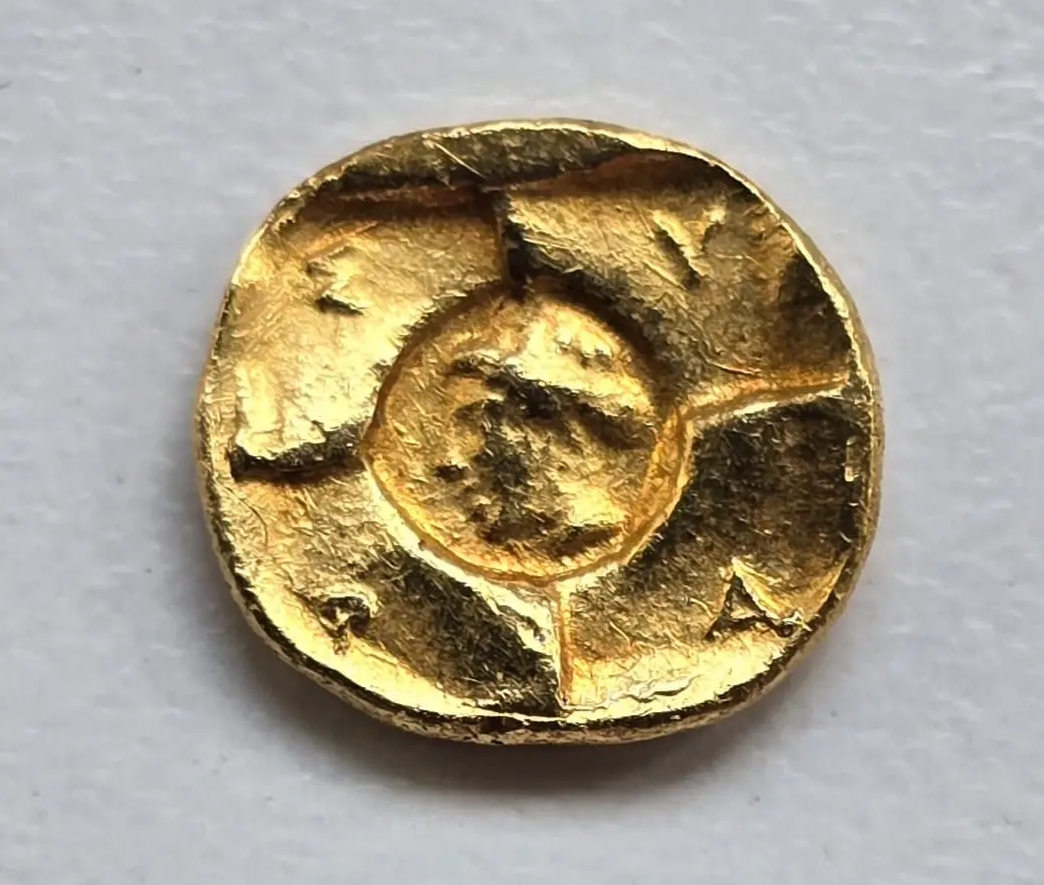
 A rare 5th century B.C. gold coin minted during the Carthaginian invasion of Sicily has been found in the ancient city of Agrigento, Sicily. It was minted around 405 B.C. by the tyrant of Syracuse, Dionysius I the Elder.
The coin was found during an emergency excavation to salvage a Greek-era tile-lined capuchin tomb at the mouth of the Akragas River. The tomb was part of the Maddalusa burial ground, in active use from the first quarter of the 6th century B.C. until the end of the 5th century B.C.
It is a 20 Litrai coin weighing over a gram that is in excellent condition. On the obverse is the profile head of Heracles wearing the skin of the Nemean lion. The reverse features a four-part incuse square with a female head in the center. Four Greek letters — ΣΥΡΑ — are inscribed in the corners of the incuse square, meaning “Syra” for Syracuse.
Founded as the city of Akragas by Greek colonists from Gela, Crete and Rhodes in 582–580 B.C., Agrigento was besieged and sacked in 406 B.C. during the conquest of Sicily by Carthaginian general Himilco. Syracusan general Dionysius had fought against Carthage since the invasion began in 409 B.C. and took power as the tyrant of Syracuse (formerly a democratic polis) in 405 B.C.
After a brief period of peace bought with enormous concessions of territory that expanded Punic control over almost all of Sicily, in 398 B.C. Dionysius I of Syracuse marshalled his forces and fought to expel Carthage from Sicily. He reduced their territories, but wasn’t able to boot Carthage from Sicily. Dionysius never stopped trying, though, alternating between peace treaties and war until his death in 367 B.C.
The [coin] is particularly significant not only for the rarity of the specimen but especially because it is situated in a specific historical moment: during the dramatic Carthaginian invasion of Sicily, at the end of the 5th century B.C., Syracuse, allied with Akrágas, minted extraordinary gold issues to support the war effort. The coin that was found belongs to this series, which recalls the tragic events that shook Greek Sicily, culminating in the conquest and destruction of Akrágas by the Carthaginians in 406 B.C.
That’s a beautiful coin. Apparently, there are other litra(i) coins from Syracuse, some of which likewise feature the word ‘Syracus’ with a picture of a lady, and Heracles strangling the lion.
As far as the coins are concerned, there is the hemilitron (0.5 litra), the litron, the dilitron (2 litrai), the decalitron (10 litrai) and 100 litrai, which must be the hekalitron – w/ Heracles and the lion 🐱️
The modern ‘liter’ (volume) has been derived from its volume of a weight of 1 kg water, and from a previous French unit (of considerable less volume, and weight), derived from the Greek unit.
Fun fact:
“Die Bürgschaft” –a ballad published by German poet Friedrich Schiller in his 1799 Musen-Almanach– remains today one of the most famous German poems.
The setting is the ancient Greek polis of Syracuse. After a failed attempt by Damon to kill the tyrant Dionysius (I or II), he is sentenced to crucifiction, but asks for a delay to marry his sister to her designated husband.
Dionysius allows him an extension of three days on condition that his friend remains to guarantee Damon’s return. If he would not be back on time, his friend would be crucified, while Damon would go with impunity.
Notably in 44 BC, the same topic is also discussed in his ‘De officiis’ –here in Bk 3.45/46– by the Roman statesman, lawyer, philosopher, orator, and writer Cicero.
…I am able to mess up in at least three languages: Of course, it should be ‘Crucifixion’!