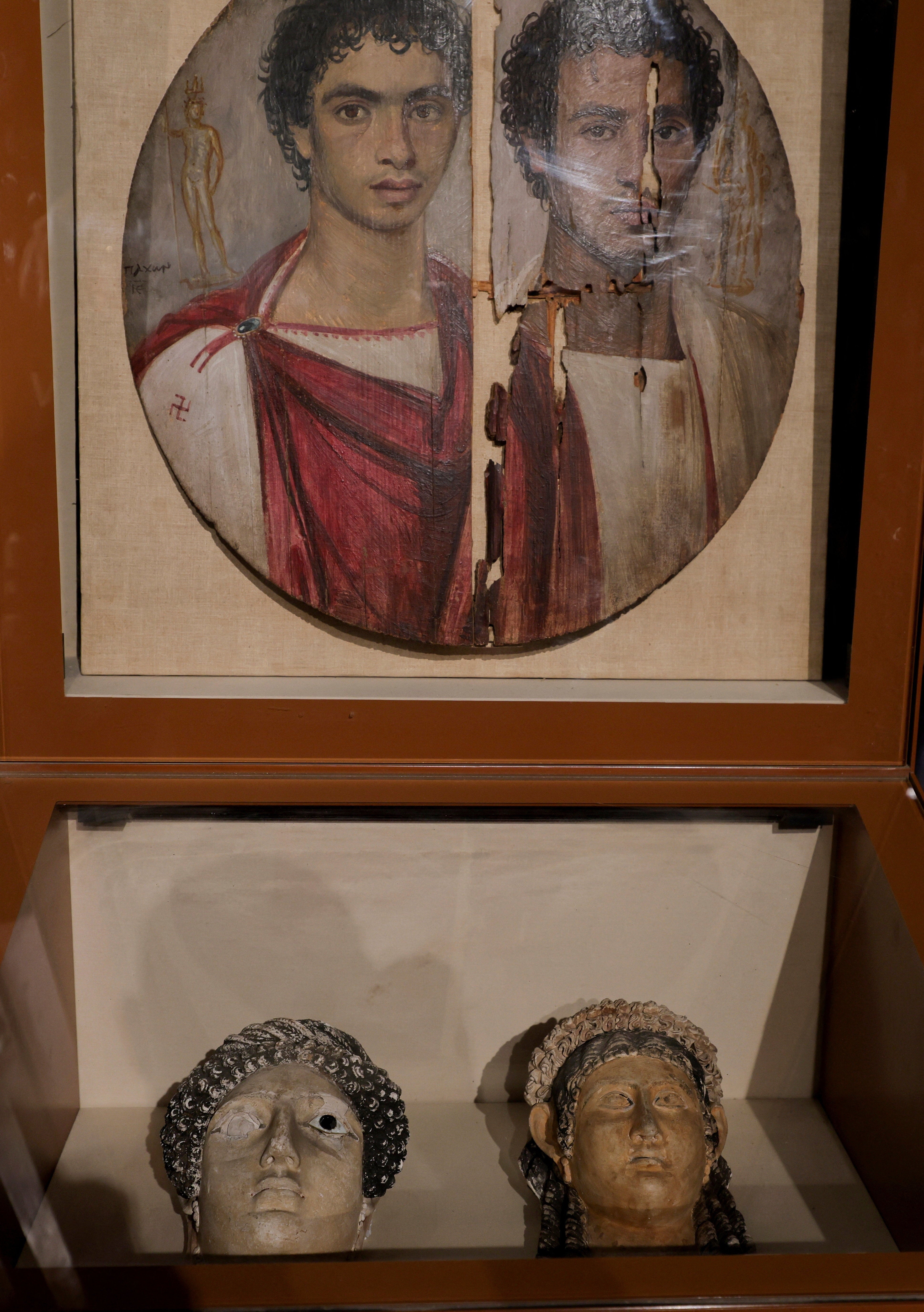
 The Tondo of the Two Brothers, one of the most striking and unusual Fayum mummy portraits, has been restored by a joint team of Egyptian and Italian conservators.
The 2,000-year-old portrait is one of hundreds of encaustic-on-wood panel paintings discovered at the Fayum necropolis southwest of Cairo. They are notable for the realism (albeit idealized in age and good looks) of the portraiture. Painted on wood then sealed with beeswax, the panels were placed over the face of the deceased and held in place with an intricate criss-cross wrapping of linen bandages.
This example is rare for its circular shape and depicts two young men standing side by side. While double portraits are known, they are less common than individual ones and this is especially rare being a double portrait on a round panel 62 cm (24 inches) in diameter.
The wood had suffered extensive damage from boring insects, likely termites, which caused parts of the painted figures to separate. An earlier intervention had also backfired, leaving fragments that were originally part of the mouth and chin of the figure on the right.
Conservators added support to the paint in the damaged areas and stabilized them with a lightweight filler matching the color of the wood. They also repaired displaced fragments, removing them, flattening them and reinforcing them before placing them back in their original locations with balsa wood supports. The treatment has left the painted surface more visually integrated and consistent. Ultrasound scans of the panel during the conservation process revealed an ancient darkening varnish was used in the hair of both men. This adds new information about how the portraits were made.
Hisham El-Leithy, secretary-general of the Supreme Council of Antiquities (SCA), highlighted the portrait’s archaeological and artistic significance and the importance of its conservation. He explained that the work is exceptional not only for the quality and expressiveness of its painting, but also because its form, technique, and state of preservation provide valuable evidence for studying portraiture in Roman Egypt.
He noted that the conservation work required particular care because both the wooden support and the painted surface were fragile. Collaboration between conservators from the Egyptian Museum and their Italian counterparts also provided an opportunity for scientific and professional exchange. The team used a minimal-intervention approach that respected the portrait’s authenticity, restoring its visual coherence while preserving evidence of its long history.
The Tondo of the Two Brothers will now go on display in Rome, leaving Egypt for the first time to be the centerpiece of a new exhibition: The Power of the Portrait: Egypt and Rome, Faces of Fayum, which runs at the Ara Pacis Museum from November 5, 2026, to May 2, 2027. It will feature more than 110 objects, including 24 painted portraits, funerary shrouds, plaster portraits and jewelry.
At least on the left side, there is apparently a date, with the month of “Παχών” (Pachon/Pashons/Bachans, or May-June), and what seems to be either the day or the year (…whatever that digamma and the epsilon might stand for).
Allegedly, “the name of the month of Pashons comes from Khonsu, a deity of the moon or of the Theban trinity and the son of Amun-Ra and Mut”.
Referring the numerals …that ‘gamma’ (3) could have been a pi (80). More likely, however, something like Ιʹε̅ would rather be “15” (with the epsilon = 5), which may result in the “end of May”.
The month on the right –i.e. if that is an inscription at all– may be Demotic. How more or less Egyptian Greeks noted Years(!) still is entirely 🇳🇱 to me (…those “yellowish deities” may play a role).
Just to clarify the statement “Painted on wood then sealed with beeswax”.
That is not how encaustic is done. Instead….pigments are mixed into melted beeswax and then while liquid are used as paint. So in essence the color and sealer are one.
Good point! – cf. ἐγκαυστικός (enkaustikós, “burned in”), from καίω (kaíō, “to burn”), apparently a beeswax-based paint with the pigments –with or without added oil– fixed in place by heating.
From what I read, there were variants with cold paint and hot cauterization irons, as well as variants with already molten wax. In our 21st century terms, we would probably speak of thermosublimination– and thermotransfer printing, or here –painting.
Depending on the application, the paint is –more or less– molten right down into the wooden medium. Note that I am just trying to make it all plausible to me, and I do not know anything.