Roman Republic-era shipwreck with hundreds of amphorae found off Sicily

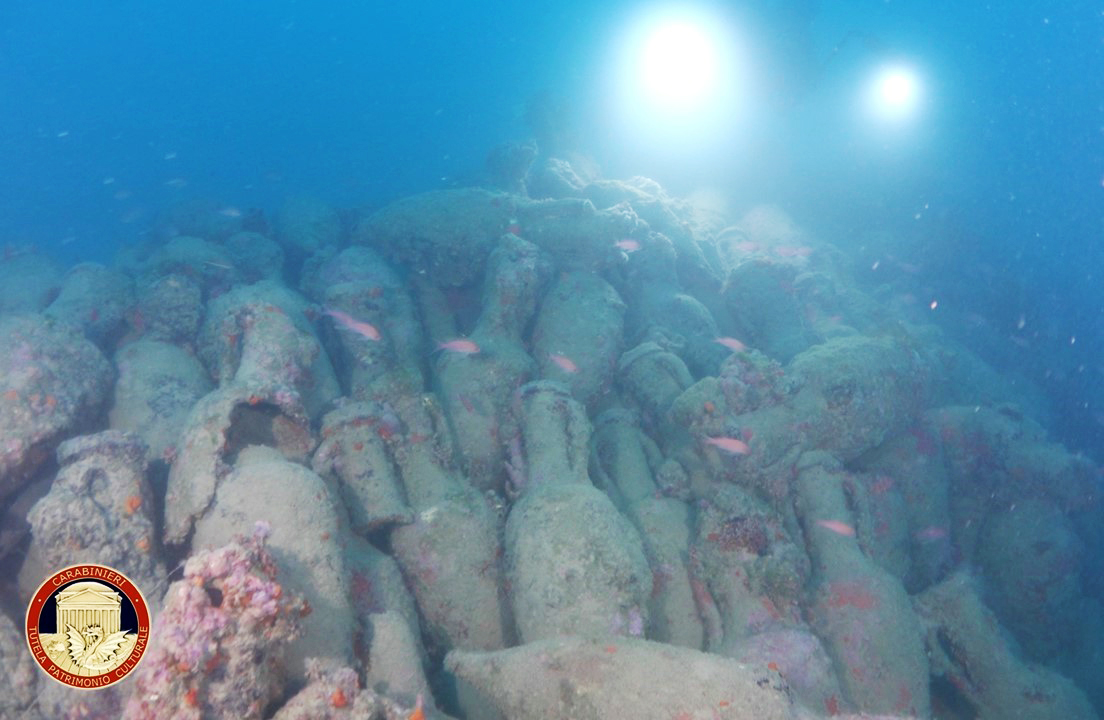
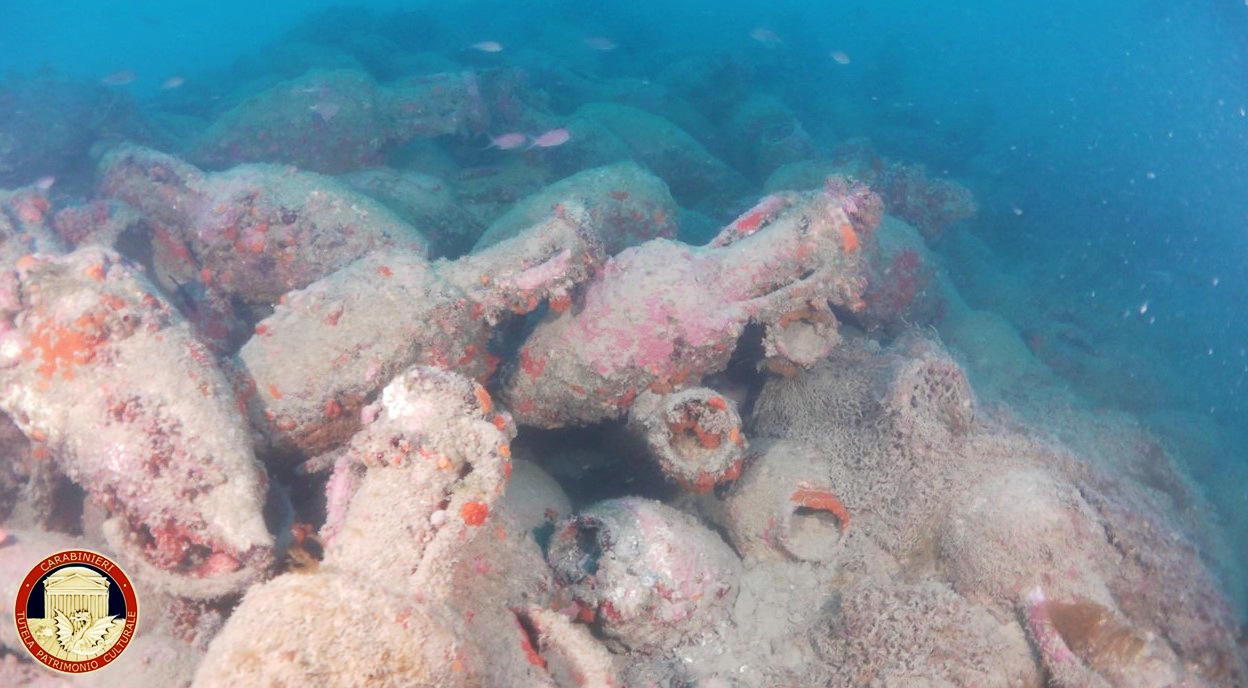
A Roman Republic-era shipwreck carrying approximately 500 amphorae has been discovered off the coast of Sicily. It dates to between the 2nd and 1st centuries B.C.

A report from two spear fishermen led the Carabinieri cultural heritage division and Sicilian heritage officials to the site three nautical miles off the coast of Mazaro del Vallo in western Sicily where divers spotted a field of amphorae at a depth of 46 meters (151 feet). The amphorae are primarily of the Dressel 1A type, large two-handled vessels widely typically used to transport wine in the second and first centuries B.C. They were manufactured in central Italy — Etruria, Lazio and south to Campania — and shipped throughout the Mediterranean trade routes. There are also Lamboglia 2 type from northern Africa, and one Neo-Punic type.

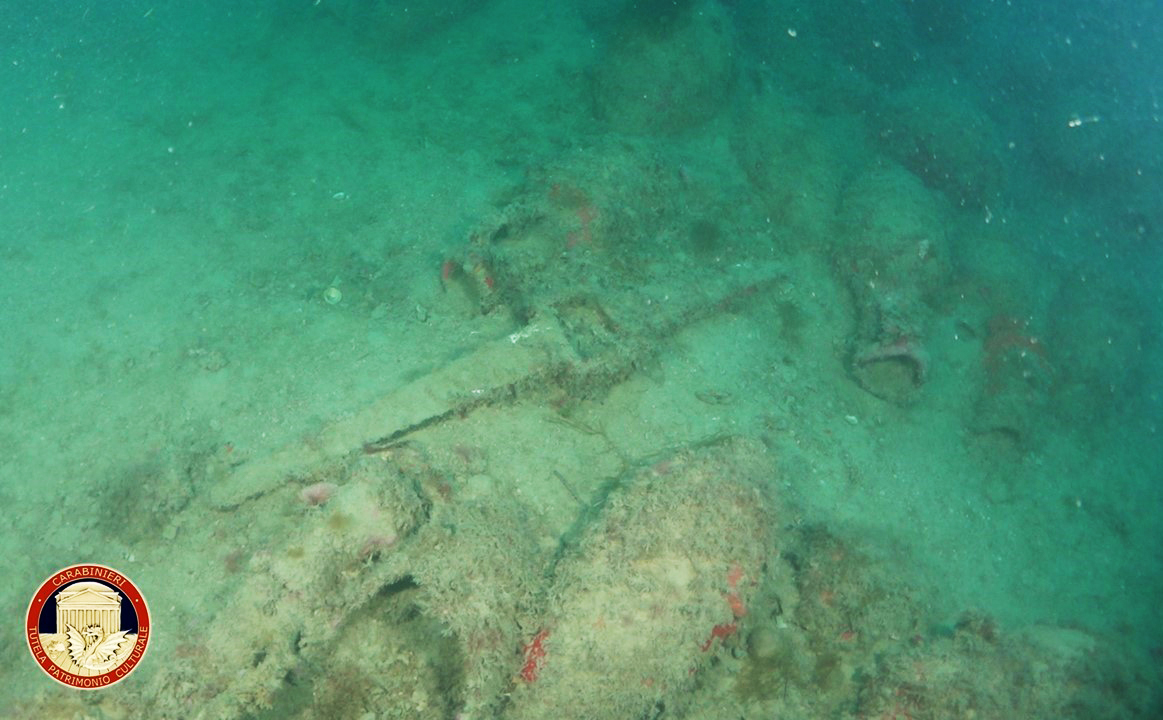
The amphora field is approximately 21 meters (69 feet) long, six meters (19’8″) wide and two meters (6’7″) deep. Divers also located two anchor stocks made of lead and a third lead object that may be part of a lead pipe.

The wreck … was described by Italy’s culture minister, Alessandro Giuli, as “one of the most important underwater archaeological discoveries of recent years”.

Giuli said the wreck offered “precious fragments of our history” and provided further evidence of the trade routes and exchanges that made the Mediterranean “a crossroads of civilisations”. […]

Over the coming months, Sicily’s superintendency of the sea is expected to carry out a new phase of scientific documentation and research at the site. Archaeologists will seek to establish more precisely the date of the wreck, the origin and intended destination of its cargo, and the condition of the surviving material, while also drawing up measures to protect what officials have described as a site of exceptional archaeological significance.

Sacred “talking drum” looted by France returned to Ivory Coast

A hundred and ten years after it was looted by French troops, the Djidji Ayokwe, a “talking drum” sacred to the Ébrié (Atchan) people of Ivory Coast has been welcomed home in a ceremony timed to coincide with country’s national independence day, August 7th.

On Friday, it was carried in a military parade through the Yopougon district of Abidjan, before continuing on to the village of Adjame, where it was made.

The black, white and red instrument was transported in a glass-fronted case on a large, decorated float and welcomed by Culture Minister Francoise Remarck, traditional leaders and hundreds of local residents.

A dozen people performed a libation ceremony, pouring a few drops of liquid onto the ground as an offering to their ancestors.

“A nation cannot develop if it doesn’t preserve its memory and promote its heritage,” said Adjame mayor Farikou Soumahoro.

He said he felt “deep emotion and great pride”.

“We want to see the drum with our own eyes so we can truly believe it belongs to us,” 69-year-old villager Jacqueline Akrebie told AFP.

Carved from hard native iroko wood, the Djidji Ayokwe is slit drum 3.3 meters (10’10”) long and weighing 430 kilos (948lb). It is not just a musical instrument, it was a culturally and religiously significant means of communication, hence “talking drum.” It could be heard from great distances, more than 10 miles away, and was used to warm of danger, as a clarion call to battle or to call people to important ceremonial invents. France declared Ivory Coast a French colony in 1893 and dispatched troops inland to establish outposts and French settlers. Native Ivorians were subjected to forced conscription for work in mines, on plantations and to serve in the military. Djidji Ayokwe was used to alert villagers that conscription forces were coming.

When France sent a punitive expedition to quash resistance in 1916, the drum was deliberately confiscated to assert colonial dominance over the Ébrié people. It was sent to France where it was absorbed into the national collection and placed on display at the Musée de l’Homme in Paris which was so overloaded with looted cultural artifacts from France’s colonial conquests that the Djidji Ayokwe was just one of many. It was moved to the Quai Branly–Jacques Chirac Museum in 2006.

The official handover between the Ivory Coast’s Minister of Culture, Françoise Remarck, and France’s Minister of Culture, Rachida Dati, took place at the Quai Branly Museum in February. The drum was shipped to Abidjan in March, where it was welcomed by traditional Ebrie leaders and dancers but it was packed in a wooden crate. It was not actually seen in public until it made its grand ceremonial entrance on Friday.

UNESCO played a key role in the negotiations for the drum’s return, and has also put up $100,000 for its preservation and to spread the word about its return. Now that it has had its official welcoming ceremony, it will go on display at the Musée des Civilizations de Côte d’Ivoire in Abidjan which has been renovated specifically so it can properly accommodate this great cultural treasure.

5th c. B.C. Syracusan gold coin found in Agrigento

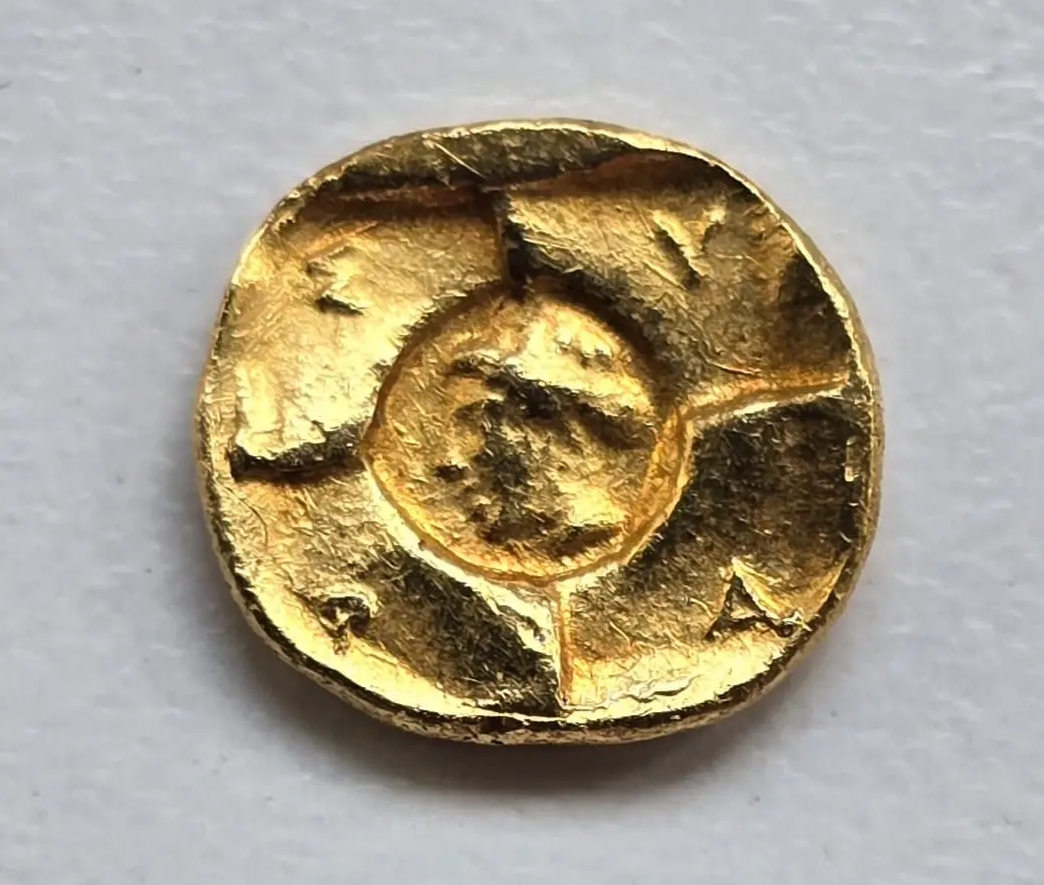
A rare 5th century B.C. gold coin minted during the Carthaginian invasion of Sicily has been found in the ancient city of Agrigento, Sicily. It was minted around 405 B.C. by the tyrant of Syracuse, Dionysius I the Elder.

The coin was found during an emergency excavation to salvage a Greek-era tile-lined capuchin tomb at the mouth of the Akragas River. The tomb was part of the Maddalusa burial ground, in active use from the first quarter of the 6th century B.C. until the end of the 5th century B.C.

It is a 20 Litrai coin weighing over a gram that is in excellent condition. On the obverse is the profile head of Heracles wearing the skin of the Nemean lion. The reverse features a four-part incuse square with a female head in the center. Four Greek letters — ΣΥΡΑ — are inscribed in the corners of the incuse square, meaning “Syra” for Syracuse.

Founded as the city of Akragas by Greek colonists from Gela, Crete and Rhodes in 582–580 B.C., Agrigento was besieged and sacked in 406 B.C. during the conquest of Sicily by Carthaginian general Himilco. Syracusan general Dionysius had fought against Carthage since the invasion began in 409 B.C. and took power as the tyrant of Syracuse (formerly a democratic polis) in 405 B.C.

After a brief period of peace bought with enormous concessions of territory that expanded Punic control over almost all of Sicily, in 398 B.C. Dionysius I of Syracuse marshalled his forces and fought to expel Carthage from Sicily. He reduced their territories, but wasn’t able to boot Carthage from Sicily. Dionysius never stopped trying, though, alternating between peace treaties and war until his death in 367 B.C.

The [coin] is particularly significant not only for the rarity of the specimen but especially because it is situated in a specific historical moment: during the dramatic Carthaginian invasion of Sicily, at the end of the 5th century B.C., Syracuse, allied with Akrágas, minted extraordinary gold issues to support the war effort. The coin that was found belongs to this series, which recalls the tragic events that shook Greek Sicily, culminating in the conquest and destruction of Akrágas by the Carthaginians in 406 B.C.

Rare runestone found in Faroe Islands

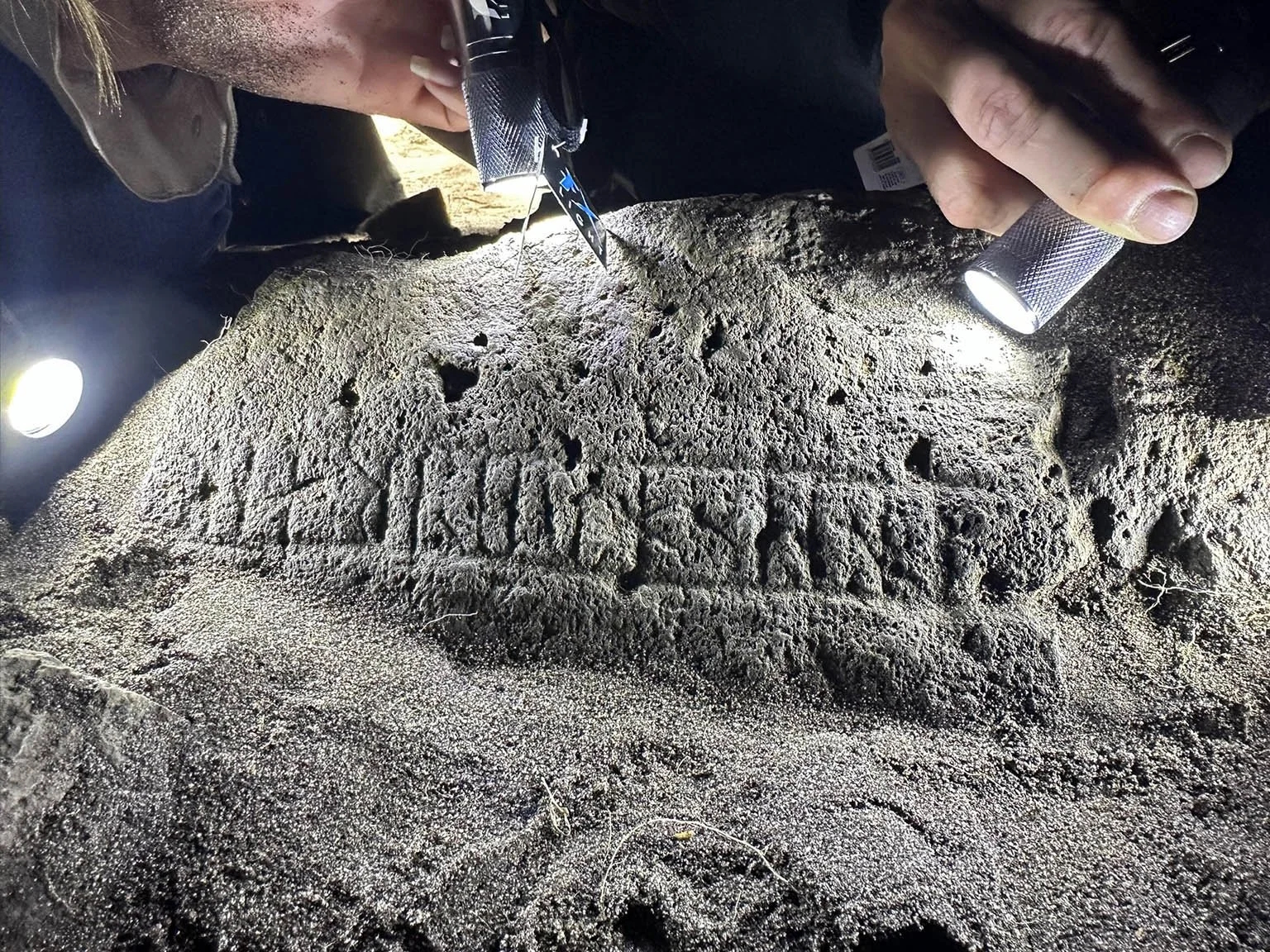
An exceptionally rare runestone has been discovered in the village of Sandur on the Faroe Island of Sandoy. The stone had been built into the floor of a building in the archaeological site of Á Sondum. The runes have not yet been interpreted, but a runeologist is scheduled to examine the stone in August.

Meanwhile, National Museum archaeologist Helgi Michelsen believes part of the inscription reads “Her hvílur” which is Old Norse for “Here lies.” If that’s accurate, the stone may be a grave marker. Other artifacts found in the July excavation include Christian artifacts which suggest the building was a medieval oratory (prayer chapel), so a burial there would make sense.

The building faces east and west, and has an entrance at the west end. These architectural features are common in medieval prayer houses and chapels. Faroese examples of east and west-facing prayer houses with an entrance at the west end are the prayer house at Bønhúsberg in Mykines, Bønhústoft in Leirvík and the toft down at Bakki at Velbastaður.

Located in the North Atlantic Ocean north of Scotland, southeast of Iceland and west of Norway, the Faroe Islands show evidence of settlement going back to the middle of the 4th century and appears to have been populated by the 7th century.

Settlers from Norway and ones of mixed Norse and Gaelic heritage from Norse communities in Ireland and the Hebrides began to arrive in the early 9th century. They built farms, reared livestock, fished, gathered food, relying on imports from other Norse colonies for essential goods like timber, metal and tools. The settlers established a parliament based on the Norwegian model and local parliaments were established in largely self-governing regions.

Christianity was introduced to the Faroes by Viking chieftain Sigmundur Brestisson around the year 1000. He had been converted by King of Norway Olaf Tryggvason and brought Christianity to the islands as a stalking horse for centralized Norwegian rule. Local chieftain Tróndur í Gøtu was the main local of resistance, although he finally converted under violent duress, and it was only after his death in 1035 that the Faroe Islands were brought under the Norwegian crown as a tributary country. The islands became their own independent bishopric in the 12th century.

The stone has been moved to the National Museum for conservation under controlled conditions.

Etruscan well with votives, human remains found in northern Italy

Archaeologists have discovered a ritual well containing votive offerings and human remains in the Etruscan city of Kainua near Marzabotto, in northern Italy’s Emilia Romagna region. The find reveals the sacred nature of water in Etruscan ritual and sheds new light on the religious rites performed at the founding of Etruscan cities.

Located on a well-traveled natural route across the Apennines, Kainua was first settled in the 6th century B.C. but did not become an organized, planned urban development until the end of the 6th century and the beginning of the 5th century B.C. The name “Kainua,” known from surviving Etruscan inscriptions, is believed to mean “the new one,” and scholars hypothesize it refers to the reorganization of the city based on the combination of Greek urban grid design with Etruscan cosmological concepts.

Kainua was abandoned in the 4th century B.C., under pressure from the Celtic migrations into northern Italy. When the area was Romanized, they built new road systems that no longer relied on the route from the Reno river valley through the northern Apennines, so the Kainua area became peripheral to traffic and no new city was built on top of the abandoned one. That makes it one of the most archaeologically significant Etruscan sites because excavations have revealed almost the entire urban fabric — streets, residences, shops, sacred precincts, the acropolis at the center and necropoli on the northern and eastern outskirts of the inhabited city.

The University of Bologna has been excavating the site continuously since 1988. The well was discovered at the end of the 39th excavation season in the sacred area dedicated to the goddess Uni. It is 4.4 meters (14.5 feet) and lined with stones from top to bottom. This distinguishes it from more than 50 other wells found in the city, marking it as a sacred place connecting the human world to the water and underworld deities.

This exceptional condition of the well and its fill have made it possible for archaeologists to reconstruct the timeline of its use. Two bronze statuettes of female figures were discovered at the bottom of the well. They are of the korai type, the Archaic Greek idealized young females with the “archaic smile” wearing a long, draped garment. They wear a headdress/diadem and one arm extended in the act of ritual offering.

They are both large and heavy, made of solid copper, attesting to their value and importance of the deposition. The larger of the two figures consists of three pounds of solid bronze. They are still bright and copper-colored from having remained fully immersed in water and therefore protected from oxidation.

Next to the statuettes, the excavation uncovered a very rare bronze plate in perfect condition and an intact key, an intricate bronze vase applique decorated with winged horses, and ceramic vessels used during the ritual ceremony. A new inscription was discovered among the materials, a reference to the goddess Cavatha, the Etruscan underworld and fertility goddess comparable to the Greek Persephone.

All of these votive offerings date to the end of the 6th century B.C. or beginning of the 5th century B.C., the time of the refounding of the city. They were placed there in the religious ceremonies attending the Kainua’s rebirth.

The fill tells the opposite story: the ceremonies marking the city’s demise. At a depth of about 11’6″, the skeletons of two adult humans were found. Initial osteological examination revealed that they belonged to a senior woman and a young man. They appear to have been deposited in a closing ritual, but further analyses including radiocarbon dating, DNA and stable isotope, will hopefully answer more questions of chronology, health, origins and death of these individuals.

According to scholars, the discovery demonstrates that the well did not only serve a practical function of water supply, but also had a profound and complex sacred and ritual significance linked to the very foundation of the city and the cult of water.

The ritual well is located in the sacred urban area of ​​Kainua . Two imposing monumental temples were discovered here, which Etruscan inscriptions attribute to the supreme divine couple of the pantheon: Tinia (corresponding to the Greco-Roman Zeus/Jupiter) and his consort Uni (Hera/Juno). The area dedicated to Uni also documents the cult of Vei (Demeter/Ceres), protector of agricultural and human fertility.

“It is precisely within this rich cultic framework that the newly discovered ritual well fits,” explains Govi . “The results of this excavation campaign therefore enrich our knowledge of the foundation rites of Etruscan cities and Etruscan religiosity with new, precious details.”